

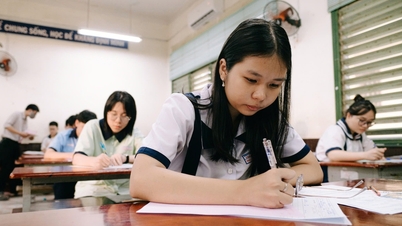
China's 2026 national civil service exam took place on Sunday (November 30), attracting more than 2.83 million candidates to take part in the written exam of general subjects in 250 cities across the country. According to China News Service , the ratio of qualified candidates to recruitment quotas was about 98:1, reflecting the fierce competition.
Before the exam, more than 3.7 million candidates were eligible to take the exam, equivalent to an actual participation rate of about 87.4%. Central government agencies and organizations plan to recruit about 38,100 civil servants, a reduction of 1,600 positions compared to 2025, while the number of candidates set a new record.
In recent years, the attraction of the civil service exam has increased sharply. The number of qualified candidates has increased from 2.6 million (2023) to 3 million (2024), 3.416 million (2025) and more than 3.7 million this year.
The ratio of qualified candidates to recruitment quota gradually increased: 70:1 (2023), 77:1 (2024), 86:1 (2025) and 98:1 (2026), reflecting the fierce competition.
Among the “hot” positions, an immigration officer position in Ruili City (under the National Immigration Administration) only had one person available, but 6,470 applications had been submitted as of one hour before the registration closing time.
Relaxing age limit: Opportunities for people to work and study higher
A notable new feature of this year’s exam is the increased age limit: Regular candidates are allowed to take the exam up to 38 years old, 3 years older than the old limit of 35. For candidates graduating in 2026 with a master’s or doctoral degree, the age limit is raised to 43, instead of 40 previously. According to Xinhua News Agency , this regulation helps break the “35-year-old ceiling” that is common in the job market, opening up opportunities for workers who want to try their hand in the public sector.
Zhu Lijia, a professor of public administration at the Chinese Academy of Governance, said: “Those around 35 have accumulated experience and professional skills, and taking the exam will improve the quality of public service. Relaxing the age limit will also open up more career options for those with higher education after they start working.”

Raising the retirement age and the appeal of the “ iron rice bowl”
According to The Guardian , in October, the government announced an increase in the exam age to match its plan to raise the retirement age. A rapidly aging population and declining pension funds have forced China to adjust its already low retirement age compared to international standards. Specifically, the retirement age for female workers in manual jobs will increase from 50 to 55; for female office workers from 55 to 58; and for men from 60 to 63.
Although public sector salaries are generally low, and many localities even owe salaries, state jobs are still sought after because of their stability, likened to an "iron rice bowl", a symbol of lifelong employment.
If in the past young people were eager to "jump into the sea" (xiahai) to enter business, now passing the civil service exam is called "going ashore" (shangan), representing a return to stability.
Changing labor market structure
George Magnus, a researcher at the China Centre at the University of Oxford, said: “Over the past decade, the employment structure in China has changed dramatically: from well-paid manufacturing and construction jobs to low-income, welfare-deficient freelance service industries. With 12 million university graduates each year, the need to find stable jobs in the public sector is understandable.”
China's overall unemployment rate is currently 5.1%, but for the 16-24 age group (excluding students) it is 17.3%. In 2023, the government stopped releasing youth unemployment figures after the figure reached 21.3% and only released them again a few months later, excluding students.
Trade wars, weak post-Covid-19 consumer demand and a competitive job market have many young people turning down jobs they deem unworthy of their qualifications and benefits. Next year, China is expected to have a record 12.7 million university graduates.
Age pressure and harsh exams
Increasing the exam age is welcomed because it helps avoid the '35-year-old curse', when businesses refuse to hire workers over 30. However, older candidates still face difficulties in balancing exam preparation and family care, a pressure rarely seen in new graduates.
The civil service exam is notoriously tough, with questions on law, physics, biology, politics and logical thinking. Since last year, the test has also included a political theory section, assessing the ability to “analyze and solve problems using the Party’s innovative thinking.” Last year’s test required candidates to analyze important speeches by President Xi Jinping in the past 12 months.
A 35-year-old mother shared her exam review schedule on Xiaohongshu : Wake up at dawn, study while taking care of her child, and sleep only 4-5 hours a night. She wrote: “Do PowerPoint during the day, study formulas and read books at night; 4am is the right time to review.”
Source: https://vietnamnet.vn/hang-trieu-nguoi-chen-chan-thi-cong-chuc-ky-vong-cong-viec-on-dinh-suot-doi-2468012.html






























![[Photo] Parade to celebrate the 50th anniversary of Laos' National Day](/_next/image?url=https%3A%2F%2Fvphoto.vietnam.vn%2Fthumb%2F1200x675%2Fvietnam%2Fresource%2FIMAGE%2F2025%2F12%2F02%2F1764691918289_ndo_br_0-jpg.webp&w=3840&q=75)
![[Photo] Worshiping the Tuyet Son statue - a nearly 400-year-old treasure at Keo Pagoda](/_next/image?url=https%3A%2F%2Fvphoto.vietnam.vn%2Fthumb%2F1200x675%2Fvietnam%2Fresource%2FIMAGE%2F2025%2F12%2F02%2F1764679323086_ndo_br_tempimageomw0hi-4884-jpg.webp&w=3840&q=75)

































































Comment (0)