

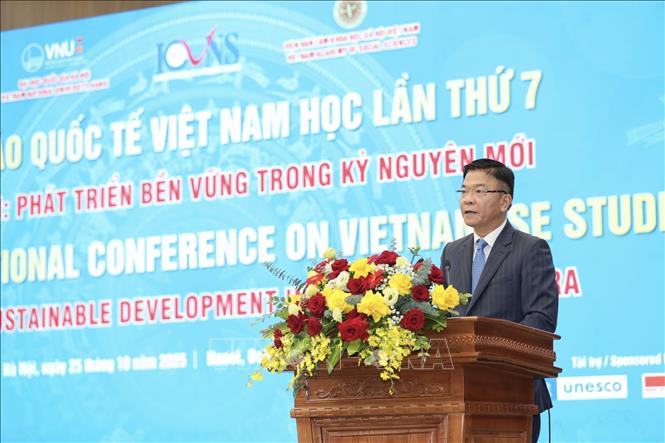
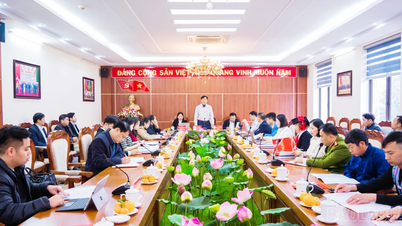
The workshop was attended by Deputy Prime Minister Le Thanh Long, along with representatives from several ministries and agencies, and approximately 1,200 Vietnamese and international scientists from more than 30 countries and territories, participating both in person and online.
A bridge connecting Vietnam with the world.
Speaking at the conference, Deputy Prime Minister Le Thanh Long shared: Every country and every nation carries within itself historical traditions, customs, and important milestones that shape its unique identity. To deeply research and understand these values, for many years, renowned fields of country studies such as Chinese studies, Japanese studies, American studies, and Indian studies have been formed and developed worldwide, as well as regional studies such as:
European Studies, Asian Studies, Southeast Asian Studies, and more recently, Global Studies. These are scientific disciplines that deeply research the history, culture, country, and people of nations, peoples, and regions; they serve as bridges connecting, exchanging, and strengthening solidarity, working together to create and maintain an environment of peace, stability, and sustainable development.
Regarding Vietnamese Studies, the Deputy Prime Minister stated: This is an interdisciplinary social science and humanities discipline that comprehensively studies the country and people of Vietnam; its glorious history with a thousand-year tradition of nation-building and national defense; its brilliant victories against foreign invaders; its spirit of unity and fervent patriotism; its unique, rich, and diverse cultural identity; and the Vietnamese people's diligence, hard work, resilience, kindness, hospitality, and constant aspiration for progress.
Throughout its formation and development, the field of Vietnamese Studies has not only been built upon the contributions of generations of domestic scholars and researchers, but has also attracted many international experts and scientists. Today, Vietnamese Studies is not only a thriving discipline in regional countries such as China, Japan, South Korea, Thailand, and Russia, but has also expanded to the United States, Germany, and France, with numerous research and translation works on Vietnamese history, society, religion, culture, and literature.
On behalf of the Vietnamese Government, the Deputy Prime Minister acknowledged and thanked the dedicated efforts of domestic and international experts, scientists, and researchers in the field of Vietnamese studies, who have made significant contributions to Vietnam's socio-economic development and helped promote the image of Vietnam and its people to friends around the world.
Deputy Prime Minister Le Thanh Long also emphasized: After 40 years of implementing the reform process, with unwavering determination and extraordinary efforts, Vietnam has achieved tremendous accomplishments. From a poor, backward country that suffered greatly after World War II, Vietnam has become a developing country with a middle income. By 2025, the size of the economy will reach 510 billion USD, ranking 32nd in the world. GDP per capita is estimated at approximately 5,000 USD, placing it in the upper-middle income group.
The Human Development Index (HDI) rose 18 places, ranking 93rd out of 193 countries and territories. The Happiness Index ranked 46th, an increase of 37 places compared to 2020. Political and social stability has been maintained, national defense and security have been strengthened, social order and safety have been ensured, national independence and sovereignty have been upheld, foreign relations and international integration have been promoted, and a peaceful and stable environment conducive to learning and development has been preserved. Vietnam has been recognized by the United Nations as one of the leading countries in implementing the Millennium Development Goals and is striving for the Sustainable Development Goals.
Entering a new era of development, Vietnam is determined to achieve the goal of becoming a developing country with a modern industrial base and upper-middle income by 2030, and a developed country with high income by 2045.
To achieve those goals, the Deputy Prime Minister stated: Vietnam focuses on building an independent and self-reliant economy, coupled with proactive and comprehensive international integration that is substantive and effective. It continues to prioritize promoting growth while maintaining macroeconomic stability, controlling inflation, ensuring overall economic balance, and developing a synchronized and harmonious socio-cultural environment that is on par with economic and political development. The overarching principle is "putting people at the center, as the subject, the goal, the driving force, and the most important resource for rapid and sustainable development," without sacrificing progress, social equity, social security, and the environment for the sake of purely economic growth.
With the strategic advice and specific solutions offered at this conference, covering all key areas of politics, economics, society, culture, education, science, technology, innovation, and international integration, the Deputy Prime Minister expressed confidence that the valuable information, knowledge, intellect, experience, and research contributions from the community of experts, scientists, and researchers will further affirm the position of Vietnamese studies, providing increasingly more practical scientific foundations to serve the cause of building, protecting, and sustainably developing Vietnam in the new era.
Proposing solutions and models for sustainable development in Vietnam.
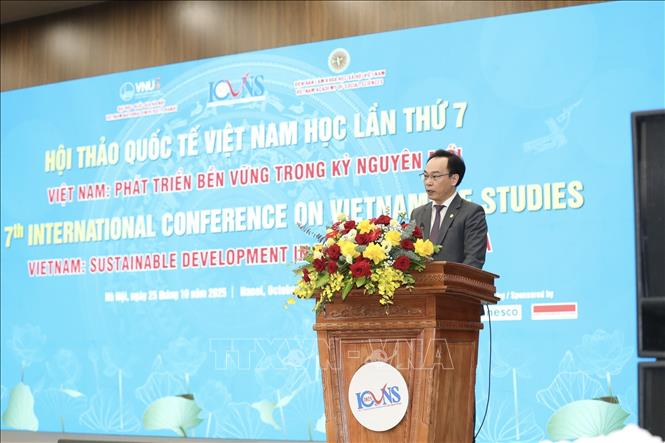
In his opening address, Associate Professor, Dr. Hoang Minh Son, Director of Vietnam National University, Hanoi, shared: Around the world, there are hundreds of research and teaching institutions on Vietnamese studies at universities, research institutes, and international organizations. These institutions have made significant contributions to Vietnamese studies, developed a global network of Vietnamese studies, and consistently supported Vietnam in its national development and international cooperation.
Within Vietnam, Vietnamese Studies has enjoyed over 20 years of solid development within the higher education system. Hanoi National University is the core center for training and research in Vietnamese Studies, with prominent institutions such as the Institute of Vietnamese Studies and Development Science, the University of Social Sciences and Humanities, and the Vietnam-Japan University. These are prestigious academic institutions that contribute to promoting Vietnamese Studies as a bridge for knowledge and spreading Vietnamese values globally.
Regarding the first International Conference on Vietnamese Studies initiated by the Vietnam National University, Hanoi (VNU-Hanoi) in 1998, after six editions, VNU-Hanoi Director Hoang Minh Son affirmed: The series of conferences has become a prestigious academic brand with international reach, bringing together thousands of Vietnamese and international scholars. Through these conferences, it has contributed to deepening the world's understanding of Vietnam's history, culture, people, and development journey; it is a symbol of global intellect, dialogue, and cooperation.
In his keynote address at the conference, Dr. Pham Duc Anh, Director of the Institute of Vietnamese Studies and Development Science, Vietnam National University, Hanoi, stated that the organizing committee received 961 scientific papers, including 105 papers from international scholars from 20 countries – a record number in the 25-year history of this conference series.
In the three plenary sessions of the conference, delegates focused on clarifying key issues facing Vietnam in the process of sustainable development, international integration, and innovation of its growth model. Many works presented highly comprehensive theoretical and practical perspectives, revolving around major thematic groups: New trends in Vietnamese studies in a globalized world, from approaches to urban regional studies, ecological civilization, to socio-cultural research, national reconciliation, and identifying Vietnamese identity in international exchange;
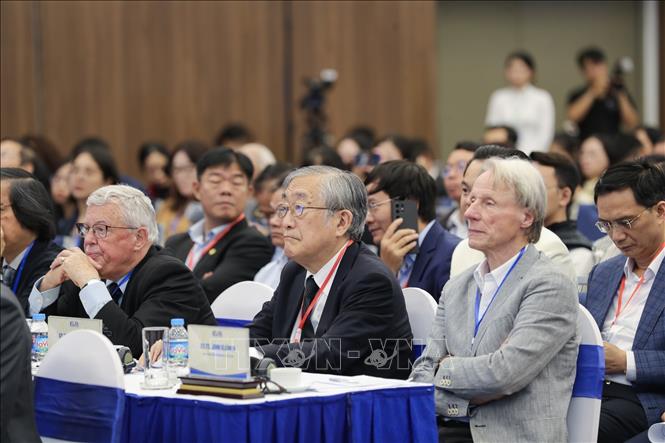
Sustainable development solutions and models for Vietnam in the new era, including institutional reform, private sector development, leveraging comprehensive strategic partnerships, climate change response and green economy, and digital transformation; Vietnam's role in the global system, approached from diplomatic, social science, and cultural perspectives.
The reports and recommendations from the workshop will be compiled, edited, and submitted to the strategic planning agencies of the Party and State as a source of data and scientific arguments to serve the development and implementation of resolutions and national development programs in the 2025-2035 period.
* On October 26th, leading domestic and international scientists attending the 7th International Conference on Vietnamese Studies will meet with General Secretary To Lam. This meeting demonstrates the Party and State's deep concern for the development of Vietnamese studies and the role of knowledge in the country's development strategy.
At the meeting, scholars will present recommendations on sustainable development strategies, digital transformation, culture, and education – key areas in realizing the aspiration of a "strong, prosperous, and happy Vietnam" by the middle of the 21st century.
Source: https://baotintuc.vn/thoi-su/hoi-thao-quoc-te-viet-nam-hoc-dua-viet-nam-phat-trien-ben-vung-trong-ky-nguyen-moi-20251025124418016.htm





























































Comment (0)