

China: Ancient limestone armor was primarily crafted for funerary purposes rather than for actual combat use.
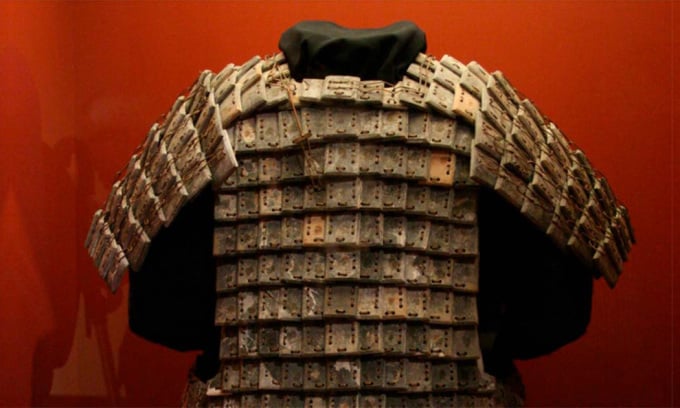
Stone armor in the tomb of Qin Shi Huang. Photo: Ancient Origins
Professor Xuewei Zhang at the Bioarchaeology Laboratory of Jilin University and his colleagues studied stone armor hoards discovered in and near the Mausoleum of Qin Shi Huang, revealing more information about burial customs of that period, Ancient Origins reported on July 2. The new research was published in the journal Science Direct .
In 1998, Chinese archaeologists discovered a hoard of stone armor in Pit K9801 at the Mausoleum of Qin Shi Huang (reigned 221-210 BC). In total, there were over 600 small limestone pieces, connected by copper wire. In 2001, other stone armor pieces and tools used to manufacture them were found in a well in Xinfeng, dating back to the Qin Dynasty.
Then, in 2019, archaeologists from the Shaanxi Institute of Archaeology excavated the Liujiagou site, near a high-rise building in Xianyang, the capital of the Qin Dynasty, and discovered 32,392 artifacts. There were even more stone tools and armor, all of which matched the stone armor previously excavated at Pit K9801 and Xinfeng. Among the artifacts at Liujiagou were several rectangular pieces of armor that were perforated, polished, and had their edges processed and nearly finished.
New research focuses on the manufacturing process of stone armor. Stone armor consists of a front and back panel, shoulder pads, and thigh protectors. The garment uses high-quality limestone with a minimal number of joints.
In the new study, the team of experts pieced together fragments of broken stone and reassembled the original armor. They also investigated the perforation techniques used to create the stone armor. The manufacturing process was similar to that of leather armor, employing a molding method. The process consisted of nine repetitive steps. The raw materials used to make the armor were not readily available locally but were imported from distant locations.
Zhang and his colleagues concluded that the 2019 excavation site was an important stone armor workshop during the Qin Dynasty. However, in reality, stone armor did not effectively protect the wearer and was easily damaged upon impact, making it unsuitable for combat. According to the new research, they were used to preserve funerary objects because they decomposed more slowly than leather armor. Thus, 2,200 years ago in China, stone armor was produced primarily for funeral purposes rather than practical use, but it still mimicked the style of armor from that period.
Thu Thao (According to Ancient Origins )
Source link


































![[Video] The craft of making Dong Ho folk paintings has been inscribed by UNESCO on the List of Crafts in Need of Urgent Safeguarding.](https://vphoto.vietnam.vn/thumb/402x226/vietnam/resource/IMAGE/2025/12/10/1765350246533_tranh-dong-ho-734-jpg.webp)

































































Comment (0)