

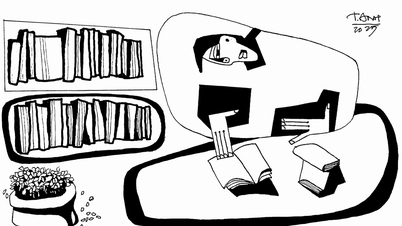
The boy tiptoed, reaching for the book "The Golden Key," meticulously turning each page. Outside the window, a thin veil of fog enveloped the church bell tower, leaving only the faint outline of its spire visible. In the enclosed room, the rustling of the pages echoed softly like a whisper. The boy was lost in the world of the long-nosed wooden dummy.
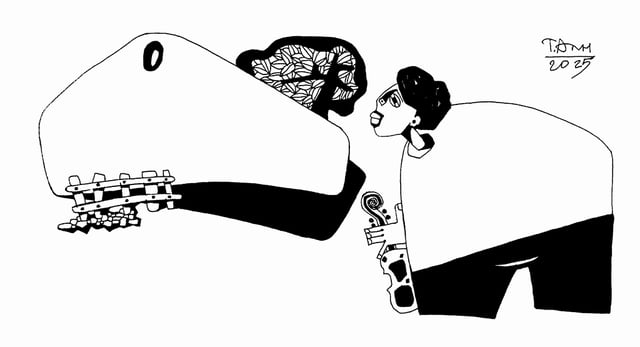
Illustration by: Tuan Anh
The rustling of footsteps on the burdock leaves startled the boy, who hid his book under his pillow and peeked curiously through the crack in the door. On the path leading to the reed field, several boys his age were chasing a flock of pigeons leisurely strolling along. Suddenly, one of them grabbed the tail of the last pigeon, causing it to flap its wings and fly away in fright, leaving behind an angry growl. The boy slid out of bed, eager to join them. After spending the whole day in the cramped attic, he felt his body stiff with confinement.
Outside, the children were still playing, tossing dry leaves on each other's heads and rolling around in the mounds of grass piled high like haystacks, none of them paying any attention to the new neighbor who had just moved in. The boy stared blankly, then silently turned back and climbed up to the wooden attic. It was his own world, not large, but quiet. A musty smell permeated everywhere, lingering in the worn-out old storybooks and colorful Lego boxes… The boy looked at them with a vacant gaze. He couldn't remember when he had lost interest in the shapes that once fascinated him. To him now, everything seemed to be just emptiness, a place where loneliness had taken root. Except for the violin hanging on the wall, the entire attic seemed to have become a silent void.
The mother and son moved into this house last fall, during the brief transition between seasons when the rains ceased, giving way to a silently creeping chill. The house was in the suburbs, behind a garden of bare eucalyptus trees, where flocks of migratory birds would take refuge, preening their wings and murmuring softly each early morning while the boy was still asleep. Sometimes, the flapping of their wings would startle him awake. He would curl up in his blanket, listening to the sounds fade into the distance as the birds soared towards the misty mountaintop. To him, this place was so dreary that even the wind rustling through the trees seemed to whisper of loneliness; the only sound that repeated itself was the slow ticking of the old clock on top of the cupboard, the sound of time passing unhurriedly.
At the age of six, one dark night, while sound asleep, she was woken up by her mother, who hurriedly changed her clothes and left with two small suitcases. From that day on, their lives were without a father. As she grew older, she gradually understood that this was the milestone of her first loss. After three years living in a poor working-class neighborhood, she and her mother moved to this isolated house on the outskirts of town, as if forgotten in the vast world outside. The lonely house nestled beside a ravine overgrown with dry, withered grass, and morning glory vines twisted and coiled around the cold, damp walls stained with yellow mold. Cobwebs hung from the ceiling down to the cracked window panes. In the corner, a worn leather-upholstered chair was stained with cigarette butts, a trace of a man who had once lived there. On the wall, a violin covered in white dust confirmed that its owner had left long ago.
As soon as he arrived at his new home, the boy took down his violin, brushing off the white dust covering the wooden body. He curiously turned the smooth, polished neck, gently touching the strings. The sound that resonated moved him deeply. A feeling of indescribable excitement. It was the first time he had touched a musical instrument, and to him, it was like a door leading to a mysterious and captivating world. That summer, his mother took him to a local violin teacher. In the early days, struggling to spell out each note, he became captivated by the sound of the violin. Outside of school, he enthusiastically played, the sound of the violin seemingly possessing a strange allure, soothing his soul each evening.
The boy pressed the neck of the violin against his shoulder and played a suite he had learned the night before. The melodious tune drifted along with the fading rays of the setting sun by the windowpane like a gentle whisper…
"Sleep soundly, my dear, so Mother can go chop banana trees far away. Sleep soundly, my dear, Father is out in the distant forest gathering young bamboo shoots…" A girl's soft singing could be heard. Though faint, the singing seeped through the crack in the door, causing the boy to stop what he was doing, peek through the curtain, and look out. Beyond his house, separated by a thick hedge, was a small attic nestled amidst a thicket of weeds. The singing from there grew louder and louder. Unlike the noisy sounds outside, the singing seemed to strain from the delicate throat of a frail child. The boy put away his instrument, quickly climbed onto the windowsill, and pulled the curtain aside. Through the dusty glass, he saw a thin girl, about eight years old, sitting amidst a pile of colorful scraps of fabric, her knees drawn up to her ears. She stopped singing and quietly bent down to examine the fabric. Looking closely, the boy realized it was a doll sewn from scraps of cloth, the size of a baby still in its cradle. The little girl hugged the doll to her chest, gently stroking it, muttering something incomprehensible, then suddenly burst into tears. The crying wasn't loud, but rather a choked, muffled sound, as if something was being squeezed in her throat.
"Hey there!" the boy called, tapping lightly on the windowpane.
The noise startled the little girl. She fell silent, cautiously stood up, her hands gripping the door frame, leaning towards the light but her neck still recoiled between her thin shoulders, only her large, round eyes revealing a look of apprehension. Behind her, a swarm of moths fluttered around the lampshade.
"Don't be scared! I'm Sumi, my family just moved here," the boy said gently, careful not to frighten the girl. "Want to hear me play the guitar? Come here!"
The boy's invitation had a strange allure. She wiped away her tears and cautiously made her way down the narrow hallway. From this side, Sumi could clearly hear the sound of her tiny footsteps scraping against the floorboards, soft and timid, like a stray cat searching for shelter for the night. Reaching the hallway, she leaned out and whispered, "Sumi, just call me Tree!" "Oh, this is the first time I've heard such a cute name!" the boy smiled, trying to sound like an older brother, even though he himself had just woken from a dream about assembling superheroes. Sumi brought his guitar to the window and solemnly played a piece, a song he believed Tree would enjoy.
After only the opening notes, the little girl's hand clutched the door frame, her eyes wide with emotion. The music soared, rippling like waves, like a space breaking free from the old attic. Her lips trembled as if she were about to say something, but she stopped. The melody ended, but her small body still leaned towards the beam of light filtering through the hallway. The lamp behind her cast a long shadow on the wall, illuminating her thin legs beneath a distorted figure, like a drawing with uneven, shading pencil strokes.
"Play it again!" The tree rustled softly, sounding like a cat's meow in the darkness. Outside the window, the wind howled, tearing off the last leaves from the trumpet vine and scattering them towards the dark river. On the stained whitewashed ceiling, the night lamp cast a warm yellow light, its glow trembling in the howling wind outside. The boy suddenly remembered the winter of yesteryear, when the trees in the garden had almost all lost their leaves and his father had chosen to leave, leaving his mother heartbroken.
From the first day they met, regularly every day, the girl would wander around, resting her chin on the window frame, her eyes fixed on the wooden attic, waiting for the boy's figure to appear. On some days, the boy would go somewhere with his mother, and the house would be completely dark.
Once, during a brief, interrupted conversation, the little girl whispered softly, as if only she could hear: "I long for my mother to come and take me away… but when I'm with her, I get beaten." "Why? Who beat you?" the boy exclaimed in astonishment. A tear rolled down her tightly pursed lips; in the darkness, her eyes glowed like two tiny specks of phosphorescence. Before he could say anything more, the small figure darted inside, behind the slightly ajar door and the faint light still lingering in the dark hallway.
***
The afternoon sun cast dappled rays across the peeling whitewashed wall. The little girl fidgeted by the window, her eyes fixed on the familiar gate. "Mom's coming to pick me up tomorrow," she mumbled, sniffling. The boy fell silent. "But… what if I go back there… and get beaten again?" "No way…" Cây whispered. She turned and ran inside, returning a moment later with a bright, adorable bunny-toothed smile. "Cây has a present for Sumi! But… you have to go out into the hallway!" the little girl's voice rang out.
The boy quietly stepped out. It was a doll sewn from scraps of fabric, the same one he'd seen before, only this time it had a lot of hair on its head—bright red strands of wool that stood out against its comically green face. "Do you like it?" the girl asked softly, as if afraid he wouldn't like the gift. "I spent several nights braiding its hair!" "I like it!" the boy replied curtly, then sighed softly, "But boys never play with dolls!" The girl wrinkled her nose and giggled, "It's so big, you could use it as a pillow!", then boasted, "I named this doll Saola. Remember to call it that, Sumi!" "Okay, hello Saola!" the boy reluctantly took the gift, looking at the doll's goofy face, trying to suppress a laugh.
The next day, the girl really did leave.
Hiding behind the door on this side, Sumi saw Cay wearing a yellow backpack, the stuffed animals dangling from it with each step. She shuffled along, her thin, wobbly legs struggling to keep up with her mother. The woman looked melancholic and weary, her face hidden in an old scarf, only her eyes visible. The two walked silently along the rough, gravel path leading to the riverbank. The dark water shimmered, and in the distance, a small boat awaited. Sumi knew that this time Cay was going to live with her mother, stepfather, and his child from a previous relationship in an apartment in the city center.
Every afternoon after school, the boy habitually looked at the armchair near the window. The Saola doll still sat there, its head tilted back, its tangled red woolen hair disheveled, its two eyes made from dark black buttons as if watching Sumi, eyes that held something unnameable. The boy would then play his violin, the melodies lingering, gentle, yet haunting.
Far away in the forest, his father was out gathering young bamboo shoots… Sometimes, the boy would suddenly hear a soft song echoing from beyond the fence, like the voice of the Tree soaring somewhere. He would rush to the window and peek through. The attic was dark and silent. The room was empty, not a soul in sight. His heart ached slightly, as if it had been gently struck by a very strange emotion.
The night was dark. On the bare, leafless branches, bats hung silently. The wind rustled the leaves on the porch. The boy left the window and went down into the garden. He wandered for a long time, occasionally looking up at the oval-shaped window in the attic, where Cây used to wait for him to come home from school every afternoon. Since the girl left, the room hadn't been lit even once. In fact, it was just an old, dilapidated attic, nothing more than a makeshift storage room where the girl's uncle and aunt kept their belongings. The frail old grandmother could only sigh in pity for her grandson.
Every night, the boy would quietly take his violin out into the hallway and play a familiar suite, sometimes just random melodies spontaneously emerging from the depths of his heart. At other times, he would simply sit there, silently gazing at the attic room. The window, ever since Mother Cây came to take him away, had been tightly shut, never once opened. The pungent smell of grass mingled with the biting cold, making the boy shiver on the sofa. The doll made of rags still sat beside him, its head tilted back, its face blank and sulky.
Far away in the forest, Father was out gathering young bamboo shoots… Behind the window, a soft singing voice rose. The melody was familiar, but it wasn't Cay's. The boy's heart tightened. He rushed forward, frantically pushing open the latch. On the other side of the window, the flickering candlelight cast a faint, fragile light, as if someone had hastily lit it. Could it be… Cay had returned? The boy cautiously stepped into the hallway, his eyes fixed on the window frame, straining to see clearly. In the flickering candlelight was Cay's mother, her face veiled in a pale gray shawl, only her deep, vast eyes visible. He trembled, leaning forward a little further. On the floor, it was indeed Cay. The little girl was fast asleep, her head resting on her mother's lap. The woman was softly singing.
Early morning. The boy woke up startled by a soft cry coming from across the garden. He rushed to the window. Under the magnolia tree, Cay stood there, her tiny hand trembling as she touched a broken, dry branch. Her eyes gazed towards the riverbank. On the dirt road, marked with the tracks of carts, her mother's figure was hurrying away, her silhouette fading into the thin mist. The rain fell silently. Cay's cries were suppressed into choked sobs. "Hush, Cay!" the boy whispered. As if sensing something, she turned around. Behind the door, the boy's eyes welled up with tears, and he raised a hand and gently waved.
"Mom will be back! Tree, don't cry!"
Source: https://thanhnien.vn/khuc-ru-giua-nhung-manh-vo-truyen-ngan-cua-vu-ngoc-giao-185251213182150825.htm



![[Image] Vietnam's colorful journey of innovation](/_next/image?url=https%3A%2F%2Fvphoto.vietnam.vn%2Fthumb%2F1200x675%2Fvietnam%2Fresource%2FIMAGE%2F2025%2F12%2F14%2F1765703036409_image-1.jpeg&w=3840&q=75)


















































































Comment (0)