

Controlling blood sugar is a major concern for many people today. Rapid spikes and drops in blood sugar after meals can negatively impact long-term health. In fact, we don't always need to drastically change our diets or follow strict dietary restrictions, according to the Hindustan Times .
Here, Dr. Alessia Roehnelt, an endocrinologist in the US, shares how to eat to control blood sugar while still keeping your usual daily meals.
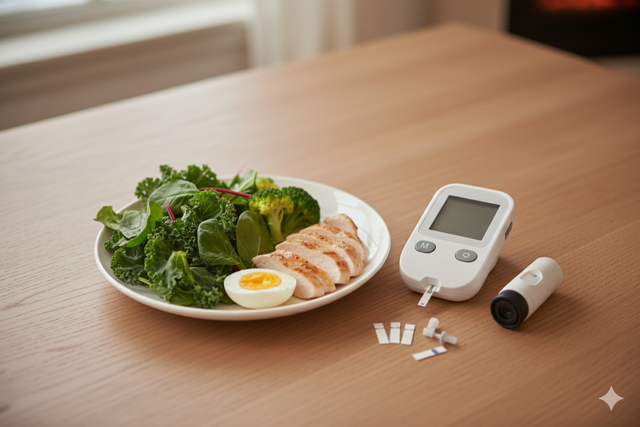
Vegetables and protein slow down the process of gastric emptying. This allows for a more gradual digestion and absorption of glucose.
Photo: AI
Common eating habits are incorrect.
In many families, meals typically begin with rice, bread, or other starchy foods. This is a very common and long-standing tradition.
However, according to Dr. Roehnelt, this way of eating can easily cause blood sugar to rise rapidly right at the beginning of the meal.
When starch is eaten on an empty stomach, it is digested and converted into glucose more quickly. Glucose enters the bloodstream at a rapid rate, causing a short-term spike in blood sugar. At this point, the body is forced to release more insulin to move this sugar into the cells, resulting in a sharp increase in insulin levels.
When insulin levels rise rapidly, blood sugar tends to drop rapidly afterward. This constant fluctuation causes fatigue, early hunger, and cravings for sweets after meals.
The order in which you eat directly affects your blood sugar.
According to Dr. Roehnelt, the order in which you eat food groups significantly affects how your body absorbs sugar. This happens even if the total amount of food in a meal remains unchanged.
This mechanism stems from digestive physiology. Vegetables and protein slow down the emptying of the stomach. As a result, the digestion and absorption of glucose occur gradually. The amount of sugar entering the bloodstream is distributed more evenly over time.
When glucose levels don't spike suddenly, the body only needs to release a moderate amount of insulin. Blood sugar is therefore more stable during and after meals.
Dr. Roehnelt explains that insulin plays a role in helping the body store fat. Therefore, by limiting sudden spikes in insulin levels, weight management and weight loss become easier.
Simply changing the order in which you eat your meals, while still consuming familiar foods, can lead to a better metabolic response in the body, helping to control blood sugar more effectively.
Source: https://thanhnien.vn/kiem-soat-duong-huyet-bac-si-chi-cach-an-dung-van-giu-cac-mon-ruot-185251217113130744.htm

![[Image] Leaked images ahead of the 2025 Community Action Awards gala.](/_next/image?url=https%3A%2F%2Fvphoto.vietnam.vn%2Fthumb%2F1200x675%2Fvietnam%2Fresource%2FIMAGE%2F2025%2F12%2F16%2F1765882828720_ndo_br_thiet-ke-chua-co-ten-45-png.webp&w=3840&q=75)
![[Live] 2025 Community Action Awards Gala](/_next/image?url=https%3A%2F%2Fvphoto.vietnam.vn%2Fthumb%2F1200x675%2Fvietnam%2Fresource%2FIMAGE%2F2025%2F12%2F16%2F1765899631650_ndo_tr_z7334013144784-9f9fe10a6d63584c85aff40f2957c250-jpg.webp&w=3840&q=75)
![[Photo] Prime Minister Pham Minh Chinh receives the Governor of Tochigi Province (Japan)](/_next/image?url=https%3A%2F%2Fvphoto.vietnam.vn%2Fthumb%2F1200x675%2Fvietnam%2Fresource%2FIMAGE%2F2025%2F12%2F16%2F1765892133176_dsc-8082-6425-jpg.webp&w=3840&q=75)
![[Photo] Prime Minister Pham Minh Chinh receives Lao Minister of Education and Sports Thongsalith Mangnormek](/_next/image?url=https%3A%2F%2Fvphoto.vietnam.vn%2Fthumb%2F1200x675%2Fvietnam%2Fresource%2FIMAGE%2F2025%2F12%2F16%2F1765876834721_dsc-7519-jpg.webp&w=3840&q=75)












































































Comment (0)