

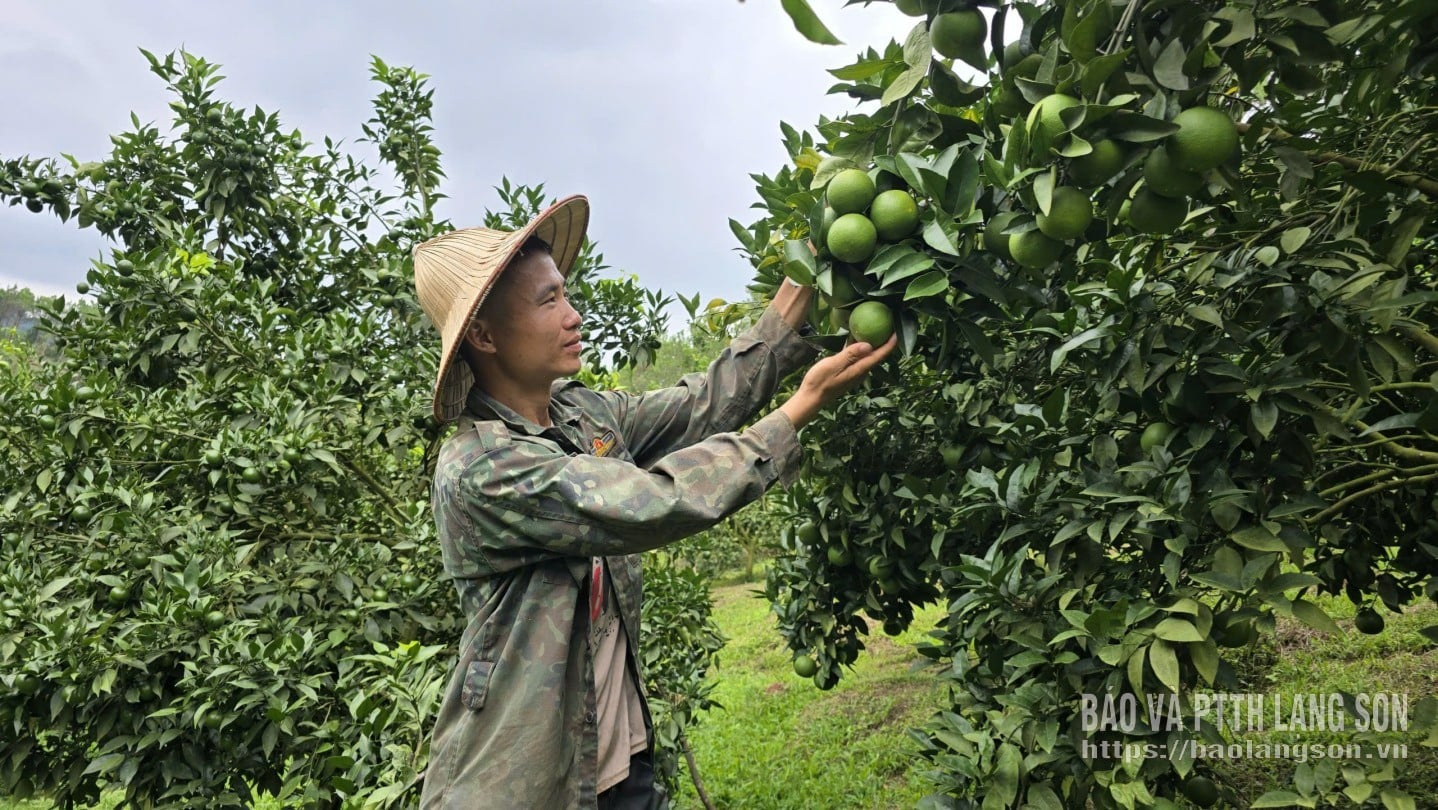
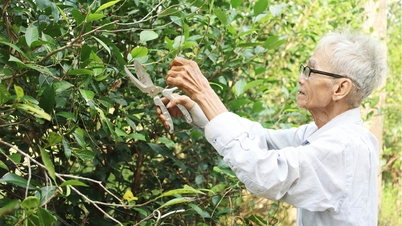
Nearly ten years ago, Mr. Ly Van Lung, in Ban Hec village, was still accustomed to low-yield rice crops and a difficult life all year round. Not resigned to poverty, he went to famous fruit growing regions such as Son La, Bac Giang , and Hoa Binh to learn from experience. Realizing that his hometown also had the potential to develop fruit trees, in 2017, he planted nearly 400 Canh oranges, Cao Phong oranges, and On Chau tangerines... Thanks to proper care, his orange garden has brought in more than 200 million VND per year. He is now expanding to 1,000 trees and plans to plant more persimmons to diversify his products.
Mr. Lung shared: The earliest ripening variety is Wenzhou tangerine, which I am currently selling for 30,000 VND/kg. I combine it with an experiential model, allowing tourists to visit and pick fruit in the garden. Since the beginning of the season, I have sold nearly 2 tons of fruit, and my income is much more stable than before.
Also choosing to develop the economy from fruit trees, Mr. Ton Van Bien's family in the same village of Ban Hec chose to grow the Vanh Khuyen rose variety. In 2015, he invested in planting more than 200 Vanh Khuyen rose trees on his family's hilly land. After many years of diligent care, up to now, each crop, he harvests 7-8 tons of fruit, bringing in an income of about 100 million VND.
Mr. Bien shared: The soil and climate here are very suitable for persimmon trees, the fruit is crispy, sweet and can be stored for a long time. I am planning to plant about 400 more trees, both to increase production and to expand the agricultural tourism experience model.
The fruit-laden gardens not only bring a stable source of income to the people but also attract tourists to visit and experience. Ms. Ly Thi Viet in Huu Lung commune shared: I learned about the orange garden in Cao Loc through social networks. When I came here, I saw that the scenery was very beautiful, the air was fresh. Picking the fruit and enjoying it in the garden by myself brought a very interesting feeling.
Effective production models in recent times have promoted the fruit tree growing movement in Cao Loc, becoming the main development direction of the locality. The whole commune currently has about 200 households growing fruit trees with an area of over 300 hectares. Of which, seedless persimmons are nearly 157 hectares, chestnuts are more than 75 hectares, plums are 31 hectares and many other types of trees.
To support people in developing their economy from fruit trees, Cao Loc commune has integrated many capital sources from the national target program on sustainable poverty reduction and development of ethnic minority and mountainous areas in the period of 2021-2025. The total capital allocated to the Commune People's Committee to implement the programs is about 10.3 billion VND, focusing on supporting production development and diversifying community livelihoods, including fruit tree planting models. Many typical projects such as "Planting and caring for chestnut trees" or "Planting and caring for Bao Lam seedless persimmons according to VietGAP standards" have brought about remarkable results.
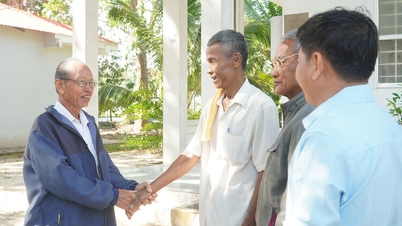
Mr. Hua Anh Tuan, Chairman of Cao Loc Commune People's Committee, said: Recently, people have paid attention to developing fruit trees in the direction of commodities. Persimmon, chestnut, orange, mango, plum, tangerine trees... are becoming the main source of income, contributing to improving life and promoting local socio-economic development. Many households earn from 100 to 300 million VND per year.
In recent years, people have also turned to safe and sustainable agricultural production. Many households have applied VietGAP procedures, prioritizing the use of organic fertilizers and limiting pesticides, to ensure the quality of agricultural products and the health of consumers. Currently, the whole commune has nearly 30 hectares of fruit trees planted according to VietGAP standards.
From the practical effectiveness of existing models, the Commune People's Committee is encouraging people to join together to establish production cooperatives. This will not only help households share experiences and provide technical support, but also facilitate the promotion and consumption of products, forming a sustainable production network.
Thanks to the effective promotion of fruit tree planting models, contributing to improving people's lives. The commune's poverty rate has decreased rapidly over the years. In the period 2021 - 2024, the commune's poverty rate decreased by about 6.73% per year on average. By the end of 2024, the whole commune had 92 poor households (accounting for 5.93%) and it is expected to decrease to 46 households (accounting for 2.96%) by the end of 2025.
Source: https://baolangson.vn/cao-loc-nang-gia-tri-kinh-te-tu-cay-an-qua-5066563.html

![[Photo] Parade to celebrate the 50th anniversary of Laos' National Day](/_next/image?url=https%3A%2F%2Fvphoto.vietnam.vn%2Fthumb%2F1200x675%2Fvietnam%2Fresource%2FIMAGE%2F2025%2F12%2F02%2F1764691918289_ndo_br_0-jpg.webp&w=3840&q=75)


![[Photo] Worshiping the Tuyet Son statue - a nearly 400-year-old treasure at Keo Pagoda](/_next/image?url=https%3A%2F%2Fvphoto.vietnam.vn%2Fthumb%2F1200x675%2Fvietnam%2Fresource%2FIMAGE%2F2025%2F12%2F02%2F1764679323086_ndo_br_tempimageomw0hi-4884-jpg.webp&w=3840&q=75)
























![[Video] Protecting World Heritage from Extreme Climate Change](https://vphoto.vietnam.vn/thumb/402x226/vietnam/resource/IMAGE/2025/12/03/1764721929017_dung00-57-35-42982still012-jpg.webp)


















































Comment (0)