

We are pleased to introduce some representative authors, aiming to provide readers with more information and understanding of Danish literature.
BEAUTIFUL FLOWERS IN THE LITERARY GARDEN (2)
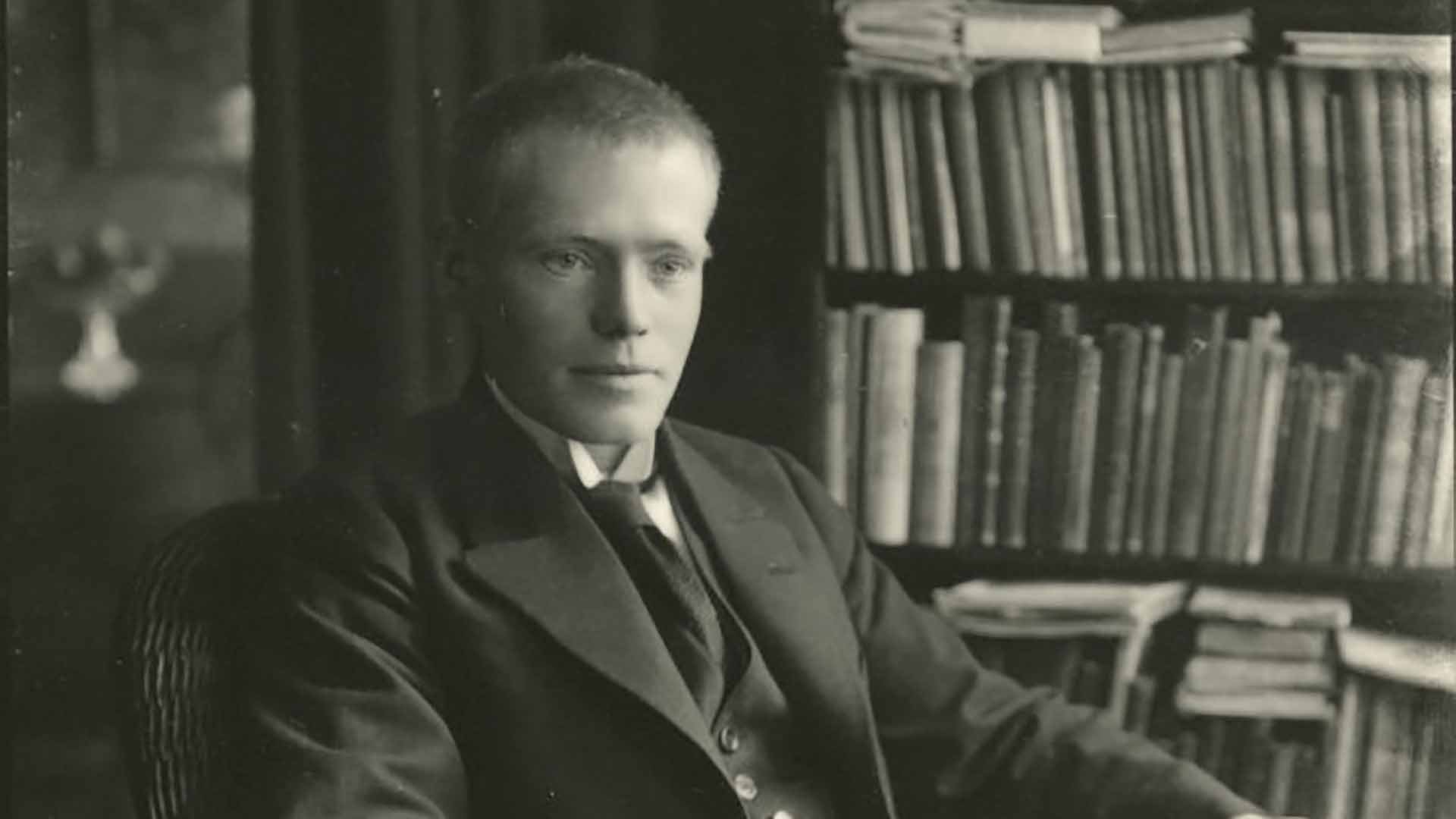 |
| Danish writer Becker Knuth. |
Becker Knuth (1892-1974) was a Danish writer. He came from a petty bourgeois family. Until the age of 32, he worked as a blacksmith and mechanic. His collection of poems (Digte, 1916) was published during World War I. Becker's poetry was anti-war. He sympathized with the lower classes and criticized narrow-minded bourgeois morality. He wrote a nine-volume novel series with many autobiographical elements: *The Daily Bread* (Det Daglige Brod, 1932), * The World Waits* (Verden Venter, 1934, two volumes), * The Restless Spring * (Uroligt Foraar, 1938-1939, three volumes), * When the Train Goes* (Naar Toget Koerer, 1944, two volumes), and *Marianne* (1956).
Blisher Steen Steensen (1782-1848) was a Danish writer and poet. He was the son of a pastor and also served as a pastor himself. His short stories depict the history and present-day life of his hometown, Jutland. Blisher held reformist ideas from the perspective of bourgeois Enlightenment, heralding the critical realism movement.
Karen Blixen-Fjnecke (1885-1962) , a Danish female writer, also used the pen names Isak Dinesen and Pierre Andresel. She wrote in Danish and English. She came from an aristocratic landowner family, owning a coffee plantation in Kenya (Africa) and residing there from 1914 to 1931. Blixen-Fjnecke followed a general humanist viewpoint, often contrasting good and evil. Her first collection of short stories was published in 1934 in the United States (in English): Seven Gothic Tales. She used African recollections in her works Farm in Africa (1937) and Shadows on the Grasslands (1960).
BRANDES Georg (1842-1927) was a Danish literary critic. He championed realism and naturalism, demanding that literature serve progress and oppose reaction. He had a significant influence on cultural life in Denmark, Sweden, and Norway. Later, Brandes was also influenced by Nietzsche and sympathized with the Russian October Revolution.
Hans Christian (1903-1966) was a Danish writer and playwright. His works address psychological and social conflicts during the German occupation. Branner's humanist viewpoint emphasized the importance of preserving individual morality over social reform. Branner depicted the alienation and loneliness of people in capitalist society. Novels: The Horseman (1949), No One Knows the Darkness (1955).
DRACHMANN Holger (1846-1908) was a Danish writer and poet, the son of a doctor. Initially, he pursued painting. Later, he worked as a journalist and writer. His attitude wavered between bourgeois radicalism and conservatism. He was initially influenced by the Danish radical critic G. Brandes, publishing the collection of poems (Digte, 1872) expressing his sympathy for the Paris Commune and the struggle of the proletariat.
After breaking away from the Brandes group, he expressed impulsive romantic feelings in plays, novels, and poetry. His travelogue, *On Coal and Chalk* (Med Kul og Kridt, 1872), and short stories , *In the Storm and in the Calm* (I Storm og Stille, 1875), depict people from coastal regions and have a realist tendency. His autobiographical novel *Forskrevet* (1890), influenced by Nietzsche, criticizes the contemporary bourgeoisie.
Otto Gelsted (1888-1968) was a Danish poet and critic. He was well-educated and worked as a journalist. In 1943, during the German occupation of Denmark, he fled to Sweden. In the 1920s, his poetry tended towards anarchism and mysticism. Gelsted expressed his belief in human progress and optimism in his philosophical and nature-celebrating poems: *The Virgin Gloriant* (Jomfru Gloriant, 1923) and *Towards the Light* (Henimod Klarhed, 1931).
Gelsted's poetry is simple and clear, contrasting sharply with the negative and pessimistic tendencies of Danish bourgeois poetry. Even in the 1930s, Gelsted's poetry showed a clear political orientation, expressing sympathy for Marxism: his collection *Under Uvejret* (1934) clearly exposed the threat of fascism. His poem *De Morke Fugle* (1940) profoundly condemned the Nazi German invasion of Denmark. His collection * Emigrantdigte * (1945) expressed fervent patriotism. Towards the end of his life, Gelsted translated classical Greek poetry.
Hansen Martin Alfred (1909-1955) was a Danish writer. He came from a farming family and worked in agriculture before becoming a teacher. Through his journalistic activities, he was in contact with the anti-fascist resistance movement during World War II. Hansen wrote novels and short stories, depicting the impact of the global economic crisis on rural areas. Life during the war shaped Hansen's existentialist attitude, distancing him from rationalism and drawing closer to the naive beliefs of the people; Hansen criticized bourgeois civilization. His anti-communist tendencies became increasingly evident. He influenced younger generations of Danish writers who followed existentialism.
Works: The Journey of Jonathan (Jonathan Rejse, 1941), historical novel The Liar (Logneren, 1950), a novel written in the form of a diary by a "modern skeptic"; symbolic method.
Source
![[Photo] Secretary of the National Assembly Party Committee, Chairman of the National Assembly presides over the meeting of the Standing Committee and Executive Committee of the National Assembly Party Committee.](https://vphoto.vietnam.vn/thumb/1200x675/vietnam/resource/IMAGE/2026/06/03/1780480353201_ndo_br_bnd-2585-jpg.webp)
![[Photo] General Secretary and President To Lam presides over a meeting with the Central Organizing Committee.](https://vphoto.vietnam.vn/thumb/1200x675/vietnam/resource/IMAGE/2026/06/03/1780482764658_a1-bnd-4741-3342-jpg.webp)
![[Photo] First session of the 14th Congress of the Vietnam Trade Union](https://vphoto.vietnam.vn/thumb/1200x675/vietnam/resource/IMAGE/2026/06/03/1780465947883_ndo_br_img-3852-jpg.webp)
















































![[Video] Sunset at Lap An Lagoon – Where the sun sets over the fishing nets](https://vphoto.vietnam.vn/thumb/1200x675/vietnam/resource/IMAGE/2026/05/31/1780192137701_beach-landscape-sea-water-nature-grass-745871-pxhere-com.jpeg)


































Comment (0)