

From early morning, on the rocky shore at the end of Cua Tung beach, the laughter and chatter of the divers drowned out the sound of the sea breeze. People called out to each other, some wading ashore and immediately opening plastic bottles to show off three or four lobsters they had caught. Mr. Nguyen Van Son, from Hoa Ly Hai neighborhood, Cua Tung town, bent down to his plastic bucket, gently pushing aside the salty water to reveal several tiny lobsters, their antennae still trembling slightly.
"You need very sharp eyes to spot them," he said. "Sometimes, just a single antenna sticking out is enough to know there's a lobster inside." Then he recounted that, typically from February to May in the lunar calendar, local fishermen gather at the reefs, where the most valuable "bounty of the sea"—lobster juveniles—to dive and catch them to sell to traders who are waiting to buy them.
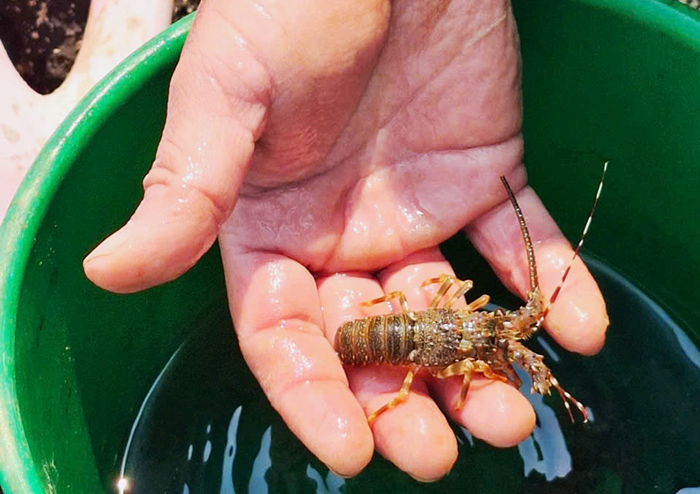
Lobster juveniles are only about the size of a little finger and are very good at hiding. They usually slip into crevices in rocks, clinging tightly to deep holes that are hard to see with the naked eye. Divers use bicycle spokes to gently poke the crevices. When the lobster stirs and jumps out, they must quickly grab it; a second's delay and it's gone. The plastic bottles they carry aren't for drinking water, but to trap the coins swimming around. Diving near the shore each day, they catch about 30-40 lobsters, selling them for 36,000 dong each, enough for a meat-filled dinner. But the sea is not a peaceful marketplace. A slip and fall, a piece of mussel cutting your foot, or a wave crashing against the rocks is enough to earn you blood and scars.
“If you want a big catch, you have to go far out,” said Tran Xuan Vu, another diver, pointing towards the swaying boats in the distance. That’s where professional divers operate. They not only have skills, but also have to invest tens of millions of dong, including small boats, air pumps, specialized diving goggles, hundreds of meters of rope, frogman suits, and heavy lead weights to sink deep. About 0.3-0.5 nautical miles from shore, they plunge into the sea like a jump between life and death. At the bottom, they shine lights, press their faces against the rocks, searching for tiny antennae. On the boat, someone waits, eyes glued to the pressure gauge, ears straining to hear the engine, hands always ready to handle any problems.
A single dive can last 3-4 hours. Skilled divers can catch hundreds of fish, earning several million dong per day. But many have lost their lives. Just a moment of the air supply being cut off, the hose getting caught in the propeller by another vessel, or the lead weights not being removed in time during an emergency, and there's no chance of returning.
It has been learned that in provinces like Phu Yen, Khanh Hoa , and Quang Ngai, the demand for lobster larvae has skyrocketed. Therefore, business owners are willing to spend millions of dong to obtain larvae from the natural sea, which are considered healthy and resistant. Thus, Cua Tung beach has become a source of supply for lobster farms in the South. But to obtain a single lobster larva, one might end up with a scar, a swollen and painful knee, or even the inability to swim for the rest of their lives.
These men would hastily eat their wives' home-cooked meals every day, head out to sea in the early morning mist, and return just before dusk. Some days they struck it rich, their pockets bulging. Other days they were left empty-handed, with only the salt on their lips and fresh cuts on their hands. They weren't dreamers, nor were they heroes. They simply chose to live by their feet, hands, and lungs, amidst the cold, rocky shores, with the belief that tomorrow would be better than today!
Source: https://cand.com.vn/doi-song/muu-sinh-duoi-day-ran-i772288/


![[Photo] Presenting the Binh Ngo Spring Edition of Nhan Dan Newspaper to officers and soldiers on the border and islands.](/_next/image?url=https%3A%2F%2Fvphoto.vietnam.vn%2Fthumb%2F1200x675%2Fvietnam%2Fresource%2FIMAGE%2F2026%2F01%2F27%2F1769491058494_trao-tang-bao-xuan-cho-cb-cs-bien-gioi-hai-dao-0994-5950-jpg.webp&w=3840&q=75)


![[Hightling] Conference on the Implementation of Tasks for 2026](/_next/image?url=https%3A%2F%2Fvphoto.vietnam.vn%2Fthumb%2F402x226%2Fvietnam%2Fresource%2FIMAGE%2F2026%2F01%2F27%2F1769477856197_dsc01637.jpeg&w=3840&q=75)


![OCOP during Tet season: [Part 2] Hoa Thanh incense village glows red.](/_next/image?url=https%3A%2F%2Fvphoto.vietnam.vn%2Fthumb%2F402x226%2Fvietnam%2Fresource%2FIMAGE%2F2026%2F01%2F27%2F1769480573807_505139049_683408031333867_2820052735775418136_n-180643_808-092229.jpeg&w=3840&q=75)
![OCOP during Tet season: [Part 1] Ba Den custard apples in their 'golden season'](/_next/image?url=https%3A%2F%2Fvphoto.vietnam.vn%2Fthumb%2F402x226%2Fvietnam%2Fresource%2FIMAGE%2F2026%2F01%2F26%2F1769417540049_03-174213_554-154843.jpeg&w=3840&q=75)




Comment (0)