

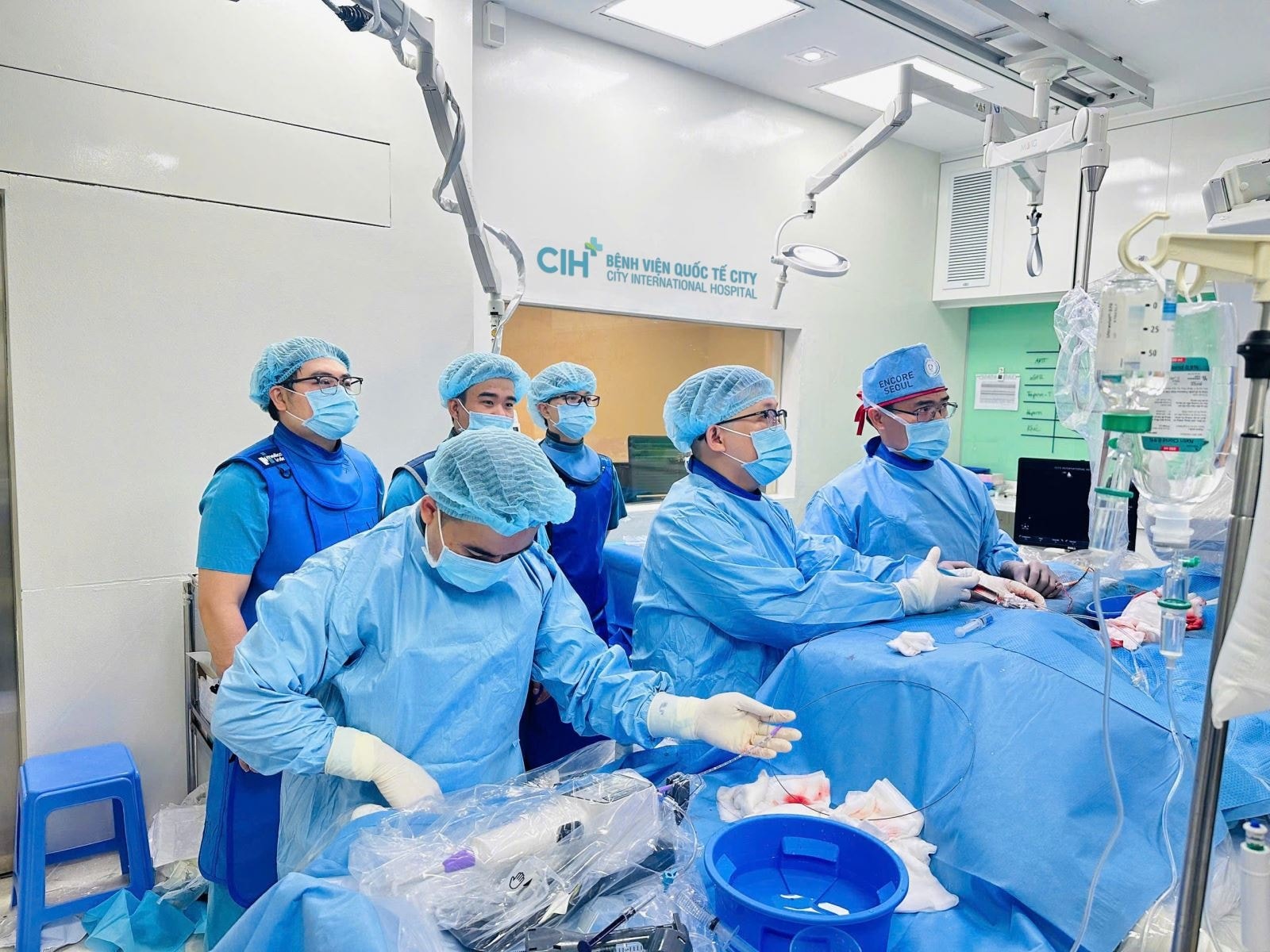
On September 11th, Dr. Le Van Tuyen, a specialist in Cardiology and Vascular Intervention at City International Hospital, stated that the patient came to the hospital for examination complaining of frequent shortness of breath and difficulty with daily activities.
Transthoracic echocardiography revealed the patient had a congenital atrial septal defect causing right ventricular dilation and pulmonary hypertension. This is a type of congenital heart disease that causes abnormal blood flow between the two atria, increasing the burden on the heart and lungs. Many patients only discover the condition when it has progressed to a severe stage or are incidentally diagnosed during routine health checkups.
"A large atrial septal defect can cause an increased flow of blood to the right heart, forcing the heart and lungs to work harder. If left untreated, patients risk complications such as arrhythmias, heart failure, pneumonia, stroke, and many other dangerous complications," added Dr. Le Van Tuyen.
At the Interventional Cardiology Department, doctors performed transesophageal echocardiography to accurately assess Mr. Khoem Vancha's condition and decided to choose the atrial septal defect closure technique using a device. This is a minimally invasive procedure that does not require open chest surgery and only local anesthesia.
Accordingly, a small, umbrella-shaped device is inserted through the femoral vein and positioned correctly to close the defect. The method is considered safe, leaves no incision, reduces pain, and allows for rapid patient recovery. After just one day, patients can return to normal activities, avoiding open chest surgery and its associated risks.
According to Specialist Doctor Le Van Tuyen, compared to open-heart surgery, the atrial septal defect closure method has many advantages, including being less invasive, having a faster recovery time, and fewer complications. This is the optimal choice for many patients, especially adults who are diagnosed late.
Dr. Tuyen advises that regular cardiovascular checkups are crucial, especially for those who frequently experience symptoms such as fatigue, shortness of breath, chest pain, or palpitations. Early detection allows for timely treatment and limits dangerous complications later on.
Source: https://baohaiphong.vn/nguoi-dan-ong-campuchia-khoi-benh-tim-bam-sinh-nho-ky-thuat-hien-dai-tai-viet-nam-520557.html




![[Image] Vietnam's colorful journey of innovation](/_next/image?url=https%3A%2F%2Fvphoto.vietnam.vn%2Fthumb%2F1200x675%2Fvietnam%2Fresource%2FIMAGE%2F2025%2F12%2F14%2F1765703036409_image-1.jpeg&w=3840&q=75)




































































![[Image] Vietnam's colorful journey of innovation](https://vphoto.vietnam.vn/thumb/402x226/vietnam/resource/IMAGE/2025/12/14/1765703036409_image-1.jpeg)

























Comment (0)