

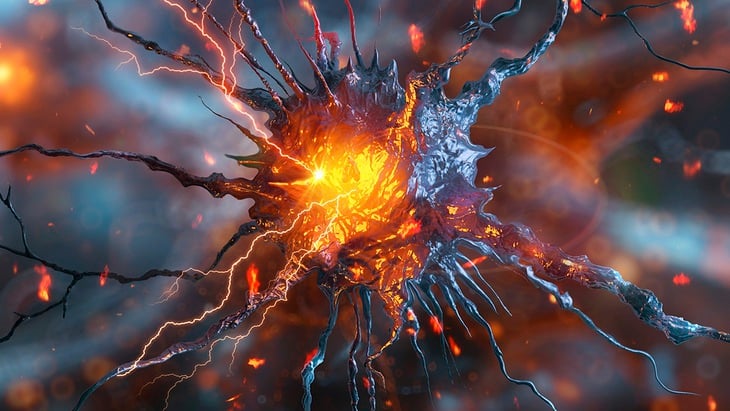
"Recharging" aging human cells will open up wide applications in disease treatment - Photo: SCIENCE PHOTO LIBRARY
For most cells, the number and efficiency of mitochondria—the tiny “power plants” inside cells—decrease with age. When mitochondria fail, they contribute to a variety of diseases in the body, from the heart to the brain.
In a new study, a team of scientists at Texas A&M University (USA) used special flower-shaped nanoparticles, called nanoflowers, to remove harmful oxygen molecules and activate genes that dramatically increase the number of mitochondria in human stem cells.
Remarkably, these energy-rich stem cells can then share their mitochondria with surrounding old and damaged cells, giving the cells that have lost their function a chance to function again.
"We have trained healthy cells to share their 'spare batteries' with weaker cells. Increasing the number of mitochondria in cells helps aging or damaged cells recover without genetic intervention or drugs," said biomedical engineer Akhilesh Gaharwar, as quoted by ScienceAlert on December 3.
The nanoflowers, made from the compound molybdenum disulfide , have a microscopic porous structure that acts like a sponge, capable of absorbing molecules that cause oxidative stress.
Removing these molecules prompts stem cells to produce more mitochondria, which they readily share with neighboring cells.
In the experiment, the number of shared mitochondria doubled compared to normal, while smooth muscle cells – which are particularly important for the heart – increased three to four times.
In heart cells damaged by chemotherapy, the survival rate of treated cells also improved significantly.
The team believes the method could be applied to many tissues in the body, such as implanting near the heart to support cardiovascular disease or injecting directly into muscle to treat muscular dystrophy.
However, the team stressed that this is just the beginning, and that animal and human trials are needed to learn more about implant placement, what dosage is safe, and the long-term effects of this method.
The study was published in the journal PNAS .
Source: https://tuoitre.vn/tim-ra-cach-sac-pin-cho-te-bao-gia-yeu-mo-huong-tri-benh-tim-mach-lao-hoa-20251203133639996.htm


![[Photo] Parade to celebrate the 50th anniversary of Laos' National Day](/_next/image?url=https%3A%2F%2Fvphoto.vietnam.vn%2Fthumb%2F1200x675%2Fvietnam%2Fresource%2FIMAGE%2F2025%2F12%2F02%2F1764691918289_ndo_br_0-jpg.webp&w=3840&q=75)



























![[Photo] Worshiping the Tuyet Son statue - a nearly 400-year-old treasure at Keo Pagoda](/_next/image?url=https%3A%2F%2Fvphoto.vietnam.vn%2Fthumb%2F1200x675%2Fvietnam%2Fresource%2FIMAGE%2F2025%2F12%2F02%2F1764679323086_ndo_br_tempimageomw0hi-4884-jpg.webp&w=3840&q=75)


























































Comment (0)