

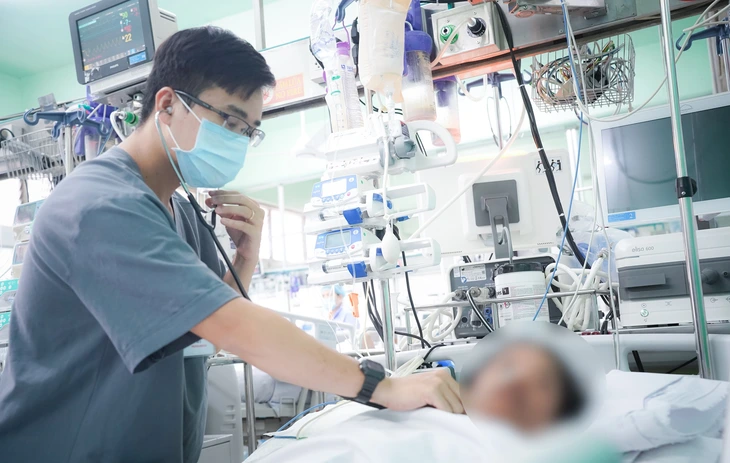
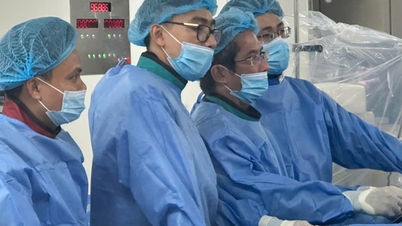
Doctors are treating patients suffering from "broken heart syndrome" - Photo: Provided by the hospital
On October 28th, Cho Ray Hospital announced that it had successfully collaborated with Tu Du Hospital to treat a female patient suffering from the rare condition of Takotsubo cardiomyopathy (also known as "broken heart syndrome").
Earlier on October 17th, Cho Ray Hospital received a request for a consultation from Tu Du Hospital regarding a female patient, VTB (42 years old, from Dak Lak ), who experienced cardiac arrest twice during surgery to treat a medical condition.
While waiting, the team at Tu Du Hospital made strenuous efforts to resuscitate the patient, helping the heart beat again. Simultaneously, the cardiology team from Cho Ray Hospital immediately arrived at Tu Du Hospital to assess the patient's condition and initially diagnose severe cardiogenic shock requiring urgent circulatory support.
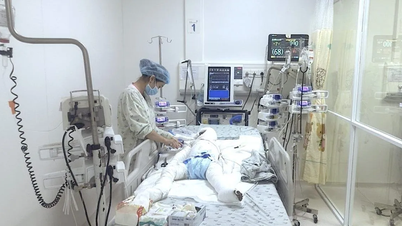
The patient was quickly maintained at minimal hemodynamic control, intubated, placed on a ventilator, and transferred to Cho Ray Hospital in critical condition. In the cardiovascular intensive care unit, the patient was found to be in severe cardiogenic shock with very high cardiac enzyme levels.
The coronary angiography results were normal, and the echocardiogram showed apical agenesis, basal hyperkinetics, and a reduced ejection fraction of only about 33% - a typical form of Takotsubo cardiomyopathy - a stress-induced cardiomyopathy that is easily mistaken for acute myocardial infarction and can progress rapidly, leading to fulminant circulatory failure.
Given the critical condition, the cardiology team held an urgent consultation with the interventional cardiology and emergency departments of Cho Ray Hospital, deciding to activate the 24/7 extracorporeal membrane oxygenation (ECMO) protocol, placing an extracorporeal membrane oxygenation system to create a "window" for myocardial recovery.
Simultaneously, a comprehensive resuscitation strategy was implemented, with hemodynamic control, lung-protective mechanical ventilation, recommended antibiotics, and multi-organ support. Thanks to a good response to intensive treatment, blood pressure and heart function gradually stabilized. The patient was gradually weaned off mechanical support and eventually discontinued the extracorporeal membrane oxygenation (ECMO).
Bedside echocardiogram results showed that cardiac contractility increased by 38% immediately after discontinuation of support, and continued to improve in the following days. Currently, after 10 days of treatment, the patient has been extubated, is breathing oxygen via cannula, vital signs are stable, and vital signs are recovering well.
Associate Professor Hoang Van Sy, Head of the Cardiology Department at Cho Ray Hospital, said this was a case of Takotsubo cardiomyopathy with a very severe and sudden progression.
The key to the treatment's success was partly due to the timely inter-hospital coordination between the two hospitals.
What is "broken heart syndrome"?
Dr. Hoang Van Sy added that Takotsubo cardiomyopathy can be triggered by physical or psychological stress, especially in patients undergoing major surgery.However, less than 10% of Takotsubo cardiomyopathy cases lead to fulminant circulatory failure. Therefore, this is a very rare clinical occurrence.
This case highlights the growing diversity and unpredictability of cardiovascular diseases, which can manifest under periods of both physical and mental stress.
Therefore, women, especially during the pre-menopausal and post-menopausal stages, should be vigilant for symptoms such as chest pain and shortness of breath following physical or mental stress, or after surgery.
This could be a sign of serious cardiovascular conditions such as myocardial infarction or Takotsubo cardiomyopathy.
In addition, cases of Takotsubo cardiomyopathy with severe cardiogenic shock complications require care and treatment at centers capable of performing mechanical circulatory support techniques such as extracorporeal cardiopulmonary support systems.
Source: https://tuoitre.vn/nguoi-phu-nu-mac-hoi-chung-trai-tim-tan-vo-dac-biet-hiem-gap-duoc-cuu-2025102815033568.htm
![[Photo] Prime Minister Pham Minh Chinh receives Lao Minister of Education and Sports Thongsalith Mangnormek](/_next/image?url=https%3A%2F%2Fvphoto.vietnam.vn%2Fthumb%2F1200x675%2Fvietnam%2Fresource%2FIMAGE%2F2025%2F12%2F16%2F1765876834721_dsc-7519-jpg.webp&w=3840&q=75)
![[Photo] Prime Minister Pham Minh Chinh receives the Governor of Tochigi Province (Japan)](/_next/image?url=https%3A%2F%2Fvphoto.vietnam.vn%2Fthumb%2F1200x675%2Fvietnam%2Fresource%2FIMAGE%2F2025%2F12%2F16%2F1765892133176_dsc-8082-6425-jpg.webp&w=3840&q=75)

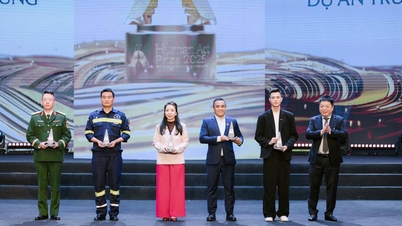
![[Live] 2025 Community Action Awards Gala](/_next/image?url=https%3A%2F%2Fvphoto.vietnam.vn%2Fthumb%2F1200x675%2Fvietnam%2Fresource%2FIMAGE%2F2025%2F12%2F16%2F1765899631650_ndo_tr_z7334013144784-9f9fe10a6d63584c85aff40f2957c250-jpg.webp&w=3840&q=75)
![[Image] Leaked images ahead of the 2025 Community Action Awards gala.](/_next/image?url=https%3A%2F%2Fvphoto.vietnam.vn%2Fthumb%2F1200x675%2Fvietnam%2Fresource%2FIMAGE%2F2025%2F12%2F16%2F1765882828720_ndo_br_thiet-ke-chua-co-ten-45-png.webp&w=3840&q=75)






















































Comment (0)