

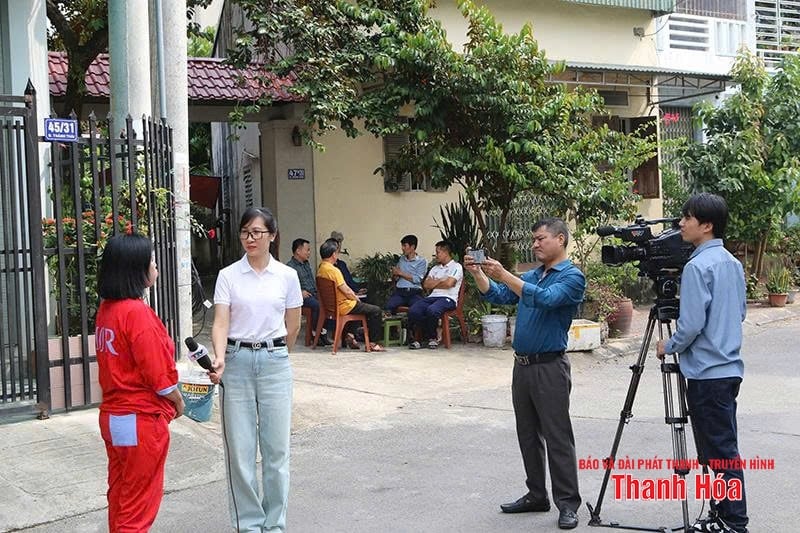
Reporters from Thanh Hoa Newspaper and Radio & Television Station working at the scene. Photo: Viet Huong
Multitasking is the "new normal".
Looking back over the past century, Vietnamese revolutionary journalism has evolved from simple printed pages, heavily laden with the mission of ideological struggle, to electronic news and video news that spread rapidly on social media. Along with this "flow," the style of journalism has also changed. While previously, newsrooms required many people to participate in a single piece—writer, photographer, editor, video editor, voiceover artist, etc.—now, in many cases, all of these roles can be combined in one person: a "5-in-1 journalist."
“Every time I go to the field, I’m always ready with my equipment: camera, phone, lapel microphone, laptop. When faced with urgent situations, I can film, write, edit, and upload the footage to CMS right at the scene. Although there are times of pressure, I’m very excited when the information is disseminated promptly across the ‘multi-platform’ of Thanh Hoa Newspaper, reaching many viewers,” shared reporter Le Hoi from Thanh Hoa Newspaper and Radio and Television Station.
Also working at Thanh Hoa Newspaper and Radio-Television Station, Viet Huong is a reporter covering legal matters. Always arriving early at the scene when readers report on incidents, from land disputes to complex civil complaints, she not only reports information quickly but also flexibly adapts her methods to convey stories through various formats. Besides insightful articles, Viet Huong also produces short videos for broadcast on the newspaper's online platform and other digital channels, helping viewers access the issues in a visual and engaging way.
"There are some legal issues that are quite dry, but when we present them through images, videos, legal diagrams, etc., people can easily understand and grasp the essence of the problem. At the same time, the rapid spread of information on social media platforms helps state management agencies access and handle issues promptly. This is a new way to make the often dry topic of law more accessible, engaging, and widely disseminated."
On the Thanh Hoa online newspaper and the Culture and Life online section, dozens of multimedia journalistic products are published and broadcast daily, ranging from television news broadcasts, short videos, and e-magazines to morning news podcasts, short stories, and essays that touch the emotions of readers. At the "digital heart" of the newsroom – the place producing the hottest digital content today – not only technicians but also editors and reporters are proactively adapting to become multi-talented journalists. They not only write news but also directly film on location, edit videos, present on-location reports, record podcasts, transfer files to edit the 6 PM news broadcast, or produce independent video publications.
According to journalist Hoang Anh Tuan, Deputy Editor-in-Chief of Thanh Hoa Newspaper and Radio-Television Station, digital transformation today is no longer an option, but an inevitable path that media organizations must take to affirm their role, position, and dominate the information market in the context of the digital media boom and increasingly fierce competition. Building a team of versatile journalists is not only an essential requirement, but also the "key" to successfully implementing the digital transformation of journalism.
Recognizing the need for innovation, over the years, press agencies in the province have actively implemented digital transformation for all their staff, reporters, and technicians, while also strongly innovating the converged newsroom model, regularly organizing training courses on modern, multimedia, and multi-platform journalism skills; and building a team that understands and skillfully uses technology in journalistic creation.

“Currently, many reporters have become proficient in content processing skills such as: photography, shooting and editing video clips, processing graphic information, exploiting digital data, interacting with readers through digital platforms... In other words, many reporters can independently create multimedia journalistic works, a testament to the shift from traditional to multi-skill journalistic practices. This brings a significant advantage to journalistic works not only in terms of quality but also in their ability to reach readers, distribute content, and receive feedback from readers,” expressed journalist Hoang Anh Tuan, Deputy Editor-in-Chief of Thanh Hoa Newspaper and Radio and Television Station.
Bearing the pressure - keeping the passion alive.
To be a versatile journalist, today's technology offers a great deal of support, from video editing and photo editing software to AI tools and data analysis applications—all within reach. But for professional journalists, technology is merely a tool—dedication to the profession is the core. They must work quickly but not carelessly, focusing on digital aspects without being swept away by trends. Therefore, the challenge of being a "5-in-1 journalist" is not just a test of skill, but also a measure of a professional ecosystem—one that offers structured training, fair compensation, and an inspiring environment.
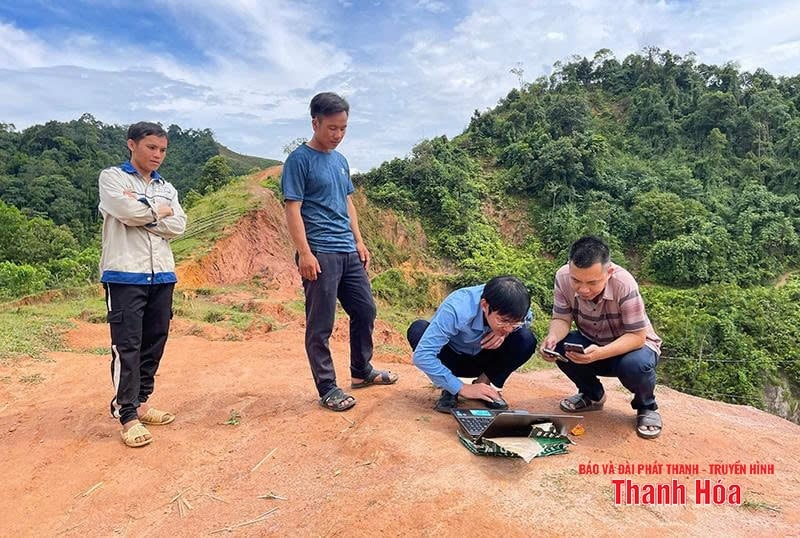
Reporter Le Hoi from Thanh Hoa Newspaper and Radio-Television Station processes news articles on a hilltop in Sai Khao village, Muong Ly commune (Muong Lat district). Photo: Provided by reporter.
“Having been accustomed to writing articles and taking photos, we now have to take on video shooting, clip editing, guiding subjects to give concise answers, post-production editing… so many steps that we are quite overwhelmed. The high workload and time pressure, coupled with our lack of specialized filming and editing skills, sometimes result in products that don't meet expectations in terms of image quality. The current compensation mechanism for multimedia productions is still not attractive enough to encourage reporters to invest boldly. In my opinion, we need a long-term plan, a well-organized work team, and the leveraging of each reporter's strengths; at the same time, there should be a dedicated technical support and post-production department to improve the quality of the work. Most importantly, we need close guidance and support from the editorial leadership so that reporters don't feel alone on this transformation,” shared reporter Viet Huong.
Furthermore, creating a compelling multimedia journalistic piece requires not only individual skills but also a fresh approach and seamless coordination throughout the entire production process.
According to reporter Minh Hai of Thanh Nien Newspaper, through training sessions and professional activities organized by the Thanh Nien Newspaper Journalists' Association, reporters, editors, and technicians have been guided on how to create multimedia journalistic works. Today, each reporter is proactively moving beyond traditional methods, independently gathering multi-layered materials – from visual images and behind-the-scenes details to quotations expressing viewpoints.
“I usually approach things from multiple perspectives, taking photos from various angles, and shooting short clips whenever possible because the presentation later requires rich material. However, from choosing the topic to designing and presenting, it's a whole series of tasks, requiring smooth, professional coordination and timely support from editors and department heads to complete a truly engaging work. Equipment such as cameras and video cameras also need to be constantly upgraded to ensure good image and sound quality. At Thanh Nien Newspaper, there is a mechanism to support reporters with money (in the form of installment loans) to invest in cameras and video cameras to keep up with trends, so this is a strength that allows reporters to always have quality equipment," Hai shared.
At conferences and forums on digital transformation in Vietnamese media organizations, leading experts and speakers have affirmed that digital transformation is the path forward; however, there is no single formula that applies to all media organizations. This is not a revolution in technology and equipment, but rather, it must first and foremost be a change in the mindset and working methods of journalists.

Hoang Anh Tuan, Deputy Editor-in-Chief of Thanh Hoa Newspaper and Radio-Television Station, affirmed that in the coming time, the Editorial Board will continue to raise awareness of digital transformation, while building a team of journalists who are strong in political conviction, professional ethics, and proficient in modern journalistic skills. “We set clear requirements regarding the ability to master technology for our reporters, aiming towards the model of a multimedia journalist: knowledgeable, ethical, proficient in foreign languages, mastering multi-platform languages, and mastering modern journalistic techniques and technologies,” journalist Hoang Anh Tuan shared.
A century of revolutionary Vietnamese journalism is a century of dedicated, honest, and courageous individuals. That journey is entering a new chapter – where journalists are not merely news providers, but leading fighters, guiding and directing on the media front!
Minh Hang
Source: https://baothanhhoa.vn/nha-bao-5-trong-1-nbsp-cau-chuyen-cua-thoi-dai-so-252780.htm




































![[Video] Sunset at Lap An Lagoon – Where the sun sets over the fishing nets](https://vphoto.vietnam.vn/thumb/1200x675/vietnam/resource/IMAGE/2026/05/31/1780192137701_beach-landscape-sea-water-nature-grass-745871-pxhere-com.jpeg)


























Comment (0)