

Scientists have found a giant mountain under the Pacific Ocean that is about 1,600 meters high, twice as high as the Burj Khalifa, the world's tallest building.
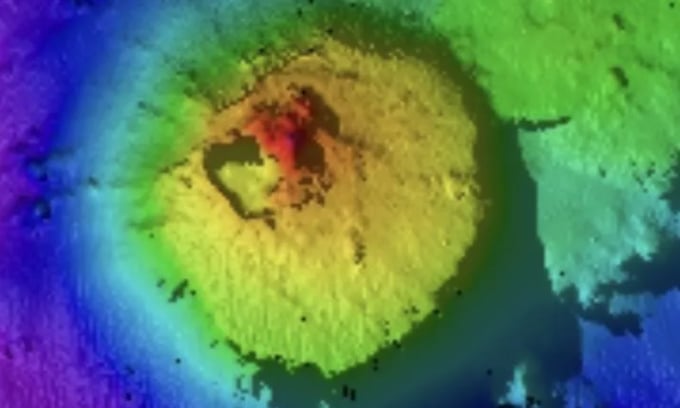
1,600 m high underwater mountain at the bottom of the Pacific Ocean . Photo: SOI
The seamount rises 1,600 meters above the sea floor and lies at a depth of about 4,000 meters below sea level. Experts discovered it during an expedition conducted by the Schmidt Ocean Institute (SOI) in international waters, 135 kilometers from Guatemala's exclusive economic zone.
Underwater mountains are underwater mountains with slopes rising from the ocean floor, according to the U.S. National Oceanic and Atmospheric Administration (NOAA). Most underwater mountains are remnants of extinct volcanoes and are often conical in shape. They are found in every ocean basin in the world, but experts don't know the exact number. The number of underwater mountains at least 1,000 meters high is thought to be more than 100,000. However, to date, scientists have only discovered a small fraction of them.
The newly discovered underwater mountain was observed by the SOI expedition using the EM124 multi-beam echo sounder aboard the research vessel Falkor (too). This instrument is capable of mapping the seabed with high resolution.
After the echosounder detected the seamount, an expert on board confirmed that the structure was not in any seafloor database. The data showed that the mountain covered an area of more than 13 square kilometers. "The fact that a seamount over 1.5 kilometers high has remained hidden under the waves until now shows that there is still a lot we have yet to discover," said Jyotika Virmani, executive director of SOI.
Seamounts are biodiversity hotspots, providing a surface for organisms such as deep-sea corals, sponges, and many invertebrates to settle and thrive. These organisms, in turn, provide food for other animals. Seamount ecosystems are often home to unique species found in only one location. Mapping and exploring these unknown areas of the ocean floor is key to helping scientists better understand Earth.
SOI is a partner in the Seabed 2030 program, which aims to map the entire seabed by 2030. Currently, the lack of detailed maps of much of the seabed makes it difficult to navigate safely, manage marine resources sustainably, and protect coastal communities.
Thu Thao (According to Newsweek )
Source link






























![[Video] The craft of making Dong Ho folk paintings has been inscribed by UNESCO on the List of Crafts in Need of Urgent Safeguarding.](https://vphoto.vietnam.vn/thumb/402x226/vietnam/resource/IMAGE/2025/12/10/1765350246533_tranh-dong-ho-734-jpg.webp)





















































Comment (0)