

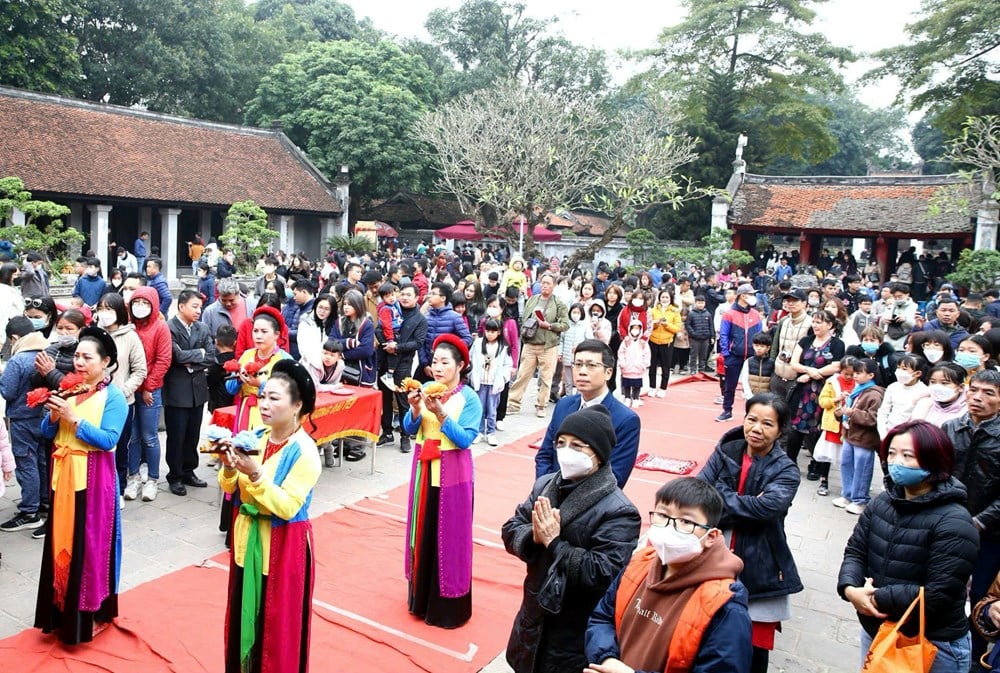
Setting a good example and creating a healthy environment.
Professor Dr. Tu Thi Loan, former Director of the Vietnam National Institute of Culture and Arts, stated that, theoretically, the concept of cultural environment has many different interpretations, both broad and narrow. In its broadest sense, "cultural environment" is almost synonymous with "social environment".
In a narrower sense, "cultural environment" is merely a component of the "social environment," which encompasses many fields: politics , economics, culture, education, science, history, religion, etc. In its narrowest sense, "cultural environment" is only one constituent element of culture and includes only the spiritual cultural elements that exist around the subject.
Family and school are the closest and most familiar cultural environments for each individual. Since ancient times, cultural institutions, customs, traditions, and behavioral norms of the community, as well as family rules, customs, and family traditions, have contributed to shaping individuals who value "humanity, propriety, righteousness, wisdom, and trustworthiness."
At any stage, building a cultural environment is always a crucial foundation, with exemplary role models at its core. According to Professor Dr. Tu Thi Loan, in the context of a rapidly changing life with many risks and negative impacts, good role models need to be widely disseminated so that the public can better understand the benefits of building a cultural environment, aiming to create healthy cultural environments.
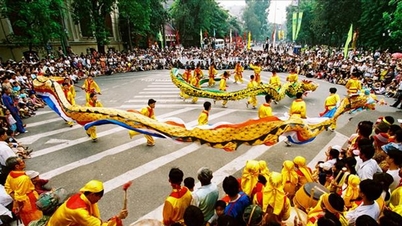
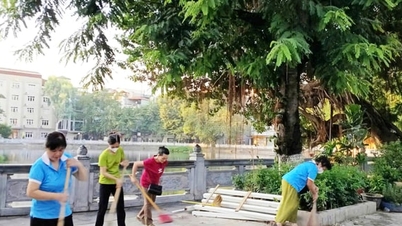
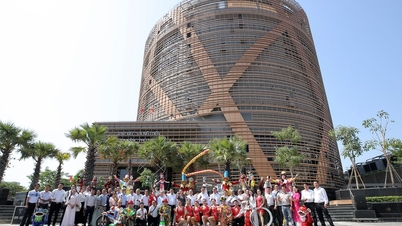
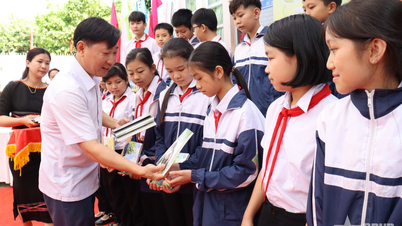
Public awareness campaigns have gradually transformed the building of a cultural environment into a collective effort, with the joint participation and contributions of the people, who are the subjects of this cultural environment. In Hanoi, building a refined and civilized Hanoi citizen has been one of the key priorities for many years.
The owners of a thousand-year-old cultural heritage have been striving to build a cultural environment through specific programs and actions. The two codes of conduct, the Law on the Capital City, and especially the City Party Committee's Program on cultural development, improving the quality of human resources, and building elegant and civilized Hanoi citizens, have laid a solid foundation for the formation and development of healthy and exemplary cultural environments.
Over the years, the Hanoi Department of Culture and Sports has also spearheaded the development of plans and solutions to implement various indicators for building grassroots cultural life; perfecting and promoting the effectiveness of regulations and customs in building grassroots cultural life; and developing model cultural villages associated with the implementation of criteria for building advanced new rural areas...

Many positive changes can be seen in the transformed appearance of exemplary models, such as the "model cultural villages" built jointly by local authorities and residents. These living environments not only provide clean and beautiful spaces but also enhance the cultural and spiritual lives of the people, with well-equipped cultural facilities, emphasis on new rural development criteria, civilized lifestyles, and cultured behavior.
Exemplary cultural village and neighborhood models such as "Self-governing villages and neighborhoods" and "Villages and neighborhoods with 5 no's and 3 clean's" have been developed and replicated throughout the city. Emulation movements such as "Hanoi women actively and creatively building civilized and happy families"; "Farmers producing and selling safe agricultural products"; "Exemplary veterans"; "Skilled workers"; "Creative labor"; and "Volunteerism for community life"... have attracted widespread public participation.
Promoting the role of cultural subjects
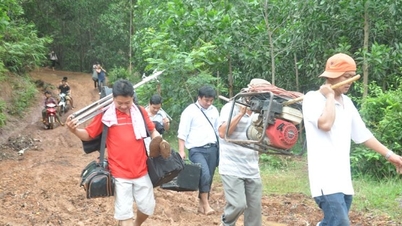
In reality, the work of building a cultural environment still has many limitations. The system of cultural institutions and the physical and technical infrastructure for cultural activities at the grassroots level are still lacking and weak, in some places dilapidated, lacking uniformity, and inefficient of use. The cultural environment still has many aspects that are not truly healthy, contrary to good customs and traditions, and moral values...
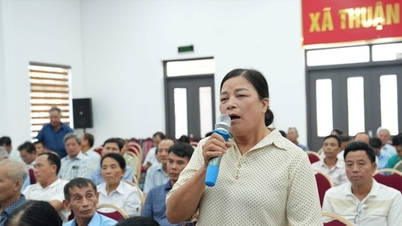
According to Associate Professor Bui Hoai Son, a full-time member of the National Assembly's Committee on Culture and Society, the first and most important solution remains raising awareness of the role and importance of the cultural environment. Only with correct understanding can we formulate legal regulations to govern the relationships within the various elements of the cultural environment.
Over the past period, the cultural sector has implemented the work of building a cultural environment in the right direction, selecting grassroots areas as key locations for operation, preservation, promotion, and multiplication of cultural values. Localities have implemented many exemplary cultural models, contributing to strengthening community bonds and improving the spiritual life of residents. This has spread, created a positive effect, and contributed to overcoming the general problem of cultural degradation.
Implementing the tasks outlined in the Resolution of the 13th National Congress of the Party, the Ministry of Culture, Sports and Tourism has adopted the motto "Decisive Action - Aspiration for Contribution," directing the entire sector to focus on key tasks and solutions to overcome difficulties and obstacles, promote tourism development, organize cultural, artistic, and sports activities to improve the material and spiritual lives of the people; and implement the work of building a cultural environment in the right direction, selecting key areas for operation, preservation, promotion, and multiplication of cultural values. The impact of building a cultural environment has permeated ministries and sectors and has been comprehensively implemented by localities.
Some models not only preserve cultural values but also contribute to economic development and attract social participation; many models have been developed into local cultural and tourism destinations. Many localities have explored and researched the application of digital technology to innovate methods of organizing professional and amateur art performances to serve political objectives and the people.
Building a cultural environment at the grassroots level is an important but difficult and challenging task. According to managers, a breakthrough is needed in institutionalizing the Party and State's guidelines and policies, continuing to improve the legal system of the sector according to the approved plan for perfecting the legal system on culture and family for the period 2021-2026; and continuing to improve the legal system related to building a cultural environment.
Focusing on the grassroots level and community life is one of the key objectives of the National Target Program on Cultural Development for the period 2025-2035. Promoting the cultural identity of different regions and building a healthy grassroots cultural environment are crucial driving forces for overall, comprehensive development, oriented towards and for the people.
Promoting a reading culture in the community.
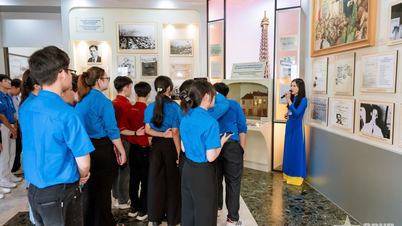
Over the past period, the Hanoi Cultural and Library Center (under the Hanoi Department of Culture and Sports) has focused on developing and gradually synchronizing and perfecting the public library system in the area. The Center has proactively applied information technology in its management and service work. Currently, the unit has implemented many modern library management software such as: online card registration, reader management, automatic borrowing and returning system via RFID, building a full-text database, digitizing documents, producing audiobooks, Braille books, etc.
In 2024, the Hanoi Cultural and Library Center added over 13,000 new books, built a full-text database for more than 107 titles (approximately 38,000 pages), and produced 40 audiobooks (equivalent to 10,000 pages) for the visually impaired. The total existing collection reached over 576,000 books, including over 31,800 foreign language books; over 20,600 local history documents; and nearly 400 types of newspapers and magazines. Products and services are increasingly diverse, including online search, on-demand reading, in-depth information provision, use of electronic documents, and photocopying for learning and research... NGOC MINH
Source: https://baovanhoa.vn/van-hoa/phat-huy-vai-role-cong-dong-161941.html




































![[Video] Sunset at Lap An Lagoon – Where the sun sets over the fishing nets](https://vphoto.vietnam.vn/thumb/1200x675/vietnam/resource/IMAGE/2026/05/31/1780192137701_beach-landscape-sea-water-nature-grass-745871-pxhere-com.jpeg)
























Comment (0)