
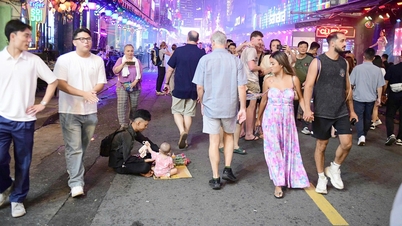
Bui Vien pedestrian street (Ben Thanh ward, Ho Chi Minh City) attracts a large number of visitors at night for entertainment, recreation, and culinary experiences, especially a large number of foreign tourists - Photo: QUANG DINH
Bui Vien pedestrian street is now often chaotic, with torturous noise, loud music from bars, encroached sidewalks, and even places where nitrous oxide (laughing gas) is secretly sold.
If Ho Chi Minh City has Bui Vien Street, then Hanoi has Ta Hien Street, a vibrant "Western Street" with a lively nightlife and dining atmosphere for tourists, but without the "torture" of noise.
A true "Western-style street" should be a place of civilized interaction, selective street art, local beers, delicious and clean meals, and valuable experiences. Bui Vien Street, however, has been given the sad name: "Poison Street."
Bui Vien Street: Expectations and a Downfall
As someone who has worked in the tourism industry for many years, I used to be proud to introduce Bui Vien Street to my international friends. But lately, every time I think about it, all I can do is sigh.
Not only do well-mannered tourists avoid it, but even the people of Ho Chi Minh City no longer want to frequent this place. Many reputable businesses and quality restaurants have quietly withdrawn from Bui Vien Street.
When it was designated as a pedestrian street (in 2017), Bui Vien Street carried the expectation of becoming the "Khao San Road of Vietnam" - an ideal place for tourists to experience food, music, street culture, and socialize with international friends.
With its rich history, central location, and large number of foreign visitors, Bui Vien has the full potential to become a cultural icon of Ho Chi Minh City's nightlife.
Instead of developing in a sophisticated and distinctive direction, Bui Vien has become a chaotic "sound feast" every night. Loudspeakers and bar music are deafeningly loud, spilling onto the street. Bars and restaurants have sprung up like mushrooms, but they lack character, focusing only on selling cheap beer and bar food.
These issues not only deter quality tourists but also cause inconvenience to the local residents.
It's time to stop ignoring this reality. Serious and concerted action is needed from both businesses operating here and the local government.
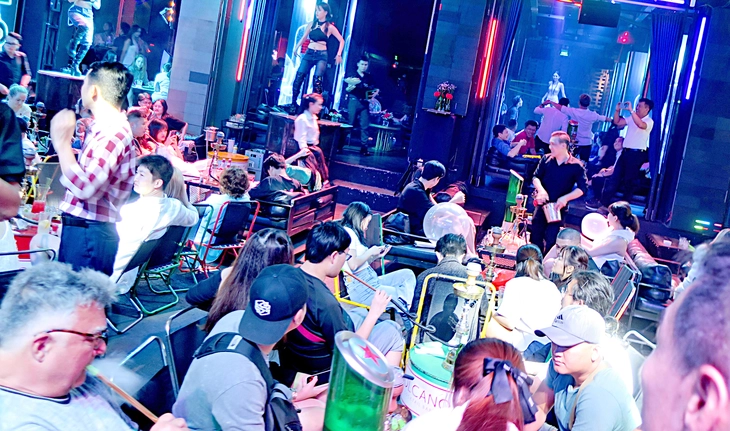
Bui Vien Street, also known as the "Western Street," is a lively nightlife spot in Ho Chi Minh City - Photo: TTD
A drastic reform is needed.
On the government's side, it is necessary to resolutely restore social order, control noise levels, rectify the encroachment on sidewalks and roads, and curb the disguised sale of stimulants such as nitrous oxide (laughing gas). A framework of operating criteria should be established for businesses in Bui Vien, requiring registration and approval based on a healthy business model.
Businesses need to be more mindful of maintaining the overall image of the neighborhood. Don't let short-term gains negatively impact the entire area. Aim for professional service, quality food, appropriate music, harmonious lighting, and a safe environment for all visitors, including women and children.
If we want Bui Vien to become a true cultural and tourist destination, we need to reposition the products along the entire street. We should invite reputable food brands and famous chefs to open restaurants here.
Bui Vien should be a place where diners can find authentic Vietnamese dishes, from Hue-style beef noodle soup and Hanoi-style grilled pork noodle soup to beef or chicken pho, hu tieu, broken rice, and banh mi... all in a civilized and clean environment.
Regular street art performances—acoustics, dance, small circus acts—should be organized instead of loud music from bars. Craft beer pubs and cafes with a local flair would add depth to the experience.
Tourism connectivity is needed: transforming Bui Vien into a starting point for city tours and nighttime food tours. Integrating digital technology into payments, reservations, and services will make the experience more convenient for tourists.
According to the book " Streets of Ho Chi Minh City ," this street is named after Bui Vien, a famous official during the Nguyen Dynasty, who was sent by Emperor Tu Duc as an envoy to the United States to establish diplomatic relations in the late 19th century.
It was a historically significant journey as Vietnam sought opportunities to engage with the Western world amidst international upheaval.
Although it is only a little over 1km long, the historical value and symbolic significance of this road are undeniable.
Bui Vien could become a national brand.
Bui Vien Street could become a national brand if we know how to do it right. Let's not let it forever be associated with an ugly, chaotic image. Let's preserve it as a cultural "asset," a tourism brand that Ho Chi Minh City can be proud of.
Rebuilding Bui Vien Street is not a one-day affair. But small steps – from controlling noise and eliminating laughing gas to attracting quality food businesses – will help restore the proper rhythm of life of a true "Western-style street."
Bui Vien - let this be a place people want to visit and want to return to. A street with a glorious history should be made bright and civilized again.
If properly redefined, Bui Vien Street is not just a pedestrian entertainment street. It has the potential to become a city-level cultural and tourism brand, or even a national brand.
Why does Bangkok have Khao San, Singapore has Clarke Quay, but we can't transform Bui Vien into a more refined symbol?
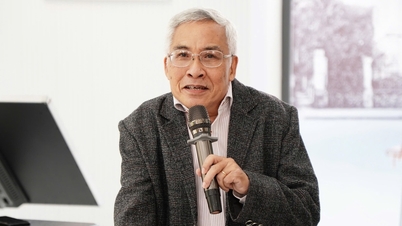
Trinh Nguyen Hung Dung (Vice President of the Ho Chi Minh City Tourism Association)
Source: https://tuoitre.vn/pho-bui-vien-da-den-luc-tro-ve-dung-nghia-pho-tay-202507300823023.htm


![[Photo] General Secretary and President To Lam presides over a meeting on the implementation of Directive No. 34-CT/TW of the Party Central Committee.](https://vphoto.vietnam.vn/thumb/1200x675/vietnam/resource/IMAGE/2026/05/19/1779187768672_a1-bnd-2350-631-jpg.webp)
![[Photo] Capturing the moment the tide recedes at Yen Binh Son rapids - a million-year-old scenic spot in Quang Ngai.](https://vphoto.vietnam.vn/thumb/1200x675/vietnam/resource/IMAGE/2026/05/19/1779175463885_yen9-1199-jpg.webp)
![[Photo] National Assembly Chairman Tran Thanh Man attends the groundbreaking ceremony for the National Highway 1A spatial axis project.](https://vphoto.vietnam.vn/thumb/1200x675/vietnam/resource/IMAGE/2026/05/19/1779161360398_ndo_br_bnd-1412-jpg.webp)






































![[Photo] General Secretary and President To Lam receives Indian Defense Minister Rajnath Singh](https://vphoto.vietnam.vn/thumb/402x226/vietnam/resource/IMAGE/2026/05/19/1779184046302_anh-man-hinh-2026-05-19-luc-16-46-58.png)

















Comment (0)