

Since the beginning of the year, many patients who came to the Central Dermatology Hospital with dark hyperpigmented patches on their feet and hands have been diagnosed with melanoma and are undergoing treatment.
Patient NVT (born in 1950), who was thin and frail, presented with a black spot in the liver area near the right heel.
 |
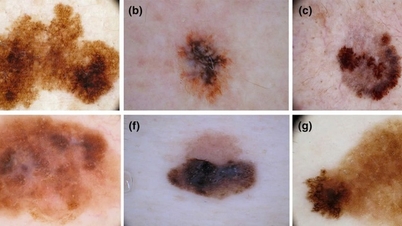
| The early signs of melanoma can be quite varied. |
The patient stated that the lesion had been present for many years, but because it did not itch, hurt, or cause any discomfort, the patient did not pay attention to it.
Over time, this dark spot not only didn't disappear but also grew larger and changed shape, becoming mottled on the skin's surface. When family members read articles about skin cancer online and saw that the symptoms described matched the patient's, they encouraged the patient to see a doctor.
At the National Dermatology Hospital, patients undergo examinations, blood tests, ultrasounds, and dermoscopy—a specialized test in dermatology that can detect early signs of skin cancer.
The diagnosis revealed that the patient had melanoma in the right sole of the foot. Doctors performed surgery to remove the entire tumor and conducted histopathological examination to accurately determine the extent of invasion and stage of the disease, thereby developing a timely and appropriate treatment plan.
Fortunately for the patient, imaging, ultrasound, and intraoperative lymph node examination revealed no signs of metastasis.
Subsequently, the patient underwent wide excision surgery, following standard treatment protocols for melanoma, to ensure complete removal of cancerous cells, minimize recurrence, and prevent skin defects after tumor removal, which were reconstructed using skin grafting techniques.
Since the beginning of the year, many patients have come to the Central Dermatology Hospital with lesions of dark hyperpigmentation on their feet and hands, which we have diagnosed as melanoma and proceeded with treatment.
This reflects the fact that people still lack awareness of dermatological conditions in general and skin cancer in particular.
Melanoma is a malignant disease that develops from melanocytes, the cells responsible for producing melanin, the pigment that gives skin its color. Currently, the incidence of this disease is on the rise.
In 2023, an estimated 97,610 new cases of melanoma occurred in the United States, resulting in approximately 7,990 deaths.
Statistics from several countries show that the incidence rate doubles every 10-15 years and increases with age. The highest incidence rates were recorded in Australia at 40/100,000 people; in the US at 12/100,000 people; and in Vietnam at 0.4/100,000 people.
Melanoma is less common than other types of skin cancer. Although it accounts for only about 1%, melanoma is the cause of most skin cancer-related deaths due to its invasive nature and rapid metastasis.
Melanoma cancer cells invade and metastasize to other organs by traveling through tissues, blood, and the lymphatic system.
Cancer cells can metastasize to any location in the body, most commonly the brain, lungs, and liver. Although the disease has a high rate of metastasis, if detected early and treated according to the correct protocol, the results are good, and the 5-year survival rate is very high.
Melanoma can manifest anywhere on the body. However, in Asians, it is most commonly found on the palms and soles of the feet, accounting for approximately 50% of cases.
Most of the patients we treat are similar cases. They begin as an area of unevenly pigmented skin, a mix of brown and grayish-black, with indistinct boundaries, painless and non-itchy. The lesion spreads outwards, and may ulcerate or develop raised nodules.
Some authors suggest that moles in certain trauma-prone areas such as the hands, feet, or shaved areas have a higher risk of developing melanoma and advise early removal of moles in these locations.
In addition, we also frequently encounter melanoma under the nail, manifesting as irregular hyperpigmented lesions that occupy part or all of the nail bed.
Subungual melanoma is often diagnosed late because it is easily mistaken for other conditions such as subungual moles, traumatic hemorrhage, paronychia, fungal infections, and subungual warts.
Therefore, any hyperpigmentation under the nail should be carefully examined, especially those lesions that extend the entire length of the nail.
The condition mostly appears as hyperpigmented lesions in areas of skin subjected to pressure or friction.
Localized malignant tumors often do not significantly affect the patient's health, so they are frequently overlooked and go unnoticed.
The early signs of melanoma can be quite varied. In fact, patients can apply the ABCDE rule, which lists early signs of melanoma, to check for abnormal lesions on their bodies.
A (Asymmetry): Moles or hyperpigmented lesions that do not have a symmetrical shape.
B (Border): The border of the lesion is irregular, jagged, or blurred.
C (Color): The color is not uniform and may include various shades such as black, brown, and even red or blue.
D (Diameter): Diameter greater than 6 mm.
E (Evolving): The lesion changes in size, shape, or color over time. If the lesion has any of the following characteristics, immediate examination at a specialized hospital is necessary.
According to statistics from the American Joint Committee on Cancer (AJCC) in 2009, the prognosis for melanoma in situ is generally very good, with a 5-year survival rate of over 90%.
For more deeply invasive tumors, the 5-year survival rate ranges from 50-90% depending on the thickness, skin ulceration, and cell division rate of the malignant tumor.
When a tumor has metastasized to regional lymph nodes, the 5-year survival rate drops significantly, ranging from 20-70%. The 5-year survival rate for melanoma that has metastasized to distant lymph nodes is approximately 10%.
This highlights the importance of recognizing early signs of skin abnormalities and seeking timely medical attention.
Early diagnosis not only improves treatment effectiveness but also increases the chances of survival and reduces the risk of metastasis.
Source: https://baodautu.vn/tang-nhanh-luong-benh-nhan-mac-ung-thu-te-bao-hac-to-d221392.html































































































Comment (0)