

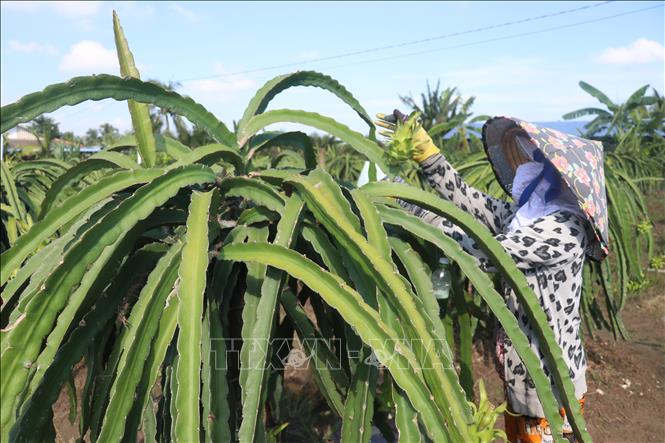
According to reports, dragon fruit wholesalers are currently buying dragon fruit at 37,000 VND/kg (grade 1), 32,000 VND/kg for grade 2, 26,000 VND/kg for grade 3, and 20,000 VND/kg for grade 4; while substandard fruit (purchased for juice or seeds) is bought at 16,000 VND/kg. Two months ago, grade 1 dragon fruit was bought by traders at 9,000 VND/kg, while grades 2 and 3 were only 5,000-6,000 VND/kg.
According to growers, dragon fruit is currently expensive because off-season dragon fruit in orchards this year is producing fewer fruits, resulting in a supply lower than demand. Additionally, this year's off-season cultivation was negatively impacted by weather conditions (storms, tropical depressions), leading to low flowering rates and disease outbreaks, resulting in fruit quality that doesn't meet export standards. The main dragon fruit season runs from March to mid-September. After harvesting the main crop, growers continue to care for their orchards to prepare for off-season production (inducing off-season flowering by using artificial lighting).
According to the Department of Agriculture and Environment of Dong Thap province, the locality has developed a specialized dragon fruit cultivation area for export of nearly 9,400 hectares, with an annual harvest of nearly 272,000 tons of fruit, concentrated in the eastern communes of the province located in the Go Cong freshwater zone, including Cho Gao, An Thanh Thuy, My Tinh An, Dong Son, Vinh Binh, and Go Cong communes. Of this, the area of dragon fruit production according to VietGAP standards is approximately 2,200 hectares, and according to GlobalGAP standards is over 300 hectares. The aforementioned communes currently have 64 export-oriented cultivation area codes covering 2,030.63 hectares supplying markets such as China, South Korea, the United States, Australia, and New Zealand, along with 5 dragon fruit packaging facility codes.
According to Mr. Nguyen Cong Thanh, Chairman of the People's Committee of Tan Thuan Binh commune, Dong Thap province, dragon fruit from Cho Gao (formerly Cho Gao district, Tien Giang province, now Tan Thuan Binh commune, Dong Thap province) has been granted collective trademark protection by the Intellectual Property Office. This is considered an important passport for Dong Thap province's dragon fruit to strongly penetrate demanding markets around the world.
The People's Committee of Tan Thuan Binh commune is guiding and creating favorable conditions for cooperatives and businesses to cooperate with dragon fruit growers to create high-value products, increase export turnover, and overcome technical barriers of trade agreements, aiming for larger consumer markets through official export channels.
In specialized farming areas, localities form cooperatives and production groups to bring together farmers, provide training, and transfer farming techniques according to GAP standards to produce safe and traceable products. They also enhance product promotion and trade for agricultural commodities... aiming to improve the value chain of dragon fruit products and contribute to the sustainable development of the dragon fruit industry.
In Tan Thuan Binh commune, Dong Thap province, Hung Thinh Phat Clean Agriculture Cooperative has established a dragon fruit growing area according to VietGAP and Global GAP standards, with 39 members participating in production across 8 cooperative groups in the hamlets of Tan Thuan Binh commune. The total area of the cooperative members' orchards is 132 hectares, growing white-fleshed, red-fleshed, and pink-purple dragon fruit varieties.
According to Nguyen Trung Quy, Director of Hung Thinh Phat Clean Agriculture Cooperative, the cooperative processes an average of 60-100 tons of dragon fruit and over 60 tons of other fruits each month for export to Japan, the US, South Korea, China, and other countries, as well as supplying supermarkets and shopping malls nationwide. This contributes to ensuring a stable market for cooperative members and dragon fruit growers in the area.
In My Tinh An commune, Dong Thap province, Thien Phuc Cooperative currently has 175 members and 245 hectares of dragon fruit cultivated according to VietGAP standards. To contribute to the development and enhancement of the value chain of dragon fruit, Thien Phuc Cooperative has invested in drying and roasting machines to produce dried products from dragon fruit and other fruits such as pomelo and custard apple. Currently, Thien Phuc Cooperative has two products – yellow-skinned dragon fruit and dried dragon fruit – that have achieved OCOP 3-star status, and nutritional candy made from dragon fruit seeds is in the process of being certified as an OCOP product.
Mr. Nguyen Huu Phuc, director of Thien Phuc Cooperative in My Tinh An commune, Dong Thap province, shared that creating a product value chain from the specialty dragon fruit helps to mitigate the "bumper harvest, low prices" situation for dragon fruit growers, contributing to sustainable development and enhancing the value of agricultural products in the area in general, and dragon fruit in particular.
Implementing the "Dragon Fruit Development Plan until 2025," Dong Thap province focuses on applying science and technology to improve the quality and competitiveness of dragon fruit in the export market. At the same time, Dong Thap province is also calling on and encouraging processing businesses to invest in building factories to produce a variety of processed products from dragon fruit, contributing to addressing the surplus during the peak harvest season.
According to the Department of Agriculture and Environment of Dong Thap province, to date, Dong Thap province has over 2,300 hectares of dragon fruit area certified as meeting GAP standards, along with 33 planting area codes for export to the Chinese market (5,493 hectares) and 92 planting area codes for export to Japan, the United States, South Korea, and Australia (1,271 hectares).
Source: https://baotintuc.vn/kinh-te/thanh-long-nghich-vu-gia-cao-gap-4-lan-20251215110143424.htm



![[Photo] Two flights successfully landed and took off at Long Thanh Airport.](/_next/image?url=https%3A%2F%2Fvphoto.vietnam.vn%2Fthumb%2F1200x675%2Fvietnam%2Fresource%2FIMAGE%2F2025%2F12%2F15%2F1765808718882_ndo_br_img-8897-resize-5807-jpg.webp&w=3840&q=75)


















































































Comment (0)