

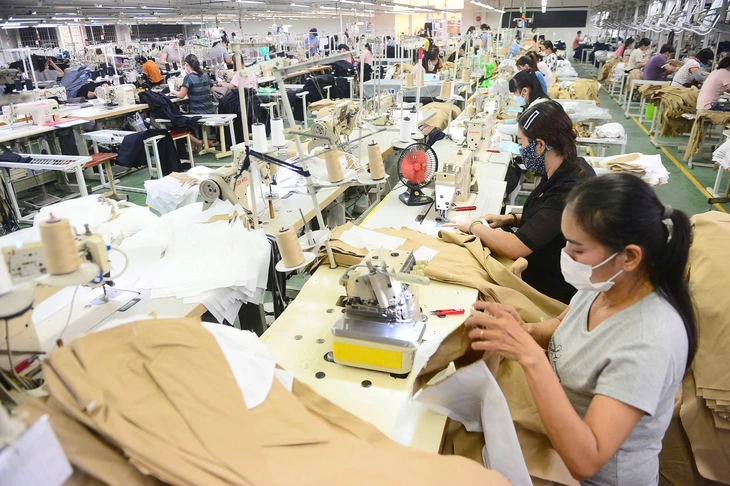
With the majority of Vietnamese textile and garment products exported to the US being American brands manufactured in Vietnam, the industry expects reciprocal tariffs to be reduced under the new agreement between Vietnam and the US. - Photo: Quang Dinh
According to the Joint Statement issued by the Ministry of Industry and Trade after Vietnam reached an agreement with the US on the framework for a reciprocal, fair, and balanced trade agreement at the ASEAN Summit 2025 currently taking place in Malaysia, many positive points in the joint statement raise expectations for Vietnamese export goods.
Continue negotiations.
A notable point in the Joint Statement is the identification of products in the category listed in Appendix 3 of Executive Order No. 14346 dated September 5, 2025. This involves: "Adjusting potential tariffs for similarly oriented partners" - to qualify for a 0% reciprocal tariff rate.
Therefore, this content will be implemented to concretize it in the Agreement on Reciprocal, Fair and Balanced Trade, along with the current policy of the US maintaining the 20% reciprocal tariff as stipulated in Executive Order No. 14257 dated May 2nd on goods originating from Vietnam, which was issued earlier.
According to Tuoi Tre newspaper, with the joint statement released, Vietnam will continue negotiations with the US on items expected to benefit from a 0% tariff. These items will be listed in Appendix 3, but the specific items will depend on the next steps in the negotiations between the two sides.
It is worth noting that not all items in this category will benefit from a 0% tax rate, but only some items.
In particular, priority should be given to reducing tariffs to 0% on goods in which Vietnam has a competitive advantage, which the US does not produce or does not need to import. For goods in which Vietnam has an advantage, such as textiles and footwear, there should even be increased imports and greater use of raw materials from the US, such as cotton for the textile industry.
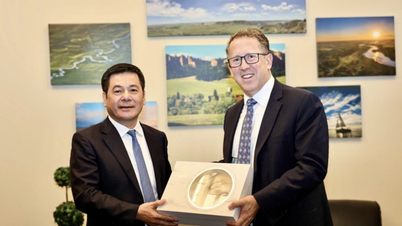
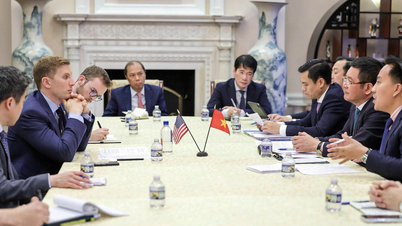
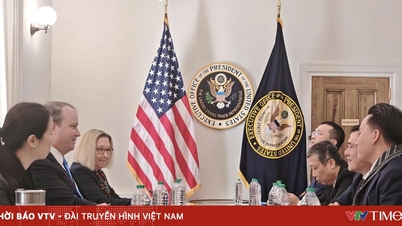
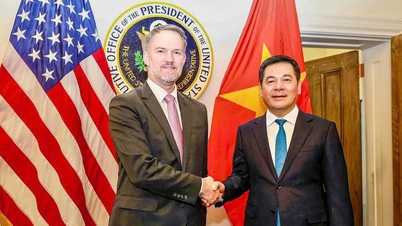
On the sidelines of the ongoing 13th ASEAN-US Summit, Minister Nguyen Hong Dien met with US Trade Representative Jamieson Greer to discuss accelerating the pace towards concluding negotiations and finalizing a reciprocal, fair, and balanced trade agreement.
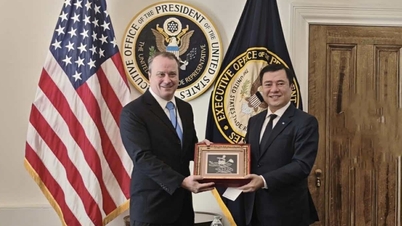
Working with US Under Secretary of State for Economic, Environmental and Energy Affairs Jacob Helberg, Mr. Dien also emphasized the spirit of unity towards completing and signing a reciprocal, fair and balanced trade agreement, as well as discussing economic and trade cooperation between Vietnam and the US, and areas with potential for promoting cooperation between the two countries.
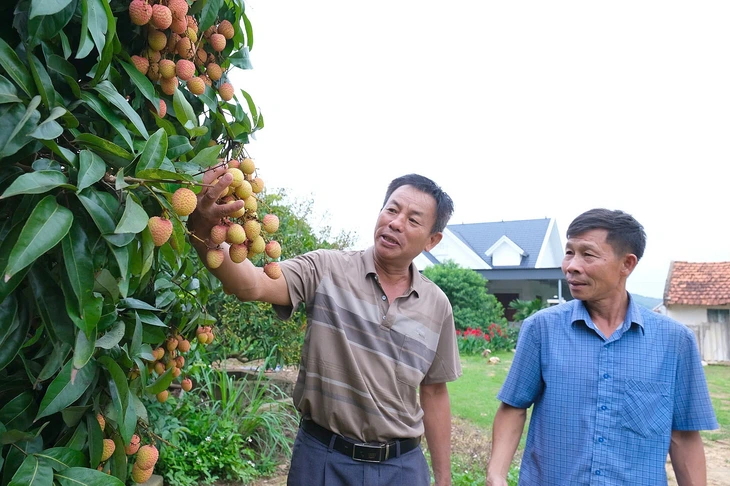
Lychee is one of many Vietnamese fruits that have been exported to the US - Photo: Ha Quan
Many key industries expect tax reductions.
Maintaining export turnover to the US at nearly $407 million in the first nine months of the year, Mr. Dang Phuc Nguyen - General Secretary of the Vietnam Fruit and Vegetable Association - believes that if agricultural products and fruits are subject to a 0% tariff, it will be a great advantage for Vietnam compared to other Southeast Asian countries like Thailand, as well as narrowing the competitive gap with South American countries.
Despite the 20% tariff, the aforementioned export value helped the fruit industry's exports to the US increase by 60%, a positive result given the overall economic difficulties. Conversely, fruit imports from the US totaled nearly $414 million, maintaining a trade deficit, although this gap has narrowed compared to previous years.
Therefore, Mr. Nguyen expects that with the cooperation agreements signed between businesses of the two countries to import fruit from the US, totaling nearly 3 billion USD as announced in the Joint Statement, Vietnamese fruit products entering the US will have the opportunity to benefit from a 0% tariff in upcoming negotiations, potentially increasing bilateral import and export turnover of fruit to 2 billion USD. This is especially true for products where Vietnam has an advantage that South American countries do not yet produce, such as durian, processed fresh coconut, passion fruit, and pomelo.
Meanwhile, Mr. Pham Xuan Hong, Chairman of the Ho Chi Minh City Textile, Garment and Embroidery Association, said that the Vietnamese textile and garment industry has many competitive advantages, being the world's second-largest exporter and ranking third in exports to the US. The US also does not manufacture textiles domestically, while many American textile brands are producing and exporting in Vietnam.
Therefore, if reciprocal tariff negotiations continue and cotton imports from the US increase, it will open up many opportunities to further reduce tariffs on Vietnamese textiles and garments entering the US to 0% as expected.
In fact, the majority of Vietnam's textile and garment exports to the US market are American brands manufactured in Vietnam, so this is a positive factor in promoting trade relations and the export of Vietnam's textile and garment industry to the US.
"This also supports American brands, as the US does not manufacture textiles and lacks the advantages of labor and cost, while Vietnam's textile industry has proven competitiveness and production capabilities. Reducing tariffs also helps support American consumers, so I hope that Vietnamese textiles will receive more attention and that the US will reduce tariffs," Mr. Hong shared.
Criteria for tax reduction
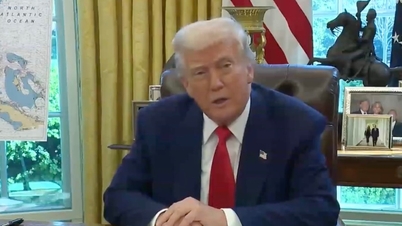
In Executive Order 14346, President Donald Trump expressed his willingness to reduce reciprocal tariffs to 0% on certain imported goods, or to modify tariffs applied under Section 232, based on a number of factors.
This includes the economic value of trade partners' commitments to the U.S. in reciprocal trade agreements, U.S. national interests, the need to address declared national emergencies, and the need to mitigate or eliminate threats to national security.
Additionally, there are products that cannot be grown, extracted, or naturally produced in the United States, or that can be grown, extracted, or naturally produced in sufficient quantities to meet domestic needs; certain agricultural products; aircraft and aircraft parts; and items not patented for use in pharmaceuticals. Accordingly, the list of goods exempt from tariffs may vary depending on agreements between the United States and its trading partners.
Source: https://tuoitre.vn/thoa-thuan-moi-ve-thue-doi-ung-mat-hang-nao-co-co-hoi-huong-thue-0-20251028073614248.htm

![[Photo] Prime Minister Pham Minh Chinh receives the Governor of Tochigi Province (Japan)](/_next/image?url=https%3A%2F%2Fvphoto.vietnam.vn%2Fthumb%2F1200x675%2Fvietnam%2Fresource%2FIMAGE%2F2025%2F12%2F16%2F1765892133176_dsc-8082-6425-jpg.webp&w=3840&q=75)
![[Live] 2025 Community Action Awards Gala](/_next/image?url=https%3A%2F%2Fvphoto.vietnam.vn%2Fthumb%2F1200x675%2Fvietnam%2Fresource%2FIMAGE%2F2025%2F12%2F16%2F1765899631650_ndo_tr_z7334013144784-9f9fe10a6d63584c85aff40f2957c250-jpg.webp&w=3840&q=75)
![[Photo] Prime Minister Pham Minh Chinh receives Lao Minister of Education and Sports Thongsalith Mangnormek](/_next/image?url=https%3A%2F%2Fvphoto.vietnam.vn%2Fthumb%2F1200x675%2Fvietnam%2Fresource%2FIMAGE%2F2025%2F12%2F16%2F1765876834721_dsc-7519-jpg.webp&w=3840&q=75)
![[Image] Leaked images ahead of the 2025 Community Action Awards gala.](/_next/image?url=https%3A%2F%2Fvphoto.vietnam.vn%2Fthumb%2F1200x675%2Fvietnam%2Fresource%2FIMAGE%2F2025%2F12%2F16%2F1765882828720_ndo_br_thiet-ke-chua-co-ten-45-png.webp&w=3840&q=75)




























































Comment (0)