

(NLĐO) – Authorities have confirmed that reports of "villas" in Ca Mau being built on rice paddy land but remaining standing for a long time are accurate.
Regarding the case of the "villa" built on rice paddy land, on January 3rd, in an exchange with reporters, a leader of the People's Committee of Tran Van Thoi district, Ca Mau province, said that Task Force 1117 had submitted a report on the inspection and review of the content related to the report by Nguoi Lao Dong Newspaper.
According to the report, the content reflected in the Nguoi Lao Dong newspaper is accurate. The decision by the People's Committee of Khanh Binh Tay commune, Tran Van Thoi district, to allow Mr. NVC (born in 1973; residing in Khanh Binh Tay commune) to build a house and structures on agricultural land is contrary to the law. The People's Committee of the commune failed to manage the situation effectively, thus not promptly detecting and handling the violation.
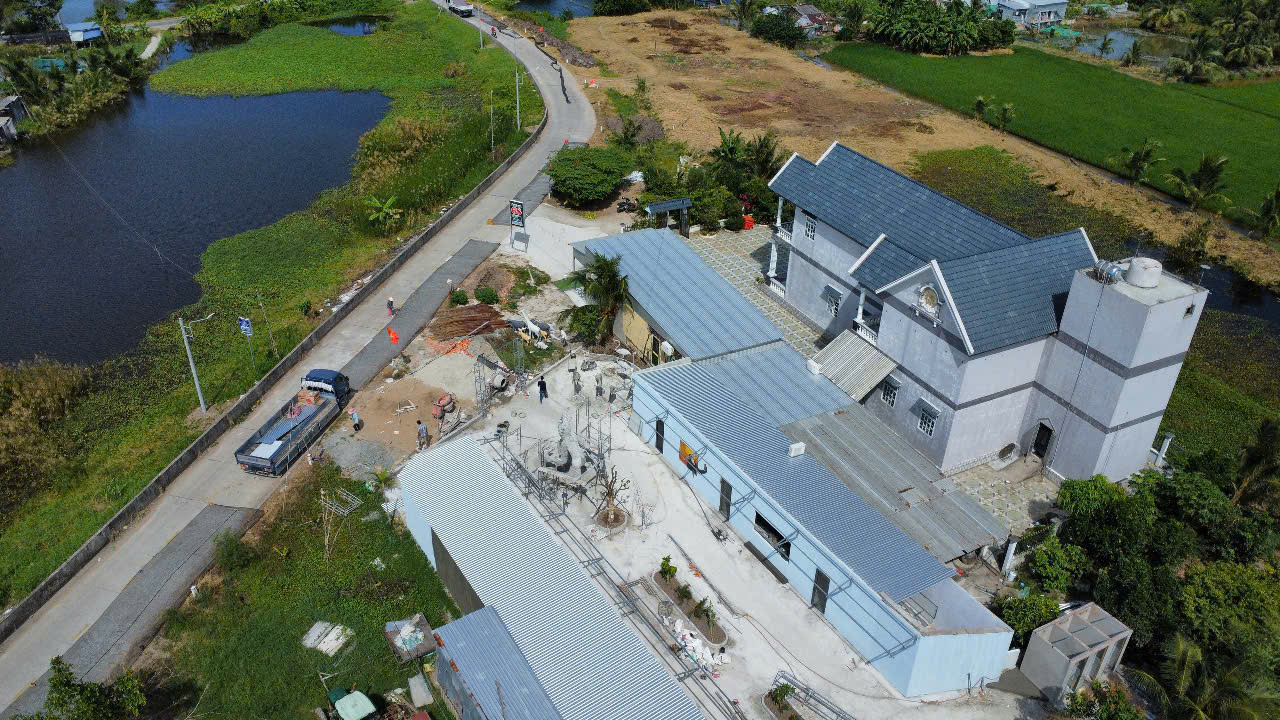
Mr. C.'s "villa" was built on rice paddy land, and another construction project is also ongoing. Photo taken on December 25, 2024.
At the same time, the task force also recommended that the Tran Van Thoi District People's Committee consider directing the Khanh Binh Tay Commune People's Committee to immediately inspect Mr. C.'s construction for commercial purposes and strictly handle the matter according to regulations. They also recommended persuading and encouraging Mr. C. to complete the procedures for changing the land use purpose for the inner portion of the land (the portion consistent with the planning) in order to relocate the house in accordance with the law…
As previously reported, many residents complained about Mr. C.'s "villa" being built on land designated for rice cultivation but remaining standing for a long time.
To clarify the information reflected by the residents, the reporter had a direct discussion with the leaders of Khanh Binh Tay Commune People's Committee. Mr. Nguyen Canh Hanh, Chairman of the Khanh Binh Tay Commune People's Committee, said that Mr. C.'s family had to relocate their house twice due to the impact of state projects. To facilitate the residents, local authorities allowed Mr. C. to build a house on land designated for rice cultivation first before proceeding with the land conversion procedures.
"Mr. C. previously submitted an application to build a house, and the authorities, assuming they could change the land use purpose, approved it. However, due to planning restrictions, Mr. C.'s land has still not been able to have its purpose changed according to regulations," Mr. Hanh explained.
The reporter also questioned whether another, rather solidly constructed building on this land belonged to Mr. C.'s relatives. "Mr. C.'s family had previously submitted a request to the local authorities to build an additional temporary structure for relatives to conduct business. The commune assigned officers to handle the request. When they noticed the family was building an 'excessive' temporary structure, the commune sent officers to remind them, and the family committed to voluntarily dismantling it when requested by the government," Mr. Hanh informed.
Source: https://nld.com.vn/thong-tin-moi-vu-biet-thu-o-ca-mau-xay-tren-dat-trong-lua-196250103121419831.htm
![[Photo] National Assembly Chairman Tran Thanh Man attends the policy seminar to promote Vietnam-Türkiye cooperation.](https://vphoto.vietnam.vn/thumb/1200x675/vietnam/resource/IMAGE/2026/04/16/1776351415367_vna-potal-chu-tich-quoc-hoi-tran-thanh-man-du-toa-dam-chinh-sach-thuc-day-hop-tac-viet-nam-tho-nhi-ky-8705791-jpg.webp)















![[Image] Bridges and roads connecting the eastern part of Ho Chi Minh City](https://vphoto.vietnam.vn/thumb/1200x675/vietnam/resource/IMAGE/2026/04/16/1776328595108_ndo_br_bh-vt5-jpg.webp)


















![[Infographic] Details of the Hanoi-Quang Ninh High-Speed Railway Project](https://vphoto.vietnam.vn/thumb/402x226/vietnam/resource/IMAGE/2026/04/16/1776338188424_anh-man-hinh-2026-04-16-luc-18-16-10.png)

![[Photo] National Assembly Chairman Tran Thanh Man meets with the Speaker of the Georgian Parliament](https://vphoto.vietnam.vn/thumb/402x226/vietnam/resource/IMAGE/2026/04/16/1776338494029_anh-man-hinh-2026-04-16-luc-18-21-21.png)










Comment (0)