

 |
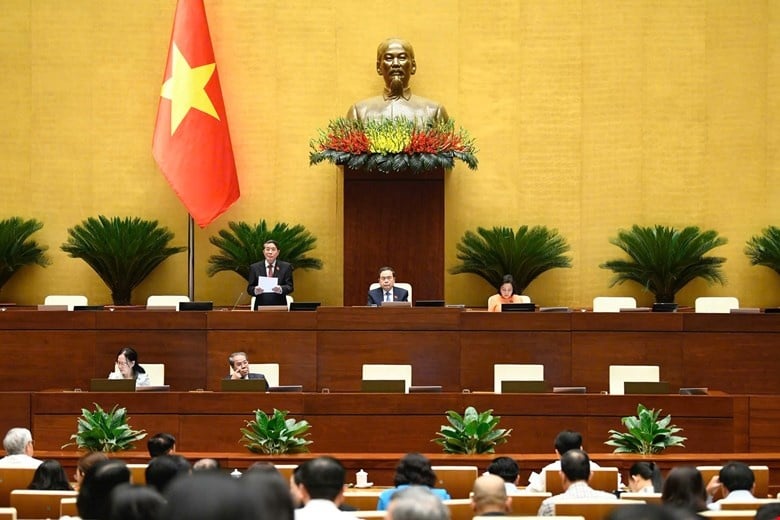
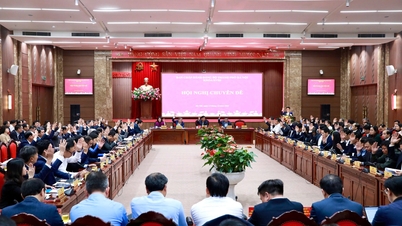
| Deputy Speaker of the National Assembly Nguyen Duc Hai presided over the session. |
Mobilizing and lending capital to increase proactiveness.
The draft Law on State Capital Management and Investment in Enterprises is being developed to institutionalize the Party's guidelines, especially the Resolution on the development of science and technology, innovation, and national digital transformation, while also addressing shortcomings in state capital management. Representative Nguyen Thi Thu Ha from Quang Ninh province stated that she supports Option 1 in Clause 3, Article 18, which allows enterprises to decide whether to lend capital to subsidiaries in which they hold more than 50% of the charter capital, with the loan amount not exceeding 50% of the equity, and the total loan amount not exceeding the actual contributed capital. She proposed adding a provision allowing enterprises to proactively decide on the source of capital and interest rates for loans, without requiring additional business lines or licenses like credit institutions, in order to utilize idle capital and support subsidiaries at a reasonable cost thanks to the parent company's good credit rating.
Representative Le Thi Thanh Lam from Hau Giang province argued that the regulation in Clause 2, Article 32, regarding salaries, remuneration, and bonuses calculated from after-tax profits, is inappropriate because these are considered reasonable expenses under the Corporate Income Tax Law. She proposed including these amounts as reasonable expenses, applicable to employees, representatives, and supervisors working directly at the enterprise, to ensure market principles, avoid burdening the budget when the enterprise incurs losses, and ensure timely payment, regardless of annual tax settlements.
Representative Nguyen Cong Van from Binh Phuoc province stated that Clause 2 of Article 29 regarding investment in subsidiaries needs to use the concept of "over 50% of equity" or "under 50% of equity" for clarity. He proposed adding a mechanism allowing businesses to use profits to invest in strategic areas, such as high technology, in order to increase long-term development resources and ensure efficient capital management.
Profit distribution and property rights protection
Representative Trinh Xuan An from Dong Nai province stated that the regulation on profit distribution after tax in Article 25 is a step forward, but the criterion of "level of completion of national tasks" in Clause 2 is unclear and unconvincing. He proposed removing this criterion, prioritizing the allocation of development investment funds before reward funds, and allowing pioneering enterprises to retain all profits to implement key projects. He also suggested using budget support and funding for science and technology development, innovation, and infrastructure, in accordance with Resolution 57-NQ/TW, to increase resources.
Representative Pham Van Hoa from Dong Thap province argued that priority should be given to establishing a development investment fund to increase charter capital as stipulated in Clause 4, Article 25, instead of submitting all profits to the state budget. He proposed allowing businesses to retain profits in special cases, such as key projects, to avoid the situation of submitting profits to the state budget and then requesting them back, thus helping businesses have the resources to implement strategic projects.
Representative Tran Van Nam from Binh Duong province supported Option 1 in Clause 1, Article 25, which allows the use of after-tax profits to cover failed investment costs, but proposed adding a mechanism to retain profits for investment in scientific and technological research projects, such as digital technology and artificial intelligence. He emphasized that this regulation needs to be clear so that businesses can proactively implement it, coupled with a strict monitoring mechanism to ensure that the profits are used for the intended purpose.
Representative Le Minh Chau from Can Tho proposed adding a regulation in Article 20 requiring a financial impact assessment before transferring state capital, with an independent appraisal report, to ensure that no capital is lost. He also suggested protecting the property rights of honest buyers in public and transparent auctions, thereby increasing transparency and the legitimate rights of all participating parties.
Source: https://thoibaonganhang.vn/toi-uu-hoa-quan-ly-va-phan-phoi-loi-nhuan-de-tang-hieu-qua-von-nha-nuoc-164087.html



















































































Comment (0)