

Currently, Ho Chi Minh City still has 3 districts/counties where the measles vaccination rate has not reached 95%: Tan Phu, District 3, and Can Gio.
On October 12, 2024, Ho Chi Minh City administered a total of 1,166 doses of measles vaccine at 139 vaccination points throughout the city . Thus, as of now, 99% of children aged 1-10 who had not received all their measles vaccine doses have been vaccinated.
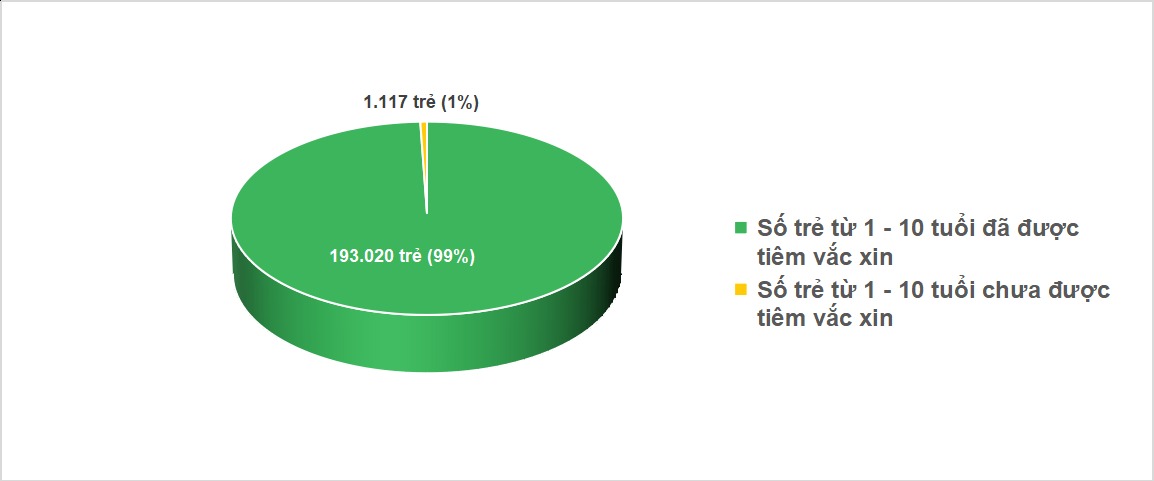 |
| Total number of measles vaccine doses administered to children aged 1-10 years (as of October 12, 2024). |
As of October 12th, the total number of measles vaccine doses administered in the city was 219,470. Of these, 45,885 doses were given to children aged 1-5 years (99.80%), and 147,135 doses were given to children aged 6-10 years (99.31%). The measles vaccination campaign achieved 99% of its planned target.
Currently, three districts have not yet reached 95% measles vaccination rate: Tan Phu, District 3, and Can Gio. The Department of Health requests that the People's Committees of these districts accelerate progress to achieve the campaign's target.
For districts that have achieved a vaccination rate of 95% or higher, it is necessary to maintain updates on the situation of mobile children to avoid missing any unvaccinated children in the area.
On October 12th, the city recorded 21 reported cases of measles-like rash (2 laboratory-confirmed measles cases, 17 clinically suspected measles cases, and 2 cases ruled out as measles), with 13 out of 22 districts and cities reporting cases of measles-like rash.
The total number of measles-like rash cases recorded to date is 1,360 (572 laboratory-confirmed measles cases, 511 clinically suspected measles cases, and 277 cases ruled out as measles). Districts with a high cumulative number of measles-like rash cases include: Binh Chanh (293 cases), Binh Tan (258 cases), and Thu Duc City (133 cases).
Health experts consider measles a global threat because the measles virus, belonging to the Paramyxoviridae family, spreads rapidly through the respiratory tract from sick people to healthy people in the community or even across borders.
Measles is dangerous because it not only causes acute symptoms but also puts patients at risk of nervous system infections, musculoskeletal disorders, multi-organ damage, and can leave many severe and long-lasting complications, even lifelong ones, such as encephalitis, meningitis, otitis media, pneumonia, diarrhea, corneal ulcers, and blindness.
In addition, measles is particularly dangerous because it can erase immune memory, destroying an average of about 40 types of antibodies that fight off pathogens.
In children, a 2019 study by geneticist Stephen Elledge at Harvard University showed that measles eliminates between 11% and 73% of protective antibodies in children.
In other words, when a person contracts measles, their immune system is destroyed and resets to its initial, immature, and underdeveloped state, like that of a newborn baby.
To minimize risks and prevent the resurgence of measles, the WHO emphasizes that vaccination is the only way to protect children and adults from this potentially dangerous disease. Countries worldwide are required to achieve and maintain a coverage rate of over 95% with two doses of the measles vaccine.
According to Dr. Bui Thi Viet Hoa from the Safpo/Potec vaccination system, children and adults should proactively get vaccinated against measles fully and on schedule to help the body produce specific antibodies against the measles virus, effectively preventing the risk of contracting measles and its severe complications, with an effectiveness rate of up to 98%.
In addition, according to Dr. Viet Hoa, everyone should proactively clean their eyes, nose, and throat with antiseptic solution daily. Limit gatherings in crowded places, avoid close contact with people showing symptoms of measles or suspected of having the disease, and do not share personal items with infected individuals. Maintain a clean living environment and supplement your diet with foods that boost the immune system.
If you experience symptoms of measles (fever, runny nose, dry cough, red eyes, sensitivity to light, rash all over the body), you should quickly go to the nearest medical center or facility for examination and timely treatment.
Source: https://baodautu.vn/tphcm-van-con-quan-huyen-chua-dat-ty-le-tiem-vac-xin-soi-d227392.html
![[Image] Vietnam's colorful journey of innovation](/_next/image?url=https%3A%2F%2Fvphoto.vietnam.vn%2Fthumb%2F1200x675%2Fvietnam%2Fresource%2FIMAGE%2F2025%2F12%2F14%2F1765703036409_image-1.jpeg&w=3840&q=75)































































![[Image] Vietnam's colorful journey of innovation](https://vphoto.vietnam.vn/thumb/402x226/vietnam/resource/IMAGE/2025/12/14/1765703036409_image-1.jpeg)



























Comment (0)