

Prolonged reverse bite can affect facial aesthetics, cause gum recession, periodontal disease, tooth wear, temporomandibular joint disorders due to restricted jaw movement, and hinder the development of the upper jaw while promoting excessive development of the lower jaw. Early detection and appropriate preventive and treatment measures are essential to limit long-term consequences.
Common causes of underbite in baby teeth
- Genetics : Genetic factors play a significant role in the formation of jaw and tooth structure. If there is a history of malocclusion in the family, the likelihood of a child developing it is higher.
- Bad habits : Bad habits such as pushing the lower jaw forward or thrusting the tongue can affect the development of the jaw and teeth, leading to an underbite.
- Respiratory and ear, nose, and throat conditions : Conditions such as chronic pharyngitis and ear, nose, and throat infections can cause children to breathe through their mouths, affecting their facial and jaw development.
- Uneven development of the upper and lower jaws : An imbalance in the development of the two jaws causes an underbite.
- Untreated tooth decay can lead to premature tooth loss and may result in an overbite.
Treatment options for reverse bite in primary teeth.
Some common treatments for underbite in primary teeth include:
- Using dental appliances such as pre-orthodontic appliances, articulators, inclined planes, etc.
- Occlusion correction.
- Treatment involves eliminating any accompanying bad habits.
Among the methods described, occlusal reshaping is one of the simpler early interventions for cases of underbite in primary teeth. This technique involves lightly grinding the enamel surface of primary teeth at points of occlusal interference, aiming to eliminate malocclusion caused by early contact. Early occlusal reshaping is primarily indicated in cases of underbite due to dental or functional factors, when the malocclusion originates from early contact of primary teeth rather than from significant skeletal misalignment.
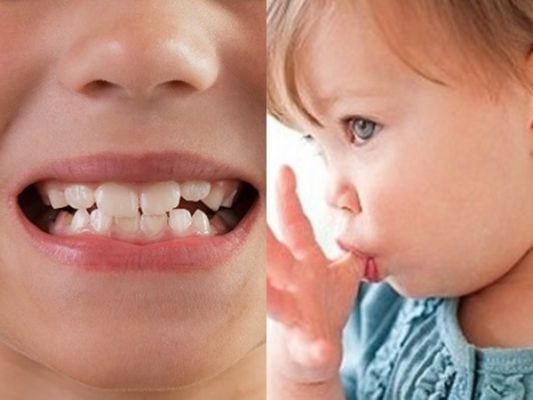
If a child is still sucking their thumb, help them break this habit before or during intervention.
In summary, the ideal indication for early occlusal reshaping is: mild underbite in primary teeth due to tooth interference, without significant skeletal deformity, and with the presence of early contact that can be eliminated by reshaping.
Alongside correcting the bite, it's necessary to eliminate risk factors/causes that contribute to the reverse bite. For example, if the child still sucks their thumb, they must be helped to break this habit before or during intervention. If airway obstruction (tonsils, adenoids) is suspected, the child needs to see a specialist for treatment. Eliminating the cause helps stabilize treatment outcomes and reduces the risk of recurrence.
After orthodontic treatment, children need follow-up appointments to assess their bite. If everything is stable, continue monitoring every 3-6 months during routine dental check-ups. If the underbite recurs (for example, when other teeth erupt or when the incisors are replaced), timely additional intervention is necessary.
If, after occlusal adjustment, the bite is still not satisfactory, or if there is suspicion of skeletal issues, additional specialized orthodontic appliances or regular monitoring of mandibular growth may be necessary to determine the next course of treatment.
Doctor's advice
- Regular check-ups help detect early abnormalities that may cause malocclusion so that they can be treated.
- Prevent tooth decay and treat cavities promptly.
- Treat respiratory illnesses and chronic pharyngitis promptly to avoid affecting maxillofacial development.
- Remind and detect and treat bad habits such as tongue thrusting and jaw protrusion early.
- Establish good eating and hygiene habits for your child: Adequate breastfeeding during the first year of life is considered beneficial for balanced jaw and facial development, while prolonged bottle-feeding may increase the risk of malocclusion. A diet that is too soft and a lack of chewing practice during the teething stage can also affect jaw development.
- In addition, parents need to teach children the habit of daily oral hygiene to protect their teeth.
Source: https://suckhoedoisong.vn/dieu-tri-som-khop-can-nguoc-rang-sua-o-tre-169251213100012591.htm
























































































Comment (0)