

Japan's English communication skills have fallen to their lowest level in more than a decade, according to a global ranking. This is raising concerns for a nation that prides itself on being an economic and educational powerhouse.
The latest report from EF Education First (Switzerland) ranks Japan 96th out of 123 countries, placing it in the lowest group – “very low” – and behind even Laos, Bhutan, Turkmenistan, and Vietnam. China ranks 86th, while the Netherlands continues to lead, followed by Croatia, Austria, and Germany.
Just 14 years ago, Japan was close to the top group. In 2011, it ranked 14th, but its ranking has declined almost every year since. Except for 2014, when it maintained its position at 26th, Japan's English proficiency has steadily declined, and this year's result is the worst ever.
The report shows that Japanese learners' reading and listening skills are much better than their speaking and writing skills – a familiar pattern that suggests they “understand but do not master” the language.
According to SCMP , the report also noted a stark disparity between urban areas – where English is more widely used – and rural areas with older populations and less exposure to foreign languages.
Notably, the group with the lowest scores was young people aged 18-25. "Although this generation is supposed to have more opportunities to be exposed to English through school and online environments, the results do not reflect that," the report noted.
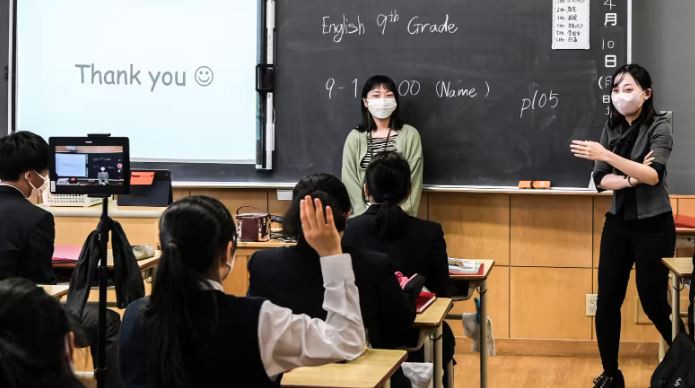
Outdated methods, overly reliant on technology.
Experts point to several reasons for the decline in Japanese English proficiency, ranging from ineffective teaching methods and outdated curricula to young people's easy reliance on translation technology.
“When I first came to Japan to teach English in 2016, English was only introduced starting in the 5th grade,” said Caitlin Puzzar, a former participant in the Japan Teaching and Exchange Program (JET). In 2019, Japan introduced the subject from the 3rd grade in preparation for the Tokyo Olympics and the anticipated surge in international visitors.
"The idea is good, but the implementation isn't right," she said.
Ms. Puzzar, who now lives in Kyoto and still works in education , said that the junior high school curriculum hadn't changed back then. "So, students were just repeating what they'd learned for the previous four years: colors, counting, and the alphabet."
Here are more reasons why Japanese people find it difficult to improve their English.
According to Ms. Puzzar, the rigid classroom culture makes learning English even more difficult. Lessons are often dry, focusing on perfect grammar and writing skills, instead of encouraging students to try, make mistakes, and correct them through speaking.
Many schools also fail to make good use of the native-speaking teachers assigned to provide support, while students are too afraid to make mistakes to speak English.
Makoto Watanabe, a professor of communication at Hokkaido Bunkyo University, argues that “one of the fundamental reasons” Japan’s decline in rankings is because Japanese people… don’t really need English.
Many Japanese businesses serve the domestic market, so they rarely require employees to use foreign languages.
" The government talks a lot about globalization and international cooperation, but English language education in schools doesn't meet the needs or interests of students," said Watanabe.
Furthermore, the popularity of tools like ChatGPT and translation apps has left young people with "no reason" to teach themselves English.
With a severe labor shortage, Watanabe says that even those with limited English skills can now easily find jobs. "More and more young people don't want to bother learning English," he observed.
Education expert Puzzar added that economic factors also play a significant role: Stagnant wages and a weak yen make it difficult for many families to afford extracurricular activities for their children, and the number of people going abroad has decreased, leading to fewer opportunities for practice.
Heated debate over how to teach English.
The EF report is generating much debate among educators and foreign teachers. One comment on Japan Today noted that even though many Japanese people have studied English for 10 years, they still struggle to have a simple conversation.
"If you attend an English class in high school, you'll find that at least 80% of the time the teacher is lecturing… in Japanese. Japanese students aren't learning English; they're just listening to the teacher talk about English in Japanese. Both the curriculum and the teaching methods need to be rebuilt from scratch," the comment read.
Another opinion is even more pessimistic: “Perhaps in just 10 years, English will become an elective subject. The reality is that the need is no longer significant – AI is increasingly becoming like a translation machine. When everything is conveniently available on phones, what reason will people have to learn it themselves?”
Source: https://vietnamnet.vn/trinh-do-tieng-anh-cua-nguoi-nhat-giam-thap-ky-luc-dung-sau-ca-lao-va-viet-nam-2471816.html




![[Image] Vietnam's colorful journey of innovation](/_next/image?url=https%3A%2F%2Fvphoto.vietnam.vn%2Fthumb%2F1200x675%2Fvietnam%2Fresource%2FIMAGE%2F2025%2F12%2F14%2F1765703036409_image-1.jpeg&w=3840&q=75)
































































![[Image] Vietnam's colorful journey of innovation](https://vphoto.vietnam.vn/thumb/402x226/vietnam/resource/IMAGE/2025/12/14/1765703036409_image-1.jpeg)





























Comment (0)