


Mr. Nguyen Do Anh Tuan - Director of the International Cooperation Department (right) and Mr. Tran Chi Hung - Vice Chairman of the People's Committee of Can Tho City (left) chaired the Conference on promoting Japanese FDI investment in the 1 million hectare high-quality, low-emission rice project. Photo: Kim Anh.
On December 12th, the Ministry of Agriculture and Environment, in collaboration with the Japanese Ministry of Agriculture, Forestry and Fisheries and the People's Committee of Can Tho City, organized a conference to promote Japanese FDI investment in the project "Sustainable development of 1 million hectares of high-quality, low-emission rice cultivation associated with green growth in the Mekong Delta by 2030".
This is an opportunity for Japanese businesses to directly listen to the concerns and needs of Vietnamese stakeholders, aiming to strongly promote investment, technology, and trade cooperation between the two countries in developing a 1 million-hectare high-quality, low-emission rice production area in the Mekong Delta.
Some key investment promotion initiatives outlined by the International Cooperation Department (Ministry of Agriculture and Environment) include strengthening the participation of Japanese businesses, investors, and science and technology organizations in production, processing, trade, mechanization, and the carbon credit market in Vietnam.
Simultaneously, the two countries will connect businesses in the application of AI and Big Data technologies; MRV systems; smart sensor-based land, water, and air pollution management; circular economy development, byproduct processing, and greenhouse gas emission reduction in rice production; and strengthen cooperation in training, developing rice cooperatives, and human resources.

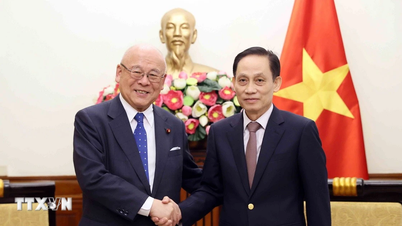
Mr. Nguyen Do Anh Tuan, Director of the International Cooperation Department, affirmed that Japan is a comprehensive strategic partner, effectively accompanying Vietnam in the green agricultural transformation. Photo: Kim Anh.
Mr. Nguyen Do Anh Tuan, Director of the International Cooperation Department, affirmed that the Project for 1 million hectares of high-quality, low-emission rice is a pioneering program of Vietnam in the world, aiming to enhance the value of the rice industry, build a brand of green, clean, and globally competitive rice. At the same time, it contributes to Vietnam's goal of achieving net emissions of "zero" by 2050.
Identifying Japan as a comprehensive strategic partner and an effective companion to Vietnam in green agricultural transformation, Mr. Tuan believes that, with Japan's technological potential combined with Vietnam's determination to green transform, the two sides will be able to build exemplary cooperation models, making practical contributions to the goals of emission reduction, green growth, and integration into the global carbon market.
Japan is currently Vietnam's largest ODA donor, third-largest investor, and a key trading partner. In the agricultural sector, the ministerial-level dialogue mechanism within the framework of the "Vietnam-Japan Medium and Long-Term Vision for Agricultural Cooperation" has become an important platform for promoting bilateral cooperation.

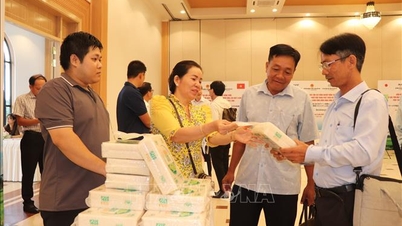
Vietnamese businesses are hoping to receive technological cooperation and partnership from Japan. Photo: Kim Anh.
An Giang province leads the Mekong Delta region in rice production area, with over 1.3 million hectares per year. Mr. Tran Thanh Hiep, Deputy Director of the Department of Agriculture and Environment of An Giang province, stated that the province currently has 964 agricultural drones, basically meeting production needs. However, sowing technology is still lacking and does not meet the requirements for implementing the project to cultivate 1 million hectares of high-quality, low-emission rice.
In addition, the province's annual rice production generates approximately 10 million tons of straw and 2 million tons of rice husk, becoming a "bottleneck" in collection and processing.
Based on this reality, Mr. Hiep hopes that Japanese partners will consider investing in three key areas for An Giang province: sowing technology, straw processing, and rice procurement with reduced emissions.
“Vietnam is accelerating the certification of low-emission green rice. I hope that Japan will invest in purchasing low-emission rice from the project, thereby promoting the project's implementation and benefiting both sides,” the Deputy Director of the Association expressed.
Trung An High-Tech Agriculture Joint Stock Company has collaborated with MURASE Group (Japan) to successfully export 500 tons of reduced-emission rice to the Japanese market.
Mr. Pham Thai Binh, Chairman of the Board and Deputy General Director of Trung An Company, said that a 1 million-hectare area of high-quality, low-emission rice is currently being established. Farmers and businesses, with the support of specialized agencies, have implemented rice cultivation processes that reduce emissions quite well. However, the stages in the process still require investment in machinery and equipment.

Mr. Pham Thai Binh - Chairman of the Board of Directors and Deputy General Director of Trung An Company - proposed a collaboration with a Japanese partner to improve the technology of machinery for processing rice straw. Photo: Kim Anh.
Mr. Binh cited the example that currently, the process of removing straw from the fields is a major concern for local authorities, businesses, and farmers, due to the numerous steps involved and the resulting high costs.
Mr. Binh suggested that Vietnam and Japan could research cooperation in improving rice harvesting machines in the following way: the rice is put into a separate container, the straw is chopped and put into another container for transport to the drying plant, helping to reduce emissions and save costs. This would be especially helpful during the rainy season, avoiding difficulties in collecting the straw.
In addition, Mr. Binh highly appreciated Japan's advanced processing technology and expressed his desire for the two sides to cooperate in building a factory to produce rice-based products, taking advantage of Vietnam's market and Japan's technology and quality standards.
Source: https://nongnghiepmoitruong.vn/thuc-day-dau-tu-nhat-ban-cho-chuoi-lua-gao-giam-phat-thai-tai-dbscl-d789007.html



























































Comment (0)