

According to experts, the Chinese government may use the tensions in the South China Sea to gauge the US response to Washington's allies.
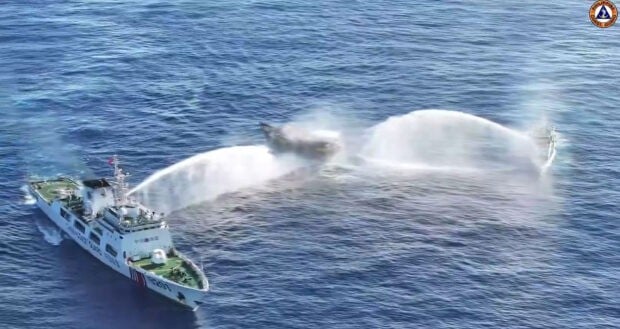 |
| One of the recent "clashes" between Chinese and Philippine ships in the South China Sea. (Source: Reuters) |
Tensions in the South China Sea have escalated following numerous confrontations between Chinese and Philippine vessels along this vital shipping lane in recent months.
According to experts, the Chinese government may use the tensions in the South China Sea to gauge the US response to Washington's allies as the administration intensifies military activity along this route, which is crucial to the global economy.
June Teufel Dreyer, an expert on US-China relations and a professor of political science at the University of Miami, noted that the Chinese government has long sought to exert pressure on the Philippines. Speaking to The Epoch Times on June 22, Dreyer stated, "China has been putting pressure on the Philippines for a long time."
Former Philippine President Rodrigo Roa Duterte pursued a pro-China policy and shifted his stance toward the US quite a few times, leading to a deterioration in relations between the Philippines and the US. But that changed in 2022 when Ferdinand Marcos Jr. took office as President.
Although Marcos wanted to change his predecessor's policies, Teufel Dreyer warned that he had few resources to do so. Teufel Dreyer said: "Marcos really wanted to. But he had very few means to do it. And he wasn't sure how much he could trust the U.S., because the U.S. was involved, albeit unofficially, in the conflict in Ukraine as well as another Israeli war against Hamas."
Meanwhile, Srikanth Kondapalli, Head of the Department of International Studies and Professor of China Studies at Jawaharlal Nehru University in New Delhi, India, described China's strategy as "two-pronged." On the one hand, Beijing exerts pressure "through military exercises abroad." On the other hand, Beijing seeks to exert pressure through "influence operations" within other countries.
Source: https://baoquocte.vn/trung-quoc-tham-do-phan-ung-cua-my-voi-cac-dong-minh-o-bien-dong-276970.html

















![[Photo] Prime Minister Pham Minh Chinh presides over the conference announcing the establishment of the International Finance Centre in Vietnam.](/_next/image?url=https%3A%2F%2Fvphoto.vietnam.vn%2Fthumb%2F1200x675%2Fvietnam%2Fresource%2FIMAGE%2F2025%2F12%2F21%2F1766309817714_ndo_br_dsc-3400-jpg.webp&w=3840&q=75)












































Comment (0)