


Associate Professor Bui Hoai Son, Member of Parliament and Standing Member of the National Assembly's Committee on Culture and Education , spoke with a reporter from Dan Tri newspaper about the Politburo and the Secretariat's request to study the direction of merging several provinces, which is receiving great public attention.
Why is it so well-received by the public?
The Politburo and Secretariat's request to study the merger of several provincial-level administrative units has received considerable public attention in recent days. Could you explain the main reasons for this public support?
- I believe there are several important reasons. One of the main reasons is the need to improve the effectiveness and efficiency of the administrative apparatus. Streamlining administrative units helps reduce intermediate layers, thereby minimizing overlap and bureaucracy, and increasing the speed of work processing. This, in turn, serves citizens and businesses more quickly and efficiently.
When the system operates smoothly, eliminating unnecessary intermediaries, resources will be allocated more rationally, creating momentum for socio-economic development.
Another important reason for public support is the desire to save budget and focus investment on essential areas. When administrative units are merged, the cumbersome apparatus is streamlined, meaning reduced operating costs, fewer administrative agencies, and fewer personnel, thereby saving a significant portion of the state budget.
This budget could be reinvested in crucial areas such as healthcare, education, infrastructure, and social welfare, contributing to improving the quality of life for the people.

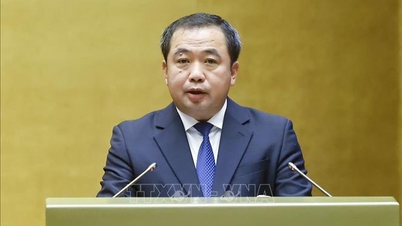
National Assembly representative Bui Hoai Son (Photo: Pham Thang).
Another factor contributing to public support is the expectation of sustainable, integrated, and long-term planning and development of localities. Currently, some provinces and cities have small populations and limited resources, making it difficult for them to develop strongly in the context of competition and integration.
When localities are merged in a rational manner, they can maximize their geographical advantages, resources, and infrastructure, thereby forming large economic and cultural centers with a stronger ripple effect in the region and the country.
Public interest and support stem from the fact that this is a major, strategic decision, reflecting innovation in national governance thinking. The reorganization of administrative units is not simply a change in geographical boundaries, but a profound reform of the organizational structure, management methods, and operation of the administration, aiming for greater professionalism, efficiency, and modernity.
This is entirely consistent with global trends, as many countries have also implemented similar administrative reforms to enhance governance efficiency.
With such clear benefits, the public's interest and support for this policy is entirely understandable.
However, for the merger to be most effective, thorough research, a reasonable implementation roadmap, and especially listening to the opinions of local authorities, experts, and the people are necessary to ensure high consensus throughout society.

Bac Ninh is the smallest province in Vietnam in terms of area, with 822.70 km2; its population is nearly 1.5 million people, ranking 22nd in Vietnam's population ranking (Photo: Bac Ninh Newspaper).
According to him, what specific criteria and conditions should be considered when studying the merger of provinces? What practical experiences from the past when merging administrative units at the district and commune levels should be applied?
- The study of merging provinces needs to be based on specific criteria and conditions to ensure effectiveness, rationality, and practicality. First and foremost, I believe that the most important factors are population size and natural area. A province with too small a population or area may face many limitations in socio-economic development, while a province that is too large may create difficulties in management.
Therefore, it is necessary to calculate a reasonable scale, ensuring a balance between population, area, and administrative capacity.
The provinces to be merged need to have similarities or complementarities in economic structure, level of development, and per capita income to avoid excessive disparities that could hinder management and resource allocation.
If one province has a strong economy while the other faces many difficulties, the merger needs a clear roadmap to ensure harmony and avoid creating policy inconsistencies and development opportunities.
Furthermore, cultural, historical, and social factors are extremely important. Mergers need to consider similarities in cultural traditions, customs, and regional identities to ensure cohesion within the community and avoid differences that could lead to difficulties in management and administration. If the two provinces have significant cultural and social differences, the integration process may encounter obstacles, affecting long-term stability and development.
Geographical factors and transportation infrastructure also need to be carefully considered. The merged provinces should have convenient transportation connections and not be fragmented by overly complex terrain such as mountains and rivers, or by excessively long distances, to ensure smooth management and operation. At the same time, the merger must also take into account the potential for developing new urban systems and administrative centers that are rational and convenient for citizens and businesses.
The merger research process should draw on practical experience gained from merging district and commune-level administrative units. In reality, some localities have successfully implemented mergers, yielding positive results in management, budget savings, and improved public service quality. However, some areas face difficulties due to disparities in development levels, cultural differences, or issues in identifying the new administrative center.
These lessons are crucial in helping us develop a well-structured provincial merger plan and avoid unnecessary mistakes.
Pilot program first, then scale up; 45-50 provinces and cities is appropriate.
A survey by Dan Tri Newspaper shows that many provinces and cities nationwide currently do not meet the criteria regarding population, natural area, and district-level administrative units as stipulated in Resolution No. 1211/2016 and Resolution No. 27/2022 of the National Assembly Standing Committee on the standards of administrative units and classification of administrative units. According to you, should these localities be considered for immediate merger?
- The fact that many provinces and cities do not meet the criteria regarding population, natural area, and district-level administrative units is a matter of concern. This necessitates careful consideration and evaluation to develop a reasonable merger roadmap.
I believe that localities with very small populations or very limited land area should be prioritized for mergers. This would not only improve administrative efficiency but also provide these localities with additional resources for development, avoiding a cumbersome bureaucracy with low operational efficiency.
When a province has a small population, limited budget revenue, and difficulty attracting investment, maintaining a separate administrative apparatus would be a waste of resources. Therefore, merging with neighboring provinces with similar conditions would optimize the administrative system, save budget, and enhance competitiveness.

With a population of 0.32 million, a natural area of 4,859.96 km2, and only 8 district-level administrative units, Bac Kan province does not meet all three standards for a provincial-level administrative unit as stipulated in the National Assembly's resolution (Source: BacKan.gov.vn).
In addition, localities with too few district-level administrative units should also be considered for merger to ensure a rational organizational model. A province with too few districts may face difficulties in maintaining and developing planning policies, socio-economic infrastructure, and in maximizing the advantages of the region.
However, mergers cannot be based solely on rigid criteria of population and area, but must take into account other practical factors such as cultural and historical similarities, socio-economic development conditions, and transportation infrastructure connectivity. Provinces with significant differences in these factors need to be carefully considered before being included in the merger plan.
The merger review process also requires broad consultation with government officials at all levels, experts, and especially the public. Ultimately, the goal of the merger is to improve governance and better serve the people, so social consensus is a key factor.
In 1976, the country had only 38 provinces and cities. After numerous mergers and divisions, from 2008 to the present, Vietnam has 63 provinces and cities. In your opinion, approximately how many provinces and cities would be appropriate for our country?
- The number of provinces and cities should be determined based on scientific and practical criteria, rather than simply a fixed number. However, considering population size, area, management capacity, and socio-economic development, I think Vietnam could reduce the number to around 45-50 provinces and cities for sustainable development.
Maintaining 63 provinces and cities with a cumbersome administrative apparatus is creating significant pressure on budgets, staffing, and operational efficiency. Meanwhile, many provinces have small populations, limited land areas, and restricted economic capacity, leading to a dispersion of resources and difficulty in leveraging their advantages.
If the mergers are carried out properly, larger provinces will be better positioned to develop stronger development strategies, attract more investment, and improve the quality of state management.
If we reduce the number of provinces but improve the quality of governance, strongly apply digital technology, and reform administrative procedures, the state apparatus will operate more efficiently.
The models of some countries with similar conditions to Vietnam could serve as valuable lessons for us. For example, South Korea, with a population of over 50 million, has only 17 provinces/cities, while China, with nearly 1.4 billion people, has only 34 provincial-level administrative units. Compared to these countries, Vietnam's 63 provinces and cities are relatively large, leading to a dispersion of resources and difficulties in macro-management.
Therefore, I believe that a figure of around 45-50 provinces and cities is reasonable. The merger process needs to be carried out scientifically, with a clear roadmap. Most importantly, there must be consensus from the people, so that the merger is not just an administrative decision, but truly brings long-term benefits to the country.
The merger of provinces is expected to open up more development opportunities for localities. What is the appropriate roadmap for this, especially with the upcoming national party congresses at all levels?
- Clearly, the roadmap for merging provinces needs careful consideration to ensure stability, consensus, and to avoid disrupting local economic and social development activities, especially as we approach the Party Congress at all levels.
First of all, I believe this process needs to be carried out in specific stages, with cautious steps, and without rushing.
The merger should be implemented on a "pilot first, then scale up" principle. Some smaller provinces with more favorable merger conditions could be selected as pilot models to gain experience and adjust policies before widespread implementation. During this time, local authorities need to stabilize their organizational structure, clearly define personnel plans, functions, and responsibilities, and avoid major disruptions during operation.
Furthermore, I believe that the merger of provinces cannot be separated from the process of preparing for the Party Congress at all levels. Therefore, the roadmap needs to be designed to align with this important political cycle.
For now, the focus could be on completing the research, developing the proposal, and gathering broad public opinion this year. If consensus is reached, the merger could begin after the Party Congress, when the new leadership has been established and there has been sufficient time to implement the next steps.
Mergers are not just changes in administrative boundaries; they also affect a range of issues related to state management, budgets, infrastructure, and people's lives. Therefore, support mechanisms and specific policies are needed to help localities quickly stabilize after mergers, leverage their advantages, and avoid disruptions in development.
If done well, this will be a great opportunity for our country to optimize its administrative apparatus, improve governance efficiency, and create a more robust development space for localities.
Thank you, sir!
National Assembly representative: Maintaining only 40 provinces and cities is appropriate.
National Assembly representative Pham Van Hoa (Dong Thap) said that the issue of merging provinces with small populations and areas had been raised in the National Assembly 5-6 years ago. With a population of over 100 million people and 63 provinces and cities, according to Mr. Hoa, that is too many.
"China, with a population of over 1.4 billion, only has 34 provincial-level administrative units (including 23 provinces, 5 autonomous regions, 4 centrally-administered cities, and 2 special administrative regions). Vietnam has repeatedly separated and merged provinces for development, but I believe this is still not thorough," Mr. Hoa said, suggesting that maintaining around 40 provincial-level administrative units might be appropriate.
The transportation infrastructure is developing rapidly, and communication is also complete and smooth, thus ensuring effective management of a large area with a large population.
Besides population size and natural area, Mr. Hoa believes that criteria related to culture, history, national security and defense, protection of sovereignty, geopolitical position, and the culture of the local community should be considered when merging provinces to ensure stability for socio-economic development.
Dantri.com.vn
Source: https://dantri.com.vn/xa-hoi/viet-nam-chi-nen-duy-tri-45-50-tinh-thanh-20250224220741967.htm




























































































Comment (0)