Ensuring the safety of tourists.
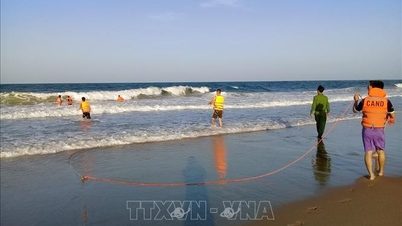
Amidst the vast ocean waves, suddenly an arm was raised, waving, accompanied by desperate cries for help. Without hesitation, two rescuers leaped into the water, cutting through the waves, while another used a speedboat to reach the drowning victim struggling frantically. Less than four minutes later, the victim was safely brought ashore by speedboat. This is just one example of the situations that can occur at sea, requiring coast guard rescue forces to quickly brave the waves to save lives.
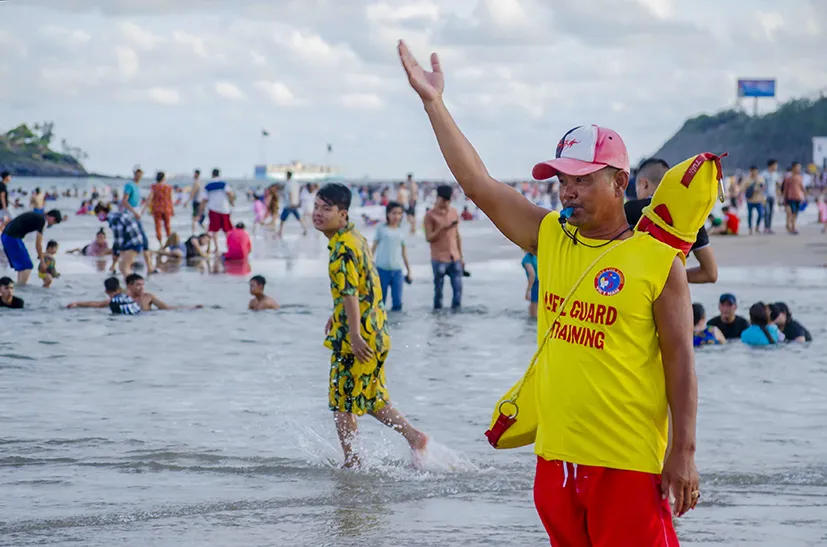
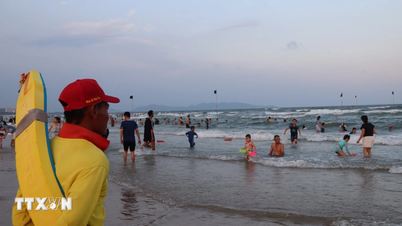
Lifeguards are stationed at the beach to ensure the safety of locals and tourists while swimming. Photo: QUANG VU
According to Le Hoang Thanh (44 years old), a lifeguard in Vung Tau, the work of a coastal lifeguard begins at 6 a.m. They have to swim out to sea to plant black flags in areas with rip currents or dangerous zones, then return to shore to watch over beachgoers. It's easier on normal days, but during holidays and festivals when tourists flock in, lifeguards have to be extremely vigilant because even a moment of carelessness or inattention can affect the lives of one or more people.
In over 20 years of his career, Le Hoang Thanh has saved countless people in distress. Whenever he hears cries for help or sees someone struggling in the water, he rushes out to sea. According to Thanh, on Vung Tau beach, life and death can happen in an instant, yet many people ignore the warnings and swim into rip currents or climb on the black flags. "The places where the flags are planted are rip currents; when they are destroyed, they inadvertently create traps that cause accidents for those who come after," Thanh said.
Submerged in the water, his face tanned, Mr. Tran Huu Bao Luyen (60 years old) blew his whistle and gestured to beachgoers to move closer to the shore, avoiding the deep, dangerous areas. Seeing a group of people, including children, heading into the sea, Mr. Luyen cautioned: “You should swim in the shallow areas, away from the black flags, because there are whirlpools there, which are very dangerous. Especially, please keep a close eye on these children.”
Having worked as a beach lifeguard for 40 years, Mr. Luyen is intimately familiar with the ebb and flow of the tides, knowing where the water is shallow and deep, where there are whirlpools, and where there are strong currents. He has also saved countless people from drowning. "Every time I save a customer from danger, I feel very happy and love my job even more because I see that what I do is truly meaningful," Mr. Luyen shared.
Currently, the Vung Tau coastal rescue force consists of 70 people, including lifeguards and medical personnel. This force is on constant duty at sea from Nghinh Phong Cape to the border of Paradise Beach, with an average of one lifeguard every 200-300 meters. In addition to announcements via loudspeakers, lifeguards also directly remind swimmers not to go to areas marked with black flags, and not to swim too early (before 6 am) or too late (after 6 pm).
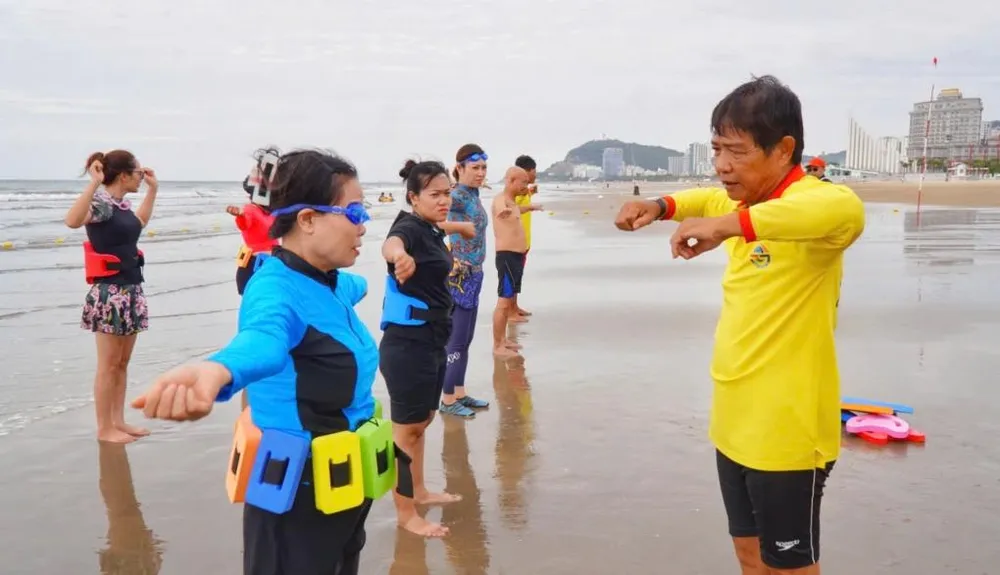
Coast guard officers instruct locals and tourists on proper swimming techniques at Bai Sau beach. Photo: QUANG VU
According to statistics from Vung Tau ward, in just the first 10 months of 2025, Vung Tau beach welcomed and served more than 3 million beachgoers. During that time, the coastal rescue force saved 28 people from the brink of death at sea.
Develop a steely mind.
According to Mr. Nguyen Khac To, Director of the Vung Tau Culture - Sports - Tourism Center, Bai Sau beach is wide but turbulent. During the monsoon season from November to April, strong currents and winds from offshore create large waves that continuously crash against the shore, gathering into currents that flow back out to sea. Where these currents and whirlpools are present, the water is calm, with almost no waves, and they will sweep away anything that falls into them. Therefore, if tourists get caught in these whirlpools without timely rescue, it will be very dangerous.
The work of rescuers is arduous, dangerous, and demands high levels of physical strength and courage, as well as the ability to withstand harsh weather and the unforgiving conditions of the open sea. During the summer months, the sun and saltwater cause skin burns and blisters. In the rainy season, the water is cold and the strong winds are biting. “They have to stand for hours, intently watching the sea, and they need nerves of steel when they rush out to sea to rescue people in the swirling currents of the ocean – where their own lives could be threatened if they didn’t have exceptional skills and unwavering determination,” said Mr. Pham Khac To.
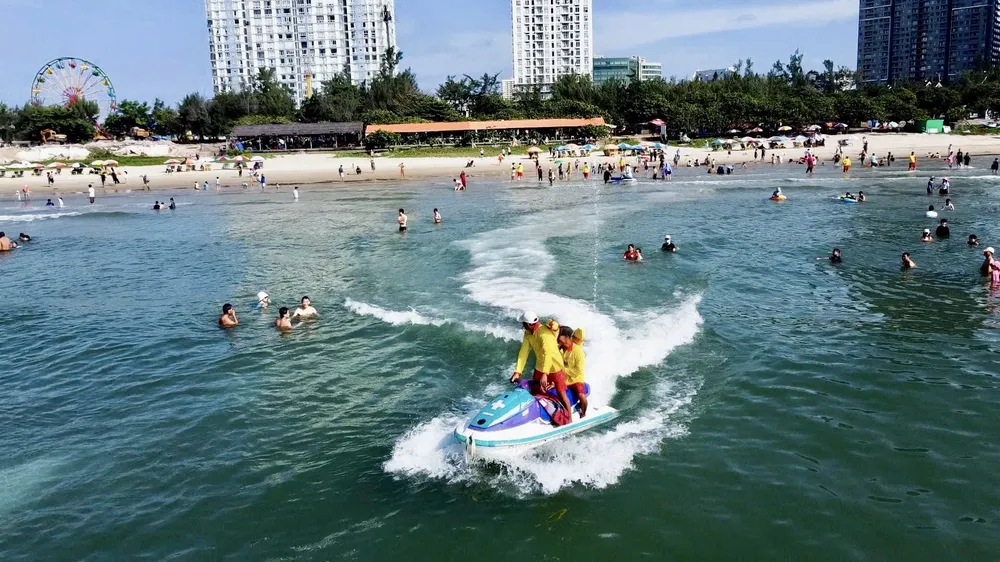
The job of a beach lifeguard requires skill and a steely resolve. In the photo: Beach lifeguards use canoes to remind and protect tourists while swimming in the sea. Photo: NGOC GIANG
Therefore, during the off-peak tourist season, all rescue personnel must participate in a rigorous 6-week training course to become elite sea rescuers.
During this training course, rescuers undergo daily physical training with comprehensive exercises; running distances from 1,000m to 3,000m; rescue swimming exercises (50m speed) using bare feet to pull the victim; rescue swimming (100m) using fins; swimming tests in distances from 200m to 3,000m; and a final exam in a 2,000m swim at sea; they also receive basic to advanced rescue training; and practice using support equipment such as jet skis and kayaks.
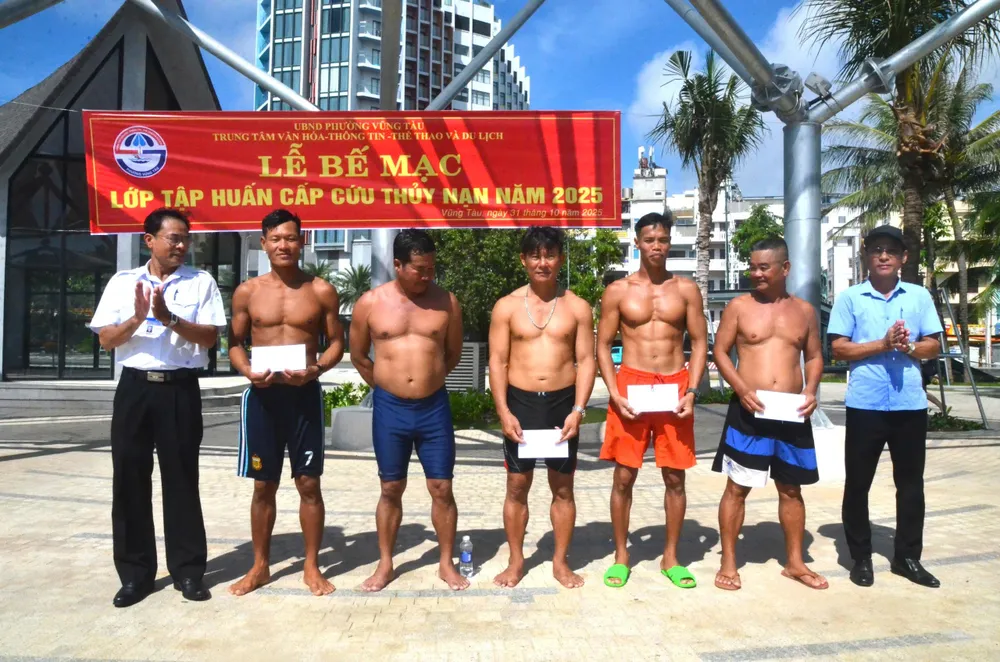
Rescuers were awarded prizes for swimming 2,000m at the closing ceremony of the 2025 water rescue training course at Bai Sau beach (Vung Tau ward, Ho Chi Minh City) on the morning of October 31. Photo: QUANG VU
In particular, the training course dedicated a significant amount of time to practical rescue techniques, including approaching victims at sea, pulling victims out of the water, carrying them out of the water, providing initial first aid, artificial respiration, chest compressions, checking pulse, etc.
Through training, rescue forces improve their physical fitness and enhance their professional skills in swimming and rescuing victims at sea, in on-site resuscitation, and especially in fostering enthusiasm, dedication to their profession, and commitment to maritime rescue (saving lives, humanitarian work).
QUANG VU
Source: https://www.sggp.org.vn/vuot-song-cuu-nguoi-post821006.html


![[Photo] General Secretary and President To Lam works with the Party Committee of the Ministry of Health on the work of Vietnamese traditional medicine.](https://vphoto.vietnam.vn/thumb/1200x675/vietnam/resource/IMAGE/2026/05/20/1779294323718_a1-bnd-2978-3319-jpg.webp)
![[Image] "Journey of Hope" promotes the organ and tissue donation movement in Vietnam.](https://vphoto.vietnam.vn/thumb/1200x675/vietnam/resource/IMAGE/2026/05/20/1779294400833_1-8910-jpg.webp)
![[Photo] National Assembly Chairman Tran Thanh Man working with the Standing Committee of the National Assembly's Delegation Affairs Committee.](https://vphoto.vietnam.vn/thumb/1200x675/vietnam/resource/IMAGE/2026/05/20/1779294340023_ndo_br_1-1691-jpg.webp)












































































Comment (0)