

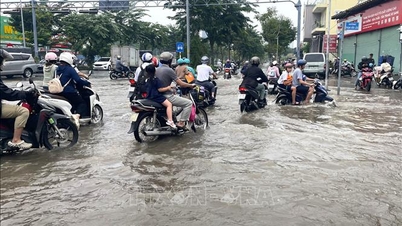
The Southern Vietnam Regional Hydrometeorological Station reported that on January 20th, the highest daily water levels at stations on rivers and canals in Ho Chi Minh City rose rapidly until mid-week, except at Nha Be station where the highest level appeared at the beginning of the week. The forecast indicates the highest tide peak will be approximately 0.05m below or at or below alarm level 3. High tides during the dry season are often accompanied by saltwater intrusion.
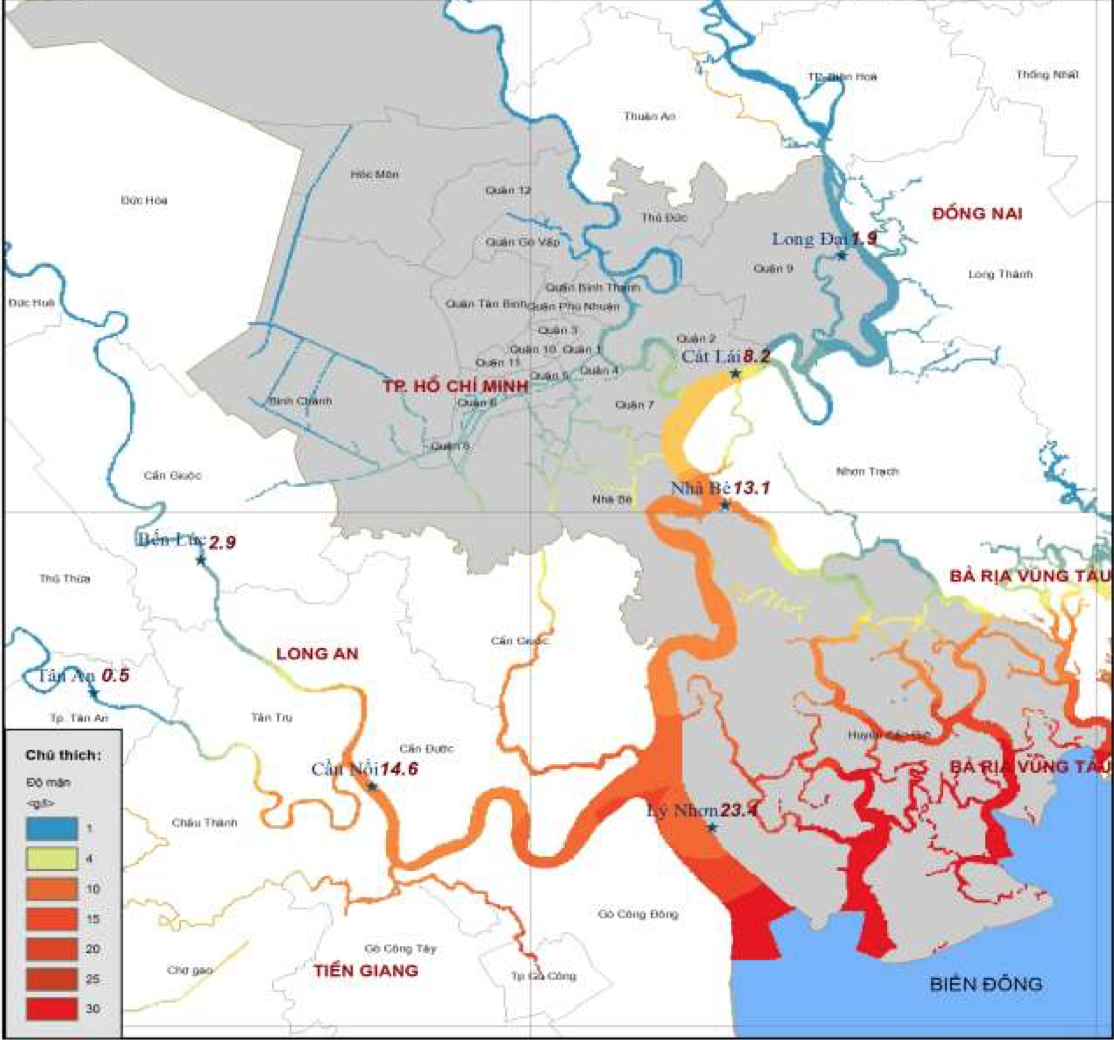
The development of saltwater intrusion in the estuaries of the southeastern region of Vietnam.
Southern Region Meteorological and Hydrological Station
Currently, it is the dry season, and the amount of water flowing from the upstream rivers is low, so seawater is entering deep inland through the river mouths, causing saltwater intrusion.
The highest salinity levels at most stations occurred in the middle of the week, except for Nha Be station where it occurred at the beginning of the week ; these levels were higher than the same period in 2023 and the multi-year average. The 4% salinity boundary penetrated furthest inland on the Saigon River, approximately 65-70 km. Next week, on the Saigon River, the 4% salinity boundary will penetrate approximately 68-73 km.
"The risk of natural disasters due to saltwater intrusion in rivers in the Ho Chi Minh City area is at level 3. Saltwater intrusion penetrates deep into rivers, canals, and streams in the Ho Chi Minh City area, affecting the lives, livelihoods, and production of people," the bulletin warned about the impact of saltwater intrusion.
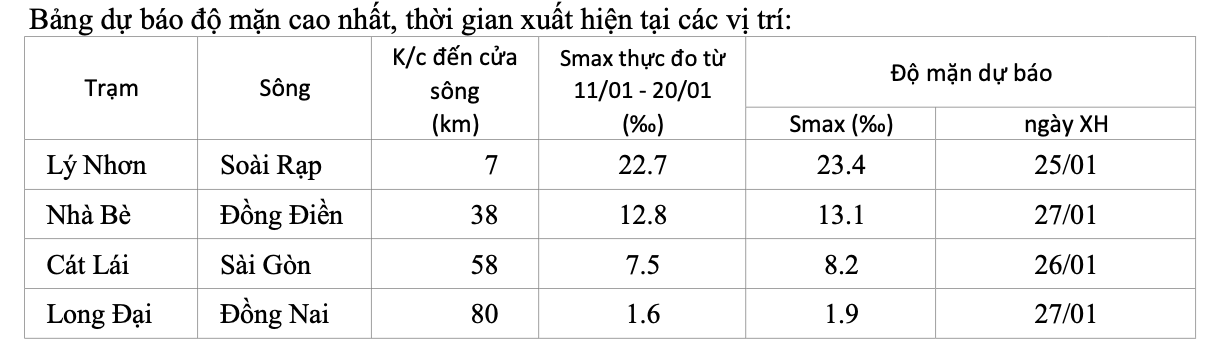
Forecast of saltwater intrusion in Ho Chi Minh City.
Southern Region Meteorological and Hydrological Station
According to Ms. Le Thi Xuan Lan, a hydrometeorology expert: This year, saltwater intrusion has arrived early and is increasing rapidly due to the upcoming high tide in early December. In addition, strong northeast monsoon winds over the East Sea are pushing seawater further inland into the rivers. Currently, areas such as Can Gio, Nha Be, and Cat Lai are affected. The impact is likely to be more severe during upcoming high tides. By early February (lunar calendar), saltwater intrusion could affect the Thu Duc water treatment plant area.
Regarding the activity of the northeast monsoon, the Southern Region Meteorological and Hydrological Station stated: In the sea area from Ba Ria - Vung Tau to Ca Mau , the northeast monsoon will gradually increase in intensity to level 5-6, gusting to level 6, sometimes level 7; sea waves will be 1.5 - 2.2m high; the sea will be slightly rough to rough. The risk of natural disaster is at level 2.
Source link

![[Image] Pleasant weather helps students enter the 10th grade entrance exam with confidence.](https://vphoto.vietnam.vn/thumb/1200x675/vietnam/resource/IMAGE/2026/05/29/1780034401612_ngay-1-thi-lop-10-minh-duy-8-5009-jpg.webp)


![[Photo] Ba Lang An Lighthouse - the "eye of the sea" amidst the "rock museum" of Quang Ngai province.](https://vphoto.vietnam.vn/thumb/1200x675/vietnam/resource/IMAGE/2026/05/29/1780038698840_anh-man-hinh-2026-05-29-luc-14-10-42.png)

























![[Photo] Admire the coral "masterpiece" amidst the million-year-old heritage of Dak Lak province.](https://vphoto.vietnam.vn/thumb/1200x675/vietnam/resource/IMAGE/2026/05/30/1780107638639_y25-jpg.webp)




































































Comment (0)