

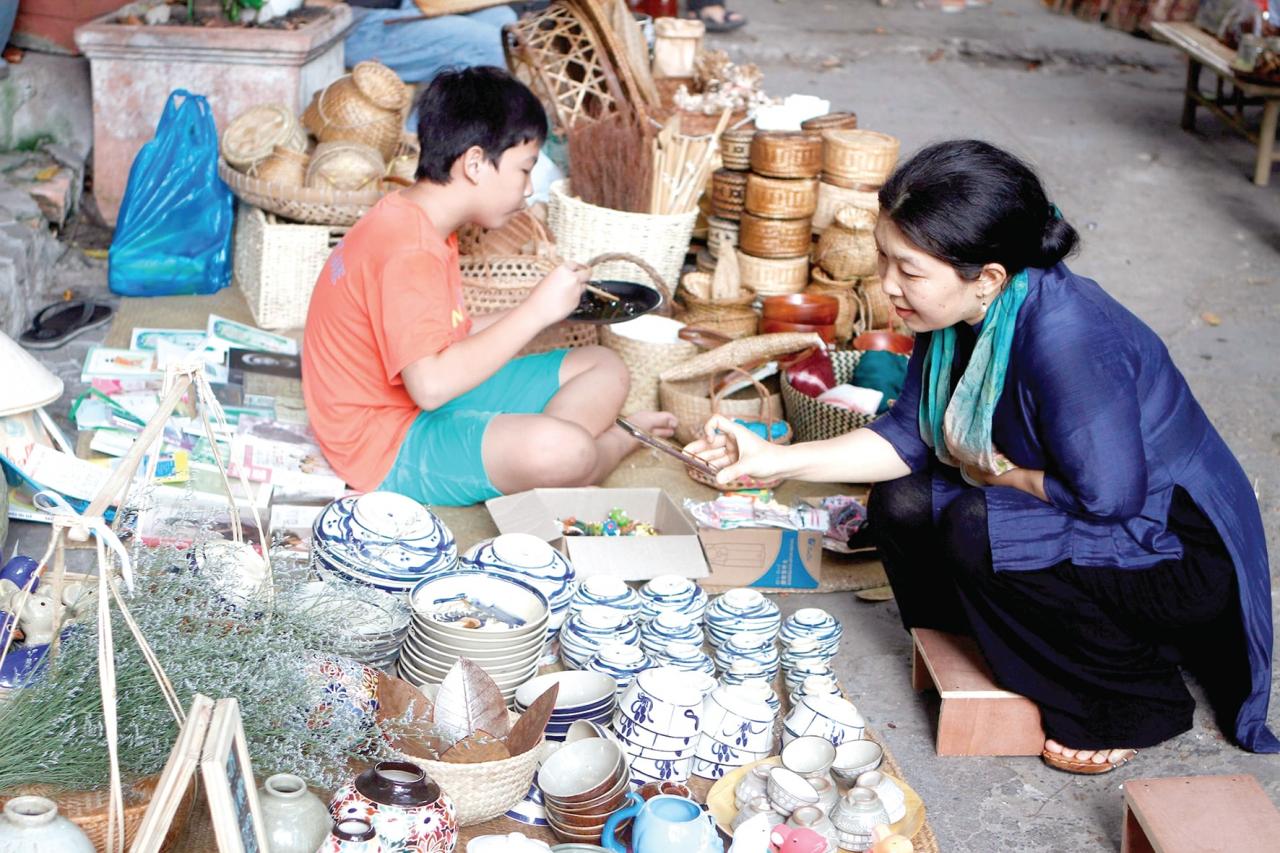
Ao Dai at the Countryside Market
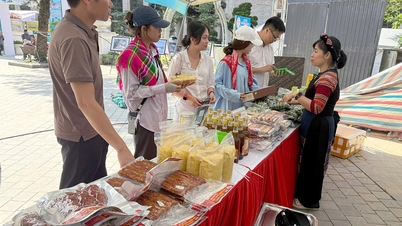
Saigon has a weekly market called Cho Que (Countryside Market), which only meets on Sunday mornings at 7 Nguyen Thi Minh Khai Street, District 1. The vendors here all wear ao dai (traditional Vietnamese dress), and shoppers also frequently wear ao dai.
The initiator of the traditional Vietnamese market in ao dai (long dress) is Ms. Nguyen Thi Thanh Thuy, President of the Mothers' Club. Thuy is perhaps one of the most frequent ao dai wearers in Saigon. The Mothers' Club has a long history in Saigon, persistently encouraging women, not only within the club, to wear ao dai as a daily habit.
Ms. Thanh Thúy is also the initiator of the "Ao Dai Handover" program - a project that receives and distributes ao dai (traditional Vietnamese dresses), helping to extend the lifespan of the ao dai. The project has been running for over 10 years.
Initially, the tradition of giving away ao dai (traditional Vietnamese dresses) involved requesting or receiving them from retired teachers, then donating them to poor teachers or recent graduates who couldn't afford to buy their own. Over time, the recipients of these donated ao dai expanded to include many women attending weddings, such as those related to marriage.
Ms. Thuy believes that wearing the ao dai (traditional Vietnamese dress) also contributes to promoting social welfare. The mothers' association also serves as a place to receive and market products from many silk and brocade villages; many tailors, cutters, and embroiderers of ao dai are people with disabilities, and the number of skilled hand embroiderers is decreasing in urban areas.
The love for the ao dai (Vietnamese traditional dress) came from her mother, a weaver in the Bay Hien area in the old days, and was passed down to her. And now, Thuy's growing daughter has naturally inherited that love. For Thuy and her daughter, the ao dai has become everyday attire.
The story of the teacher who has worn the traditional Vietnamese dress for 27 years.
Ms. Nguyen Thi Hong Duyen, an English teacher at Nguyen Hien High School (Duy Xuyen district), recently conducted a small survey with her students.
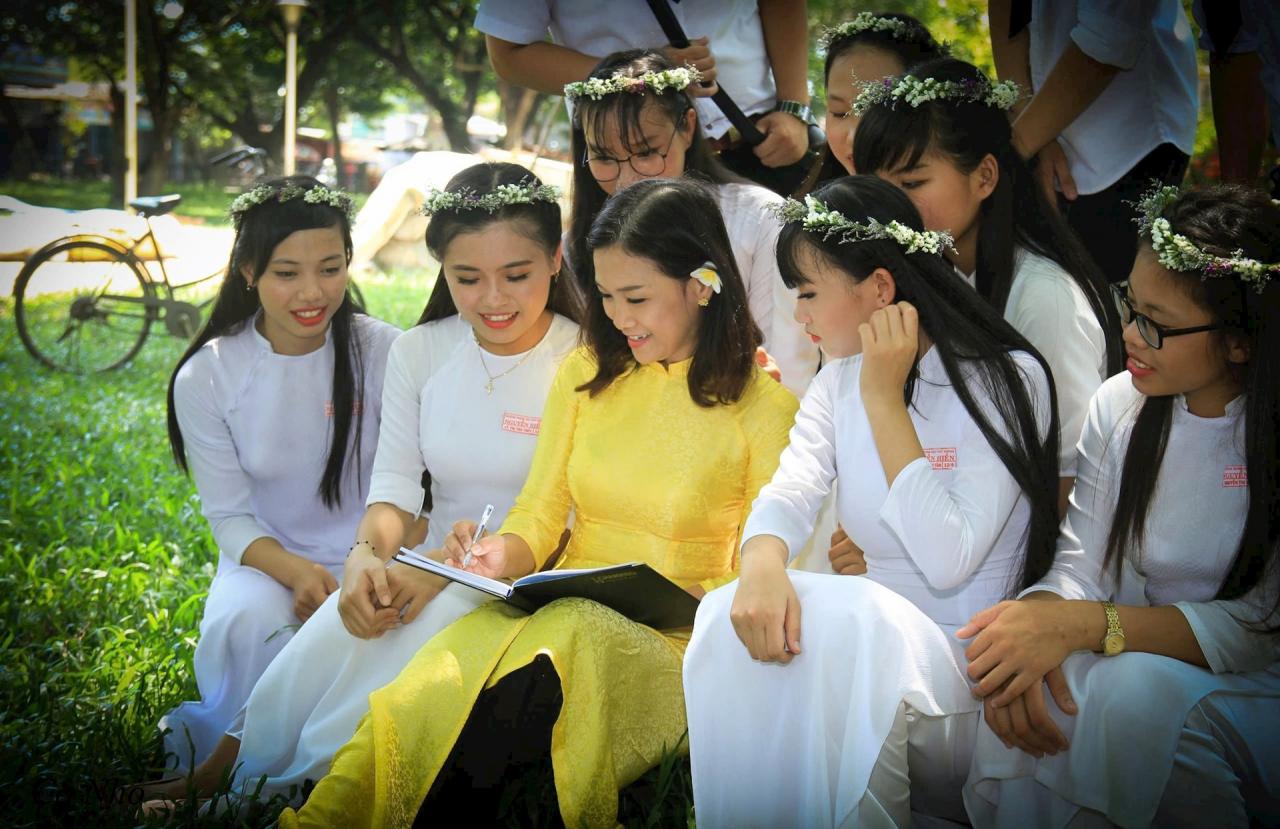
"When asked about the traditional ao dai, all the students in my 11/8 class agreed that the ao dai is the most beautiful outfit for women, and they preferred seeing their teachers wearing ao dai rather than Western suits."
"Over 50% of female students said they like wearing the ao dai (traditional Vietnamese dress) on holidays and during spring outings; but surprisingly, 95% of female students in class 11/8 said they don't like wearing the ao dai to school. They cited reasons such as: not being able to run and jump, not being comfortable when moving, difficulty in walking, and the dress getting dirty easily," Ms. Duyen said.
When teacher Duyen asked the students in class 10/1 the same questions, she received similar answers. Besides that, some students said they were happy to wear the ao dai for the first time, but found it inconvenient and cumbersome to move around in it on subsequent occasions. One student even suggested that while the ao dai flatters the figure, it also accentuates the physical flaws of some female students.
“About two-thirds of the female teachers at my school are hesitant to wear the traditional ao dai to class every day, even though they agree that they look more beautiful in it. I am one of the few who prioritizes beauty; as long as it looks good, I'm willing to put in the effort. For 27 years of teaching, I have worn the ao dai throughout all my classes. The ao dai is the outfit that makes me feel most confident when appearing in front of people,” Ms. Duyen shared.
And this teacher expressed the view that everyone looks more beautiful in an ao dai, from the elderly to young children. However, many women find it inconvenient to wear an ao dai. Those wearing an ao dai must walk slowly and leisurely; if they walk quickly, they risk tripping and falling due to the wide skirt and trouser legs getting in the way.
"To overcome this, I usually choose modernized ao dai (Vietnamese traditional dress), with shorter skirts, narrower and shorter trouser legs, a looser fit, and a slightly stretchy material for ease of movement and suitability for my daily commute."
Currently, there's a trend for hand-embroidered linen ao dai (traditional Vietnamese dress), with a loose fit, not too tight at the waist, comfortable to wear, and possessing a simple, charming beauty. Aren't the flight attendants of Vietnam Airlines still very dynamic and beautiful in those ao dai?” – Ms. Duyen added.
The story of a fashion boutique for Japanese tourists.
For nearly 30 years, the Mangrove fashion shop on Mac Thi Buoi Street in Ho Chi Minh City has been a popular destination for Japanese tourists looking to have their ao dai (traditional Vietnamese dress) made.
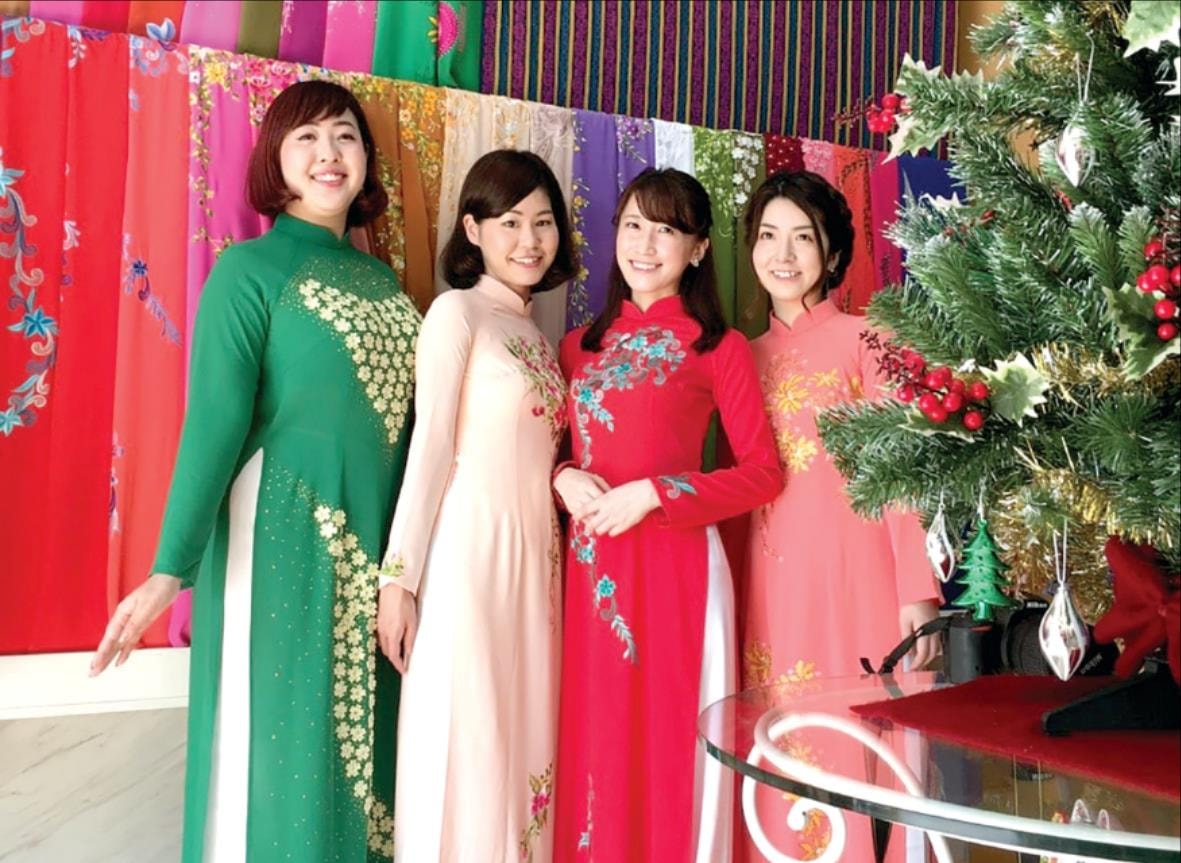
Mr. Van Nhat Biu, the shop owner, recounts a common occurrence: if a Japanese tourist comes to the shop with a Vietnamese friend, the Vietnamese friend will inevitably advise the Japanese friend, requesting the shop to tailor the ao dai in the traditional style—meaning a fitted waist, a flattering silhouette, and a long skirt... After receiving the dress, the Japanese customer will wear it to please their friend, then return to the shop alone to request a larger size.
Japanese tourists love wearing the ao dai (Vietnamese traditional dress), but they prioritize comfort for everyday activities. They often choose modernized ao dai designs, or dresses that are longer than knee-length but don't have the hem touching their heels, preferring a collar rather than a boat neckline, and not a fitted waist.
The way they try on a new dress to see if it fits well is by... stretching their arms, moving their shoulders back and forth, and checking if it feels tight under their armpits. If it feels comfortable, then it's fine. Mr. Biu said he was quite shocked to see Japanese women wearing his shop's ao dai (traditional Vietnamese dress) with sneakers, but he got used to it and found it quite beautiful.
The shop owner smiled, saying that because he'd been sewing so many ao dai (traditional Vietnamese dresses) for Japanese customers, his seamstresses couldn't go back to sewing them in the traditional style. He said Japanese customers really liked hand-embroidered ao dai, and he was happy that it helped stabilize the livelihoods of his artisans, whom he'd known for decades. It's a profession that's dying out as skilled hand embroiderers are becoming increasingly scarce in Saigon.
"Seeing Japanese people wearing traditional Vietnamese clothing while sightseeing makes me very happy. Just think, even if they wanted to, they couldn't wear their traditional kimono as comfortably in their daily lives as the ao dai. I like innovation. It's only when people look at the ao dai and ask what kind of dress it is that, then there's something to worry about," Mr. Biu said.
Source: https://baoquangnam.vn/ao-dai-muon-neo-3143727.html














































































Comment (0)