

In 2021, at the 26th Conference of Parties to the United Nations Framework Convention on Climate Change (COP26), Vietnam declared its goal of achieving net emissions of “zero” by 2050; participating in the Global Declaration on the Transition from Coal to Clean Energy, not building new coal-fired power plants after 2030, and gradually reducing coal power from 2045; reducing methane emissions by 30% by 2030 compared to 2020; strengthening forest protection and land use management to reduce greenhouse gas emissions; and participating in the global adaptation alliance… At COP27, Vietnam actively negotiated the establishment of a Joint Economic Partnership (JETP) with countries within and outside the G7.
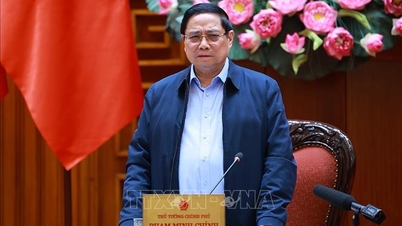
Immediately after COP26, Vietnam established a National Steering Committee to implement Vietnam's commitments at COP26, chaired by the Prime Minister and comprising 19 representatives from various ministries and agencies.
As the energy sector's governing body, the Ministry of Industry and Trade has closely followed the Government's directives and the contents of COP26 to develop strategies, projects, and action programs/plans to implement Vietnam's commitments, prioritizing the development of renewable energy and refraining from developing new coal-fired power projects after 2030; and implementing a thorough energy transition.
Specifically, no new coal-fired power plant projects will be developed after 2030. Before 2030, only coal-fired power plant projects currently in the investment preparation phase will be developed. Fuel conversion to biomass and ammonia will be implemented for plants that have been operating for 20 years when costs are suitable. Plants older than 40 years will be decommissioned if fuel conversion is not feasible. The goal for 2050 is to completely eliminate coal for electricity generation, shifting entirely to biomass and ammonia.
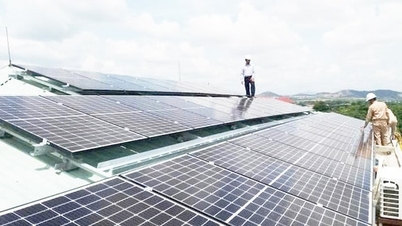
Promote the development of onshore and offshore wind power, and solar power, in accordance with the system's absorption capacity and the grid's power distribution capabilities. Prioritize and encourage the development of rooftop solar power for self-sufficiency.
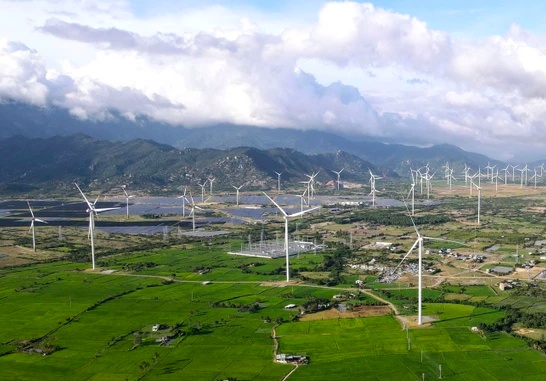 |
| Developing renewable energy will contribute to helping Vietnam achieve the COP26 goals. |
To contribute to achieving the COP26 goals, the Ministry of Industry and Trade has also outlined a suitable and focused direction for the development of the power source structure. Accordingly, priority is given to the efficient exploitation and use of renewable energy sources for electricity production; the proportion of electricity produced from renewable energy sources (including hydropower) is expected to reach approximately 30.9-39.2% by 2030, aiming for a renewable energy rate of 47%, provided that the commitments under the Joint Political Declaration establishing the Just Energy Transition Partnership (JETP) with Vietnam are fully and effectively implemented by international partners, and approximately 67.5-71.5% by 2050.
Efficiently exploit and utilize domestic fossil fuel resources in combination with imports: Gradually reduce the proportion of coal-fired power plants, prioritize the development of domestic gas-fired power plants, and develop imported LNG power plants on an appropriate scale. Implement energy transition closely aligned with global technological development trends and cost trends.
By 2030, the total capacity of operating coal-fired power plants and projects under construction is expected to reach approximately 30,127 MW, accounting for 20.1% of the total power generation capacity. The target for 2050 is to completely eliminate coal-fired power generation, shifting entirely to biomass/ammonia, with a total capacity of 25,632-32,432 MW, producing 72.5-80.9 billion kWh (5.3-6.6% of total electricity production).
Along with the energy transition, Vietnam will promote the efficient and effective use of electricity; continue to accelerate the development of smart grids capable of integrating renewable energy sources with a high penetration rate; and upgrade and build increasingly advanced and modern transmission and distribution grids.
With the power development program outlined in the Power Development Plan VIII, CO2 emissions from the electricity sector are projected to reach 204-254 million tons in 2030, 226-254 million tons in 2035, and 27-31 million tons by 2050 (lower than the 35 million ton limit mentioned above). Thus, the energy transition roadmap in Power Development Plan VIII ensures the target of net emissions of "zero" by 2050 as stipulated in Decision No. 896/QD-TTg.
In addition, the Ministry of Industry and Trade is actively developing a plan to implement Directive No. 13/CT-TTg of the Prime Minister dated May 2, 2024, on strengthening the management of carbon credits to implement the Nationally Determined Contribution (NDC). Simultaneously, it is coordinating with relevant agencies to review the legal basis, domestic practical situation, and international experience regarding the management, trading, and exchange of renewable energy certificates (RECs) in conjunction with achieving national emission reduction targets.
Source: https://congthuong.vn/bo-cong-thuong-no-luc-cu-the-hoa-cam-ket-tai-cop26-322213.html


















































































Comment (0)