

 |
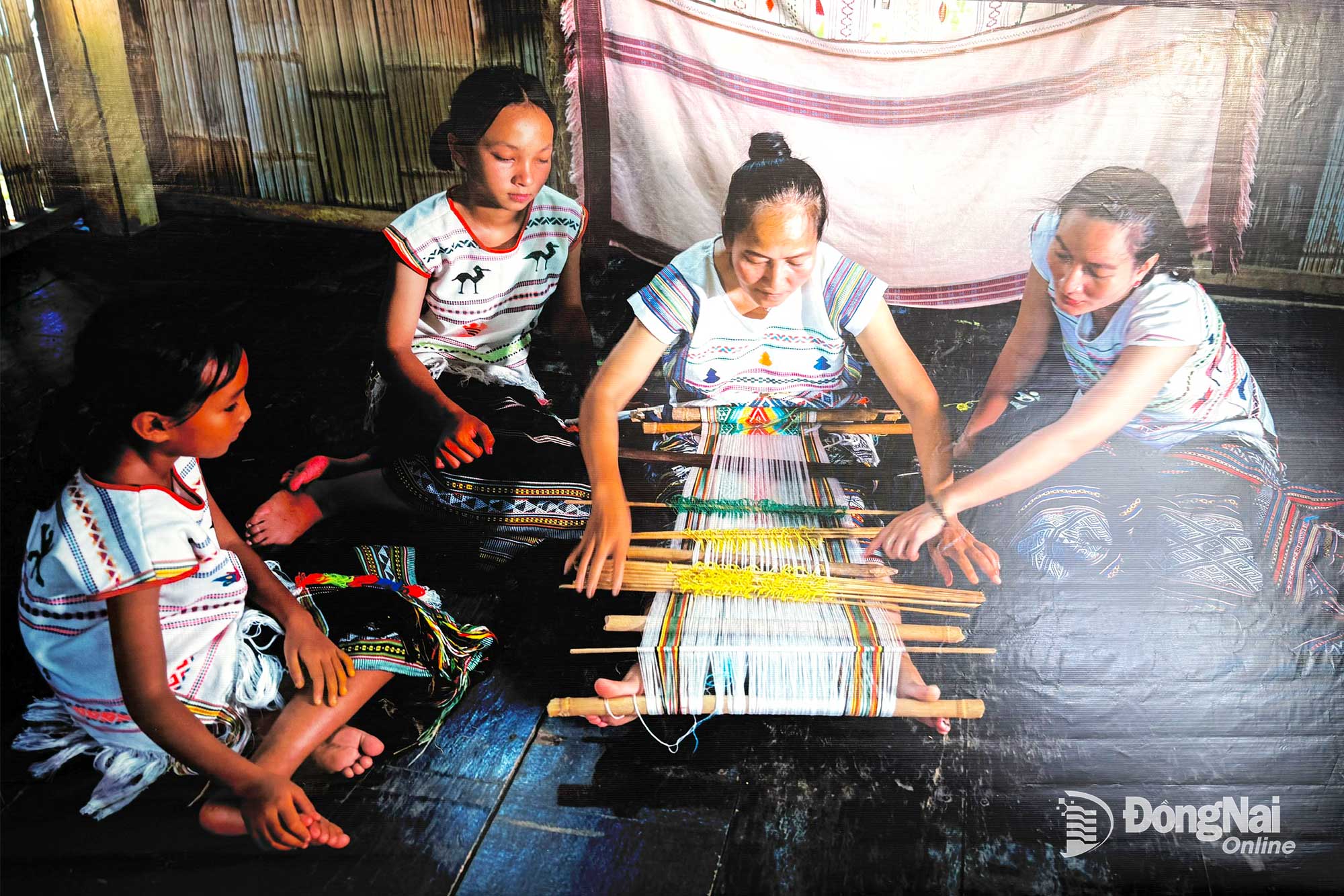
| Artisan Ka Rỉn instructs her daughter Ka Hương and granddaughter in traditional brocade weaving techniques. Photo taken at the museum. |
The story of the traditional brocade weaving craft of the Ma ethnic women in Ta Lai commune is being retold through a special thematic exhibition at the Southern Vietnam Women's Museum ( Ho Chi Minh City).
It carries both the love and the soul of the nation.
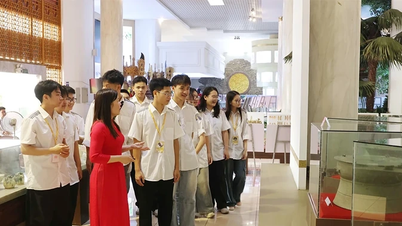
In the small but cozy space of the museum in the heart of the bustling city, the traditional costumes of the Ma ethnic group in Ta Lai commune captivate those who love traditional culture. The exhibition not only displays traditional Ma clothing such as loincloths, shirts, skirts, blankets, scarves, baby carriers, and products for tourism such as bags and bracelets, but also takes viewers back along the Dong Nai River to Ta Lai village to learn about the origins and the creation of a brocade fabric. It depicts women like artisans Ka Rin and Ka Huong engrossed at their looms, personally performing all the steps to create a brocade fabric, imbued with the love and soul of their people. These diligent women, passing down their skills from generation to generation, are contributing to preserving the community's valuable heritage amidst a constantly changing world and the threat of traditional crafts disappearing.
 |
| Visitors learn about the traditional brocade weaving process of Ma ethnic women, displayed at the museum. Photo: Nhat Ha |
Ms. Nguyen Thi Hoa (residing in Ho Chi Minh City) shared: “Through visiting and learning about the thematic exhibitions, artifacts, and documents on this traditional craft, I clearly feel the cultural identity and creativity of the Ma women.”
From the age of 8-9, Ma girls begin learning their first weaving techniques from their grandmothers and mothers. This transmission process is not only about teaching techniques and patience, but also about experiencing the community's culture. A finely crafted brocade fabric embodies the pride, talent, and skill of the Ma woman, reflecting her stature and the aesthetic values of her community.
To revive traditional brocade weaving in contemporary life, products have been creatively designed to serve the tourism industry. This transformation not only helps preserve ancient techniques and patterns but also affirms the value of this heritage in the context of integration.
A crystallization of identity and pride.
To create these elaborate and exquisite traditional brocade fabrics, Ma women diligently spin yarn, dye it with leaves, roots, and tree bark, and meticulously thread the shuttle and press the yarn. It's a complex and meticulous process, a culmination of the plants and trees of the mountains and forests, the skillful hands of the women, and the unique colors of nature. The white threads are dyed using natural ingredients such as turmeric for yellow, the bark of the Barringtonia tree for brown, and the leaves of the Terminalia catappa tree for pink. The indigo (dark blue) color was originally dyed using indigo leaves, but this method has now been lost, so dark blue, light blue, and green colors are now dyed using industrially produced threads. Similarly, the lac leaf, used to create red, has also disappeared.
Ta Lai commune was formed by merging three communes: Ta Lai, Phu Thinh, and Phu Lap. Ta Lai is famous for its natural beauty and the cultural identity of its ethnic minorities, especially the Ma and S'tieng people. Among them, the Ma people have created a distinctive cultural space, and their brocade weaving is an important intangible cultural heritage, deeply reflecting the worldview and beliefs of the community.
The dyeing materials are boiled to extract the liquid, then the yarn is soaked in this liquid repeatedly, dried after each soaking to ensure the color penetrates deeply and lasts longer. After dyeing, the yarn is washed and completely dried. Next, the yarn is wound lengthwise and mounted on a loom. Finally, weaving and pattern creation – the main stage, encompassing basic weaving techniques and complex pattern-making techniques – takes place. After removing the loom, the fabric is straightened. A piece of fabric is created through the continuous creation of delicate and creative patterns, reflecting the intelligence, aesthetics, preservation of folk knowledge, and the natural environment surrounding the lives of the Ma people.
Nhat Ha
Source: https://baodongnai.com.vn/dong-nai-cuoi-tuan/202512/phu-nu-dan-toc-ma-gui-tam-tinh-qua-khung-det-66a0b1c/



![[Image] National Assembly discusses the implementation of the socio-economic development plan.](https://vphoto.vietnam.vn/thumb/1200x675/vietnam/resource/IMAGE/2026/04/20/1776696707422_ndo_br_img-20260420-185419-jpg.webp)
![[Photo] General Secretary and President To Lam meets with National Assembly delegates from ethnic minorities.](https://vphoto.vietnam.vn/thumb/1200x675/vietnam/resource/IMAGE/2026/04/20/1776696701056_a1-bnd-8331-3342-jpg.webp)
































































Comment (0)