

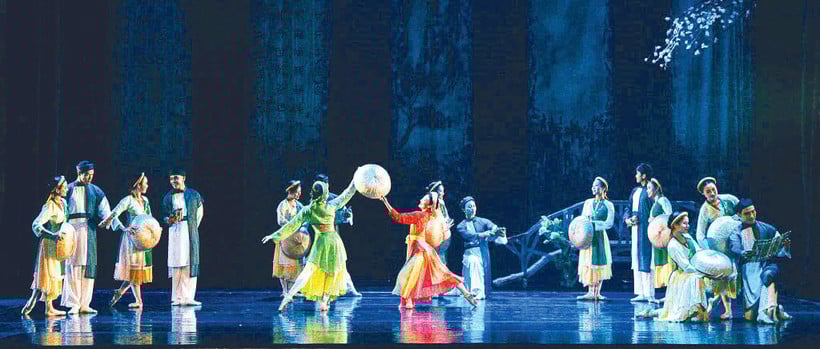
From meticulously researched publications and international translation projects to theatrical adaptations, folk performances, and educational activities, as well as contemporary art, all contribute to spreading the value of this masterpiece. The aesthetic, humanistic, and spiritual values of Vietnam are continuously explored, continued, and inspire ever more profoundly and vividly.
Bringing the Tale of Kieu into contemporary life.
According to the plan of Ha Tinh province, the 260th anniversary of the birth of the great poet Nguyen Du will take place at Thanh Sen Square (Thanh Sen ward) with the art program "The Great Poet Nguyen Du - A Shining Heart". A multi-tiered stage is expected to be elaborately constructed, incorporating modern performance technology. More than 200 artists from the central and local levels will participate in recreating the emotional layers, fate, and humanistic spirit of the Tale of Kieu through the language of light and music . This is a completely new approach, bringing the masterpiece to a contemporary stage, increasing the interaction between tradition and technology. In addition, there will be activities rich in cultural identity such as: Kieu performances, recitations of Kieu, calligraphy of Kieu, and folk games related to the characters and stories of the great poet Nguyen Du. Many localities, especially Tien Dien district, have planned to organize folk festivals where people will directly participate in performances, readings of Kieu, and "living with Kieu".
In the academic and publishing fields, many new books on The Tale of Kieu have been introduced, including research, comparative, and explanatory editions serving both general and specialized readers. These publications contribute to providing knowledge about the text, and many are presented in a visually appealing, easy-to-read format suitable for young people. Academic seminars and conferences on Nguyen Du and The Tale of Kieu are being prepared, bringing together experts in linguistics, textual studies, and cultural studies from both Vietnam and abroad. Notably, several projects to translate the masterpiece into languages around the world , as well as the organization of international conferences on translation, continue to expand.
In the field of arts and culture, over the past five years, many contemporary directors, artists, and designers have begun to approach the Tale of Kieu in new forms, combining various art forms, applying digital art, video art, modern music, illustrations, interactive exhibitions, etc., to expand the work's dialogue with today's technology and visuals. Many theaters and artists have strived to open up new aesthetic paths for Nguyen Du's masterpiece to engage with the public. The clearest example of this trend can be seen in the "Ballet Kieu" by the Ho Chi Minh City Symphony Orchestra and Opera House (HBSO). First performed on June 20, 2020, under the direction and choreography of Nguyen Thi Tuyet Minh, the work surprised the art world by recounting Kieu's fate through the subtle movement of ballet, blended with elements of folk dance. The combination of modern performance technology and national identity has helped "Ballet Kieu" create a new standard for approaching classical literature on stage. It is no coincidence that in 2025, the play will continue to be restaged by a new generation of young and enthusiastic artists.
Contemporary art is also reviving the spirit of the work through visual art and interactive spaces. In Da Nang, the young artist community has created a "new wave" in approaching the Tale of Kieu through a large-scale multimedia exhibition, supported by the British Council's "Connections Through Culture 2025" program and major technology partners. Breaking free from the limitations of traditional paper paintings or illustrations, the exhibition brings together a rich array of materials: video art, digital art, illustrations, graphic design, installation art, light, and sound in a space divided into multiple emotional lines evoking Kieu's journey through life and her thoughts, while also expanding to address contemporary questions: the plight of women, the right to choose, the value of sacrifice, and the spirit of freedom.
More in-depth investment is needed.
Although The Tale of Kieu has strongly inspired many forms of creative expression, numerous experts and artists share the same opinion: For this great legacy to truly enter contemporary life with its rightful stature, deeper, more systematic, and professional investment is especially important. Associate Professor, Dr. Nguyen Dang Diep, Director of the Institute of Literature, emphasized: “The Tale of Kieu is a multi-layered artistic whole. In it, every word and image is connected to the narrative structure and the system of cultural allegories. If we separate it from Nguyen Du's aesthetic context or interpret it arbitrarily according to fleeting tastes, the creative work can easily stray from its spirit.” According to him, “renewing” should not be understood as changing or attempting to “modernize” with superficial layers of decoration, but rather as opening up new approaches and perspectives while still preserving the humanistic essence, philosophical nature, and beauty of the six-eight meter language that Nguyen Du painstakingly created.
Sharing the same viewpoint, art critic Nguyen Anh Tuan – one of the persistent advocates for integrating cultural heritage into the new art movement – argues: “Masterpieces offer a symbolic ecosystem with the potential for endless transformation. Therefore, contemporary artists should not feel limited within the framework of text, but can approach it with new materials, so that each form opens up another dimension of thought. Art cannot be renewed to suit popular tastes, but needs to explore what poetry will be like when it enters the digital space, when it is fragmented, restructured, or activated by movement.”
Associate Professor Pham Xuan Thach commented: “Expanding the scope for The Tale of Kieu also requires considering the aesthetic language of the era. The important thing is not how accurately the work is recreated, but to preserve its core humanistic spirit. If we consider a masterpiece to be perfect, it will be very difficult to add more value; that is, we have separated The Tale of Kieu from life. However, artistic creations only become valuable when they do not fall into two states: either being overly dependent on the original work or destroying it simply to attract attention. The right path must be a path of dialogue, requiring artists to answer the question: Why is this work still important to people today? If they cannot answer that question, then even if they recreate every detail accurately, it will still only be a soulless copy.”
In reality, certain limitations still exist in the way the work is adapted. There have been films inspired by The Tale of Kieu that have failed to be convincing. Attempts to recreate Kieu's world on screen often fall into the trap of imitating situations and borrowing from classical art, rather than developing a unique cinematic language that both respects Vietnamese culture and suits contemporary aesthetics.
Similarly, in the field of publishing and research, many versions of Truyện Kiều have been printed, compared, commented on, and translated into many languages around the world… but their value is not always guaranteed. Some foreign language translations lack consistency in conveying meaning, and some commercially published works even lack a reputable review board. This inadvertently creates ambiguity in information, making it difficult for international readers to correctly identify the value of this masterpiece.
Even in theatrical and performance arts, many projects remain merely illustrative, failing to truly engage in dialogue with profound humanistic values and philosophical depth. These limitations highlight a crucial lesson: the successful renewal of a work can only be achieved through depth of understanding, a receptive attitude, respect for the original text, and modern creative methods. Only when the efforts are properly invested—from research and adaptation to stage, film, music, and fine arts—can a work truly move from being merely "repeated" to genuinely "coming back to life" in the contemporary consciousness.
Source: https://nhandan.vn/boi-dap-suc-song-cho-kiet-tac-truyen-kieu-post929137.html












![[Video] AI application for early detection of common diseases on cassava plants](https://vphoto.vietnam.vn/thumb/402x226/vietnam/resource/IMAGE/2025/12/10/1765328634749_avatar-of-video-1038119-png.webp)
![[Photo] Urgently help people soon have a place to live and stabilize their lives](/_next/image?url=https%3A%2F%2Fvphoto.vietnam.vn%2Fthumb%2F1200x675%2Fvietnam%2Fresource%2FIMAGE%2F2025%2F12%2F09%2F1765248230297_c-jpg.webp&w=3840&q=75)












































Comment (0)