

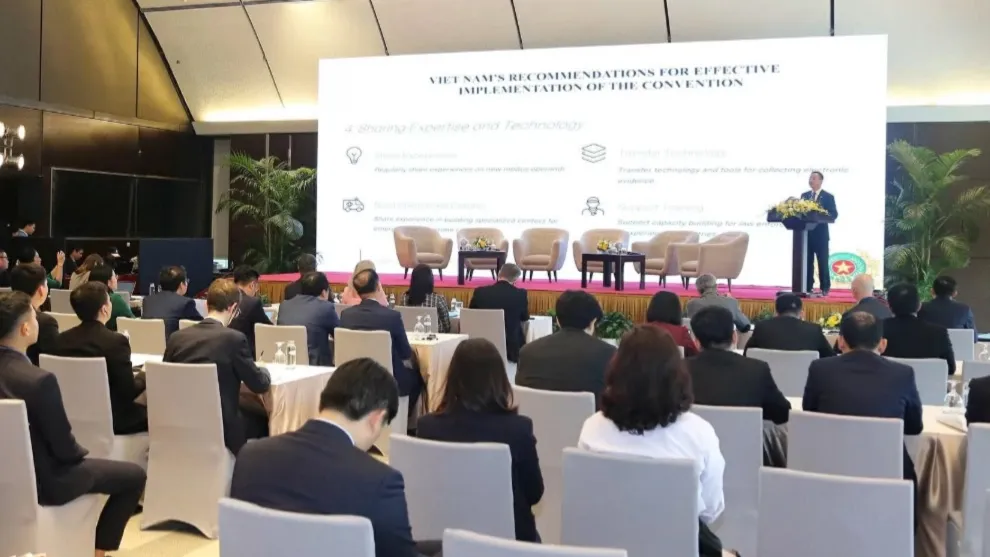
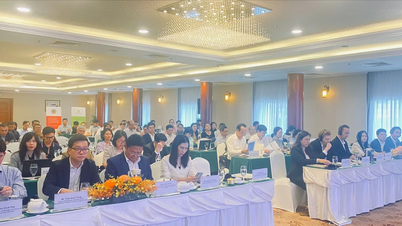
Speaking at the seminar, Lieutenant General Pham The Tung, Deputy Minister of Public Security , stated that international cooperation between law enforcement agencies worldwide in combating cybercrime is extremely intense, especially within the multilateral cooperation frameworks of the United Nations and Interpol. However, the process of international cooperation still faces difficulties and obstacles, particularly in legal matters.
Due to the lack of a global legal framework governing cooperation among nations in combating cybercrime, the results of this crime fight remain limited. Many cases and incidents cannot be investigated or prosecuted because of inconsistencies in the legal systems of different countries.
In the coming period, the situation regarding transnational crime, especially cybercrime, will continue to be complex. Therefore, the Deputy Minister of Public Security proposed several specific tasks to further strengthen cooperation in order to effectively implement the United Nations Convention against Cybercrime.
Firstly, countries should promptly complete the procedures for joining the Convention and focus on incorporating its provisions into their national legal systems.
Secondly, in the implementation process, countries need to flexibly apply the provisions of the Convention as well as their own national laws to enhance the effectiveness of international cooperation in investigating and handling cases related to cybercrime.
Third, countries need to strengthen public-private partnerships in combating cybercrime. In fact, technology companies, banks, service providers, and cryptocurrency exchanges hold a vast amount of information related to the identities, behaviors, and operating methods of criminals, as well as data exchanged between users and criminals. This is a crucial source of evidence that helps investigative agencies and law enforcement agencies prove crimes.
Fourth, countries need to regularly share experiences in preventing and combating cybercrime, especially new criminal methods and tactics; transfer technology and tools to support the process of collecting electronic evidence; share experiences in building specialized centers for emergency response to cybercrime; and support training and capacity building for law enforcement agencies in countries lacking experience...
Fifth, countries need to cooperate closely in developing strategies for public awareness and education on cybersecurity. Every citizen and organization needs to become the first line of defense in cyberspace, possessing the knowledge to participate in a safe and healthy digital environment, and knowing how to protect themselves from the increasingly sophisticated scams, intrusions, and data theft tactics of criminals.
Sixth, the United Nations and Interpol need to strengthen their coordinating role in international cooperation activities in sharing criminal information; coordinating joint investigations of cases and apprehending perpetrators involved in cybercrime; and providing technical support, training, and capacity building for law enforcement agencies in various countries to combat cybercrime.
At the seminar, delegates agreed that cybercrime is becoming a global threat with increasing sophistication and spread, requiring close cooperation between countries. A worrying trend is that cybercriminals are exploiting artificial intelligence to create more sophisticated forms of fraud. Therefore, the implementation of the Hanoi Convention will strengthen global response capabilities to these cross-border threats.
Source: https://www.sggp.org.vn/cac-quoc-gia-can-trien-khai-hieu-qua-cong-uoc-cua-lien-hop-quoc-ve-chong-toi-pham-mang-post820054.html


![[Photo] Prime Minister Pham Minh Chinh holds a phone call with the CEO of Russia's Rosatom Corporation.](/_next/image?url=https%3A%2F%2Fvphoto.vietnam.vn%2Fthumb%2F1200x675%2Fvietnam%2Fresource%2FIMAGE%2F2025%2F12%2F11%2F1765464552365_dsc-5295-jpg.webp&w=3840&q=75)
![[Photo] Closing Ceremony of the 10th Session of the 15th National Assembly](/_next/image?url=https%3A%2F%2Fvphoto.vietnam.vn%2Fthumb%2F1200x675%2Fvietnam%2Fresource%2FIMAGE%2F2025%2F12%2F11%2F1765448959967_image-1437-jpg.webp&w=3840&q=75)







































![[OFFICIAL] MISA GROUP ANNOUNCES ITS PIONEERING BRAND POSITIONING IN BUILDING AGENTIC AI FOR BUSINESSES, HOUSEHOLDS, AND THE GOVERNMENT](https://vphoto.vietnam.vn/thumb/402x226/vietnam/resource/IMAGE/2025/12/11/1765444754256_agentic-ai_postfb-scaled.png)










































Comment (0)