

From native plants to marketable products.
Ta Rut commune is a remote and isolated area with a fragmented terrain, where the lives of the people mainly depend on agricultural and forestry production. The percentage of poor and near-poor households remains quite high. In the past, some key crops such as cassava and corn contributed to the local economy , but the efficiency was not high.
Based on this reality, local Party committees and authorities have proactively sought new directions in restructuring crop patterns. Among these, the restoration of the indigenous dwarf banana variety, which has long been associated with the local people, is suitable for the soil and climate, and has stable economic value, is considered a strategic choice.
In 2019, with the support of the Vietnam Women's Union, a pilot project for cultivating native dwarf bananas was implemented in the commune. In 2021, the model received further funding to mitigate damage caused by floods and expand production. Based on this, a cooperative for cultivating native dwarf bananas was established with 15 initial members, gradually forming a production model based on linkages and cooperation, in line with the collective economic development orientation.
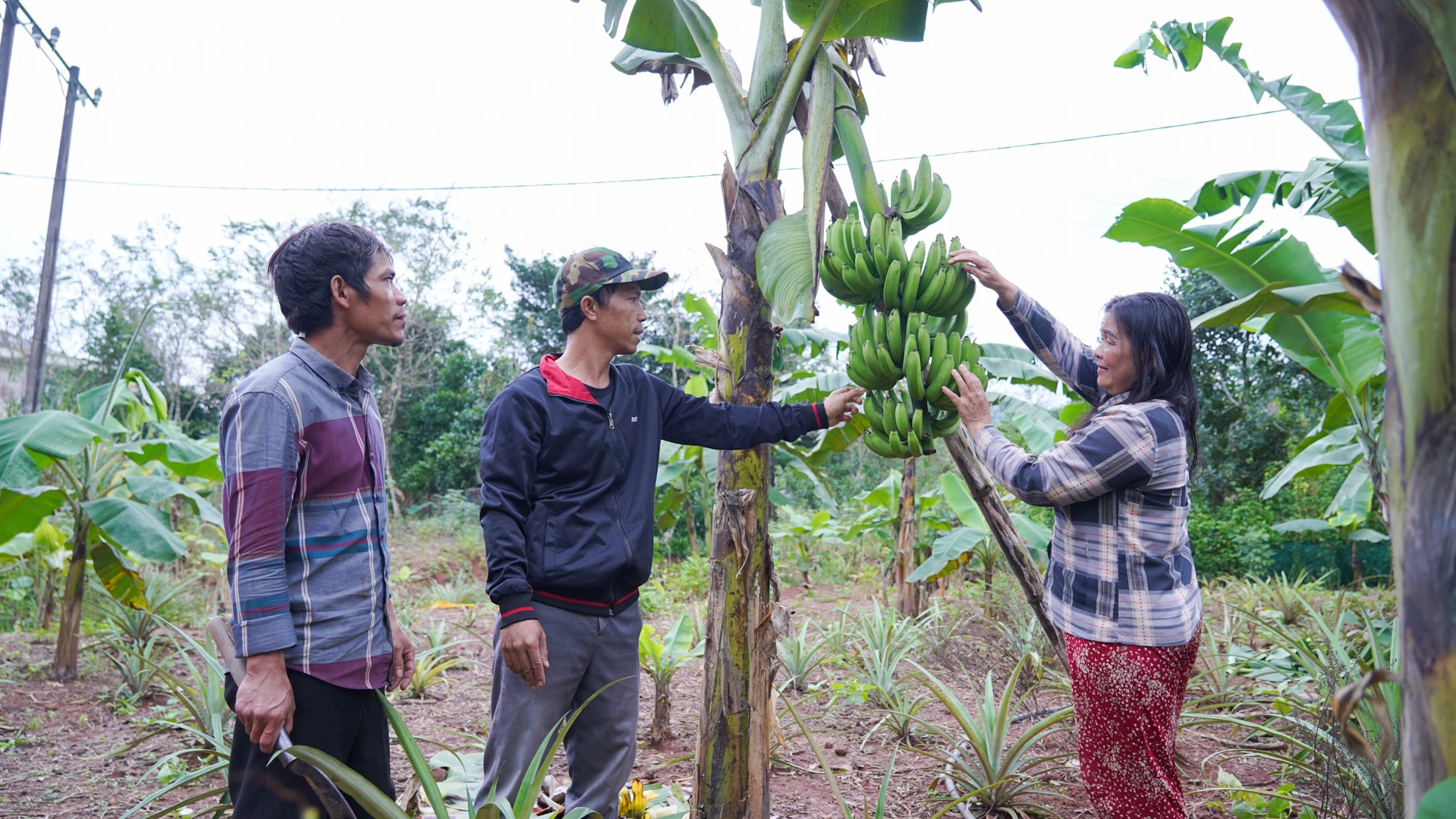 |
| Agricultural extension officers directly visited Ms. Ho Thi Buoi's garden (A Dang village) to guide her on how to care for the native dwarf banana variety - Photo: L.TR |
After more than four years of implementation, the model has yielded approximately 5,700 bunches of bananas, with an average selling price of 100,000 VND per bunch, generating a total revenue of nearly 500 million VND. In addition, members of the cooperative have also supplied over 5,000 seedlings to neighboring localities, bringing in over 150 million VND in revenue.
Ms. Ho Thi Buoi, a member of the cooperative in A Dang village, Ta Rut commune, said that previously, her family planted native dwarf bananas without fertilizer and at a low planting density. Therefore, the yield, production, quality, and efficiency were not as expected. However, since participating in training courses, her family has learned to use well-rotted manure to fertilize the plants. The bananas are better cared for, have fewer pests and diseases, and yield significantly higher economic returns.
Efforts are being made to turn the native dwarf banana into a "poverty alleviation crop".
Besides generating income from fruit and seedlings, the native dwarf banana model in Ta Rut commune also contributes to creating local jobs and improving the production skills of the people through technical training courses and guidance on safe, bio-secure cultivation processes that do not use pesticides, thus contributing to environmental protection and public health.
Building on its initial success, the model of cultivating native dwarf bananas commercially has spread rapidly within the community. With the goal of transforming the crop structure and increasing income for people in mountainous areas, the local government continues to cooperate with the Provincial Agricultural Extension Center to develop a model for cultivating red Cavendish bananas in Ta Rut commune. The model was implemented from September 2024 on an area of 2.5 hectares, with the participation of 3 households in A Pun village. The households received 100% support in terms of seedlings, fertilizers, and technical guidance from planting and caring for the plants to harvesting.
Mr. Ho Van Bau, an agricultural extension officer in Ta Rut commune who directly teaches techniques to the people, said: "We guide the farmers according to the correct technical procedures, from digging holes of the right size, choosing the appropriate time for planting, applying balanced fertilizer, and caring for the plants to prevent diseases. In addition to training, agricultural extension officers directly go to the gardens to 'show them how to do it'. After a year, when the banana cultivation model is stable, it is handed over to the households to independently care for and harvest the bananas."
According to Ho Phuong Nam, Deputy Head of the Economic Department of Ta Rut Commune: “Currently, there are about 20 hectares of native dwarf banana trees in Ta Rut commune. In the future, the locality will continue to expand the area and apply scientific and technical methods, supporting people with fertilizers and providing more thorough guidance on the care and harvesting process. The current issue is that, for the native dwarf banana model to truly become a “poverty alleviation crop” for the people, it is necessary to build a large-scale, commercial dwarf banana growing area that can supply large orders. Therefore, the locality urgently needs the support of economic development programs and the joint efforts of units and businesses inside and outside the province. Only then can the native dwarf banana tree become a new key crop, making an important contribution to socio-economic development and poverty reduction in the locality.”
Le Truong
Source: https://baoquangtri.vn/kinh-te/202512/can-nhan-rong-mo-hinh-chuoi-lun-ban-dia-o-xa-ta-rut-c9d6cd6/

![[Photo] Prime Minister Pham Minh Chinh attends the Conference summarizing and implementing tasks of the judicial sector.](/_next/image?url=https%3A%2F%2Fvphoto.vietnam.vn%2Fthumb%2F1200x675%2Fvietnam%2Fresource%2FIMAGE%2F2025%2F12%2F13%2F1765616082148_dsc-5565-jpg.webp&w=3840&q=75)




































































Comment (0)