

Wherever the floodwaters reach, the rice grows there.
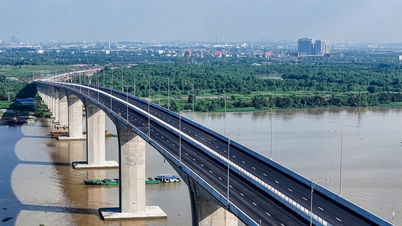
To reach the flooded rice paddies, we contacted Mr. Dang Van Cuoc, an agricultural technical officer in Vinh Gia commune, beforehand. Upon arriving at the vast expanse of water, we met Mr. Cuoc at the beginning of a concrete bridge under construction. On the other side of the canal, Mr. Cuoc instructed us to turn around and then cross a cable-stayed suspension bridge to continue our journey. The roads here are like a maze; if you're not a local, you could easily get lost in this "dog-yawning" field. After driving for a while and still not reaching our destination, we asked Mr. Cuoc, "Are we almost there?" Mr. Cuoc replied loudly, "Just a few more kilometers to the flooded rice paddies."
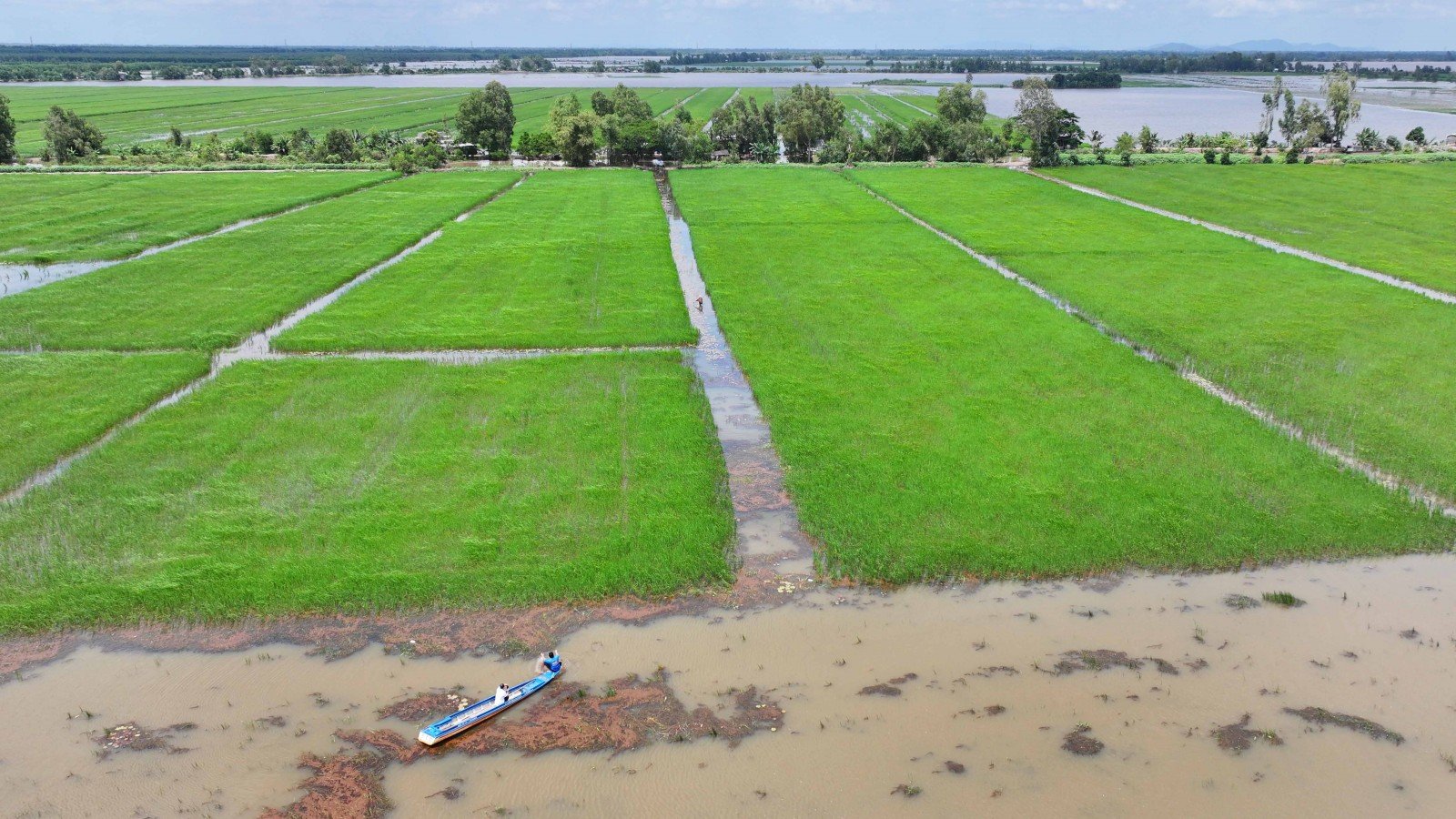
The floating rice plants grow larger as the floodwaters rise. Photo: THANH CHINH
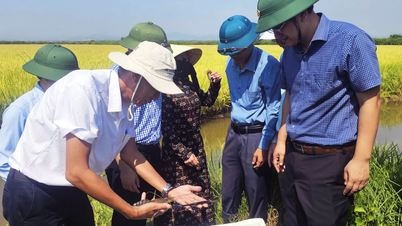
Crossing the dike along the rice paddies, we saw farmers sitting and watching over the water pumps to prevent flooding in their rice fields, which were bending like ripe tamarind fruit. This year, the floodwaters were so high that they almost reached the dike's edge, and some farmers, fearing their rice crops wouldn't be ready in time for harvest, were constantly on standby to drain the water. Continuing across the concrete bridge, we reached a hamlet of houses along the canal. During the flood season, the Long Xuyen quadrilateral plains were covered in vast stretches of water. Some sections of the canal banks were flooded up to knee-deep, yet farmers still drove back and forth daily to take their children to school and to the distant market. Passing through this sparsely populated, remote hamlet, we felt as if we had wandered into a remote area from decades ago, a time when our ancestors pioneered the reclamation of the acidic soil.
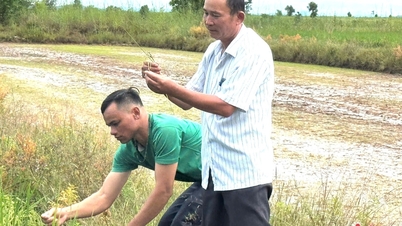
We arrived at a house with a corrugated iron roof, where we were greeted by Mr. Duong Minh Giang (30 years old), who has lived in this rice field since childhood, hardy and weathered by the harsh conditions of the acidic soil. Pointing to the flooded rice fields stretching towards the storm, Mr. Giang proudly said: "This flood season, my family planted 5 hectares of rice, and the rice is currently heading. Every day I go out to watch the floating rice plants grow with the rising water. The rice plants grow taller and taller as the water rises, it's a beautiful sight."
Conservation driven by passion.
Listening to Giang's story, we could feel this young farmer's passion for the floating rice crop in the acidic soil. Giang led us down to his composite boat and across the lush green floating rice fields. He stuck a pole deep into the water and pulled it up to show us; the water was nearly 1.7 meters deep. However, the rice plants were 0.6 meters above the water surface. The boat glided through the fields, yet the rice plants that had just fallen to the water's surface immediately straightened up, swaying in the wind. "Despite the effects of many storms during the flood season, the rice plants are unharmed, that's why I love cultivating this rice variety every year. Taking advantage of the flood season, I also fish around the fields with hooks and nets; if I have more than I can eat, I make fish sauce," Giang said.
The rice plants are floating 0.6m above the floodwaters. Photo: THANH CHINH
Currently cultivating 5 hectares of floating rice in this acidic soil field, Mr. Giang said that the characteristic of this rice variety is its adaptability to large floods. In the fifth lunar month, Mr. Giang soaks and germinates the seeds, then sows the rice. When the floodwaters inundate the fields, the rice plants grow day by day along with the floodwaters. “The cultivation process doesn't require much fertilizer or pesticides… Floating rice is super clean, free from weeds or pests. In December, when the water dries up, it's time for farmers to harvest. After that, I plant cassava to earn extra income,” Mr. Giang said.
Floating rice varieties have low yields. Currently, the price of rice is only 8,000 VND/kg, and the cultivation time is 6 months. After deducting costs, farmers don't make a profit. “Previously, Loc Troi Group had a contract to purchase floating rice at 15,000 VND/kg. It seems this type of rice is less popular in the market, so the company stopped signing contracts with farmers. After that, farmers produced floating rice and sold it to traders at low prices. According to experts, super-clean floating rice is considered an organic product, very good for health,” Mr. Giang said.
Mr. Dang Van Cuoc said that in the entire acidic soil area, there are still 17 households cultivating floating rice with an area of 60.5 hectares. Previously, hundreds of hectares of floating rice were cultivated here, but due to fluctuating prices, farmers are not enthusiastic about this rice variety. To preserve floating rice in the acidic soil, it is necessary for businesses to sign contracts to guarantee the purchase of the product so that farmers can feel secure in production. "Many farmers have the idea of offering tourists the opportunity to explore the techniques of growing floating rice in the flooded fields," Mr. Cuoc expressed.
According to Master's degree holder Le Thanh Phong, Deputy Director of the Institute of Climate Change at An Giang University, who specializes in researching, preserving, and breeding floating rice varieties, the floating rice in Vinh Gia commune is cultivated by farmers in a way that is "in harmony with nature." Farmers are currently preserving the genetic resources of this indigenous variety. Through research and surveys of floating rice in acidic soil fields, Mr. Phong stated that if the market and prices are unstable, the area under floating rice cultivation will gradually decrease over the years.
On a mild midday, bidding farewell to the barefoot farmers in the Long Xuyen quadrilateral rice paddies, and looking back at the floating rice fields, we hoped that in the future, large enterprises would come to purchase the ultra-clean produce from this acidic soil region, so that the farmers could have an easier life.
| According to Master's degree holder Le Thanh Phong, "There is a company in Ho Chi Minh City that is buying old, hard-cooked floating rice to make pho noodles for export to Europe. However, this company only started buying two years ago and is guaranteeing the purchase of the product in Vinh Chau commune, Tay Ninh province. I invited a company in An Giang to buy floating rice, and because it's a new business, the owner said they will gradually expand the scale of their floating rice product guarantee in the future." |
THANH CHINH
Source: https://baoangiang.com.vn/cay-lua-mua-noi-tren-dong-phen-a466979.html
![[Photo] General Secretary and President To Lam presides over a meeting on assessing national development resources.](https://vphoto.vietnam.vn/thumb/1200x675/vietnam/resource/IMAGE/2026/05/20/1779253785852_a1-bnd-2943-8519-jpg.webp)



![[Photo] National Assembly Chairman Tran Thanh Man working with the Standing Committee of the Economic and Financial Committee](https://vphoto.vietnam.vn/thumb/1200x675/vietnam/resource/IMAGE/2026/05/20/1779249584387_ndo_br_1-jpg.webp)






















































Comment (0)