

The 2025-2026 dry season is predicted to be more severe than ever due to climate change and the devastating consequences of Typhoon Yagi (Typhoon No. 3) in 2024. Given the alarming risk of forest fires, the Agriculture and Environment Newspaper interviewed Mr. Tran Van Trien – Head of the Forest Protection Department Region I – about the forest fire prevention situation in the North and the urgent solutions being implemented.
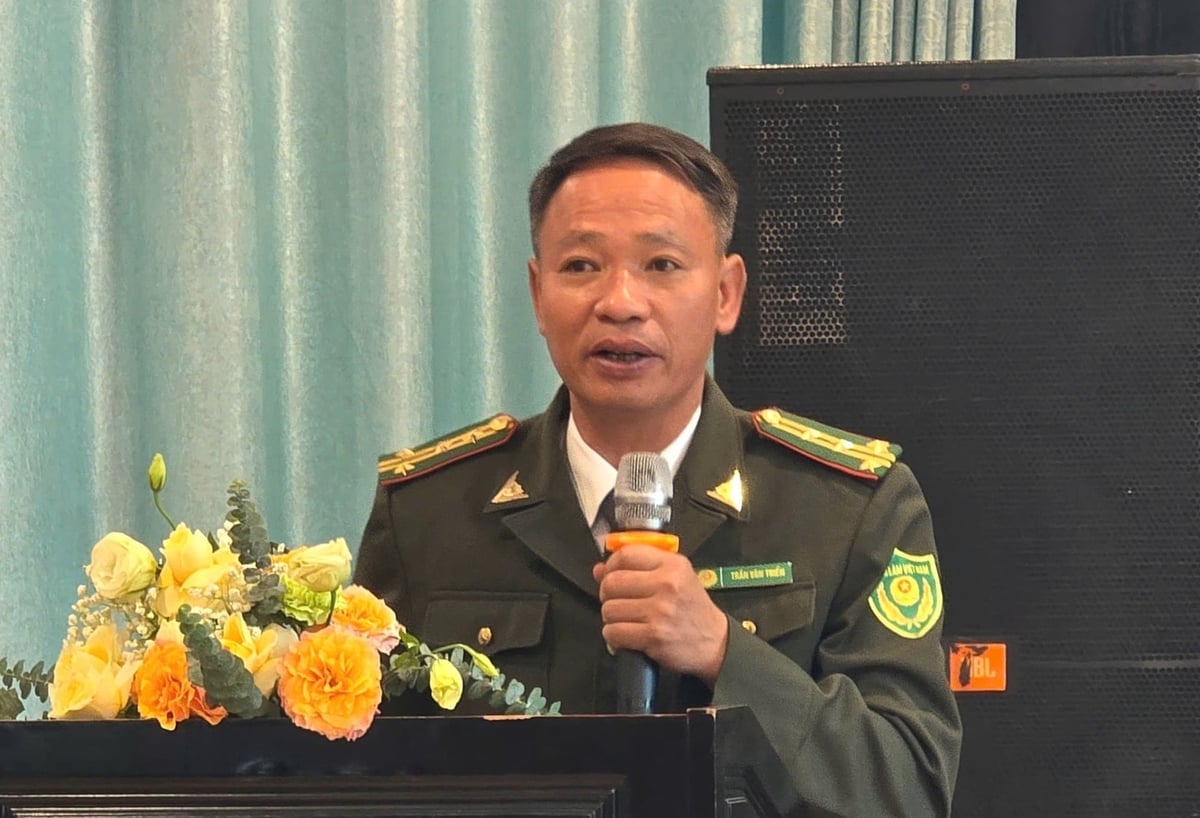
Mr. Tran Van Trien - Head of the Forest Protection Department, Region I. Photo: Dinh Muoi.
The risk of fire is unprecedentedly high.
Sir, could you give an overview of the current forest situation in Region I (Northern Vietnam), particularly in Quang Ninh province ?
Mr. Tran Van Trien: The operational scope of the Regional Forestry Department I after reorganization includes 12 provinces and cities with a total natural area of approximately 10.66 million hectares. The entire region has about 5.828 million hectares of forested land, accounting for 39.19% of the national forest area, including 3.89 million hectares of natural forest and 1.94 million hectares of planted forest; the average forest cover reaches 51.75%. Natural forests have very high biodiversity, many endemic species, and great value for conservation, scientific research and environmental protection, especially in mitigating flash floods and landslides on the steep and fragmented terrain of the North.

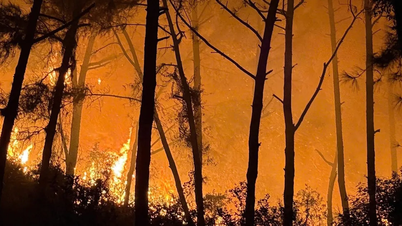
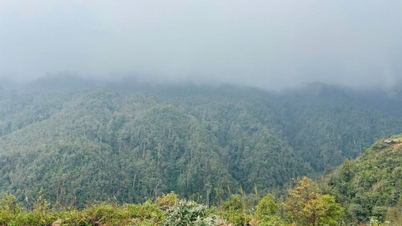
Climate change and the severe consequences of Typhoon No. 3 (Yagi) in 2024 are still present, posing a threat of forest fires during the 2025 dry season. Photo: Regional Forestry Department I.
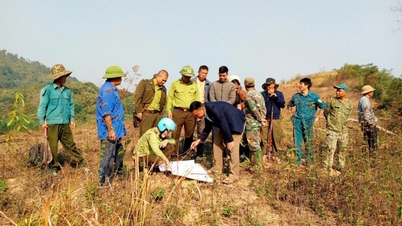
Quang Ninh province alone has approximately 433,666 hectares of forest land, with 282,010 hectares covered by forest (119,653 hectares of natural forest and 162,357 hectares of planted forest). This province also suffered the most severe damage from Typhoon Yagi, affecting 120,000 hectares of forest, with about 80,000 hectares completely destroyed and still unable to be replanted. The amount of fallen trees represents a "massive amount of flammable material," posing a very high risk of fire and threatening the environment and adjacent forests.
The number of fires increased by 37% in just 11 months.
This year's dry season is predicted to be longer and more severe. In your opinion, what is the current risk of forest fires in Region I?
Mr. Tran Van Trien: The prolonged dry weather, coupled with nearly 216,000 hectares of forest in the North being affected by storms (of which 129,000 hectares were completely destroyed and have not yet been replanted), has significantly increased the risk of forest fires. In fact, in the first 11 months of 2025, the entire region experienced 213 forest fires, an increase of 58 incidents (37%) compared to the same period in 2024. The entire political system had to mobilize nearly 10,000 people along with numerous vehicles and equipment to participate in firefighting efforts to minimize damage. We predict that the 2025-2026 dry season will remain very dangerous, with the potential for many large fires.
What specific measures has the Regional Forestry Department I implemented to protect forests and prevent forest fires?
Mr. Tran Van Trien: The Sub-Department has implemented comprehensive measures, with particular emphasis on forest fire prevention: issuing weekly forest fire forecasts (including holidays and Tet); urging localities to develop forecast level lookup tables; monitoring the warning system of the Department of Forestry and Forest Protection, and transferring 1,095 fire points to localities for immediate inspection and handling. We organized 12 mobile propaganda campaigns, numerous joint patrols, and urged forest owners, especially national parks and nature reserves, to strictly fulfill their obligations to protect forests and prevent and fight fires as stipulated by law.
How are activities such as constructing firebreaks and utilizing surveillance technology carried out?
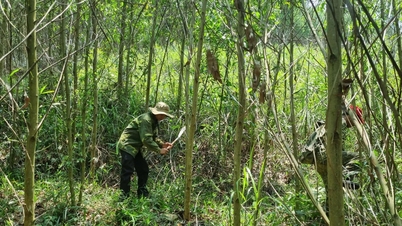
Mr. Tran Van Trien: Building firebreaks and clearing flammable materials are very effective solutions in fire prevention. Monitoring technologies such as drones and cameras are extremely useful in firefighting, helping commanders clearly identify the scope and scale of fires on the steep terrain of Northern Vietnam. Thanks to the attention of the Ministry of Agriculture and Environment, the Forestry and Forest Protection Department, the Sub-department has been equipped with some modern equipment, which significantly contributes to monitoring forest changes and promptly handling violations.
Inter-sectoral coordination – the key to sustainable forest protection.
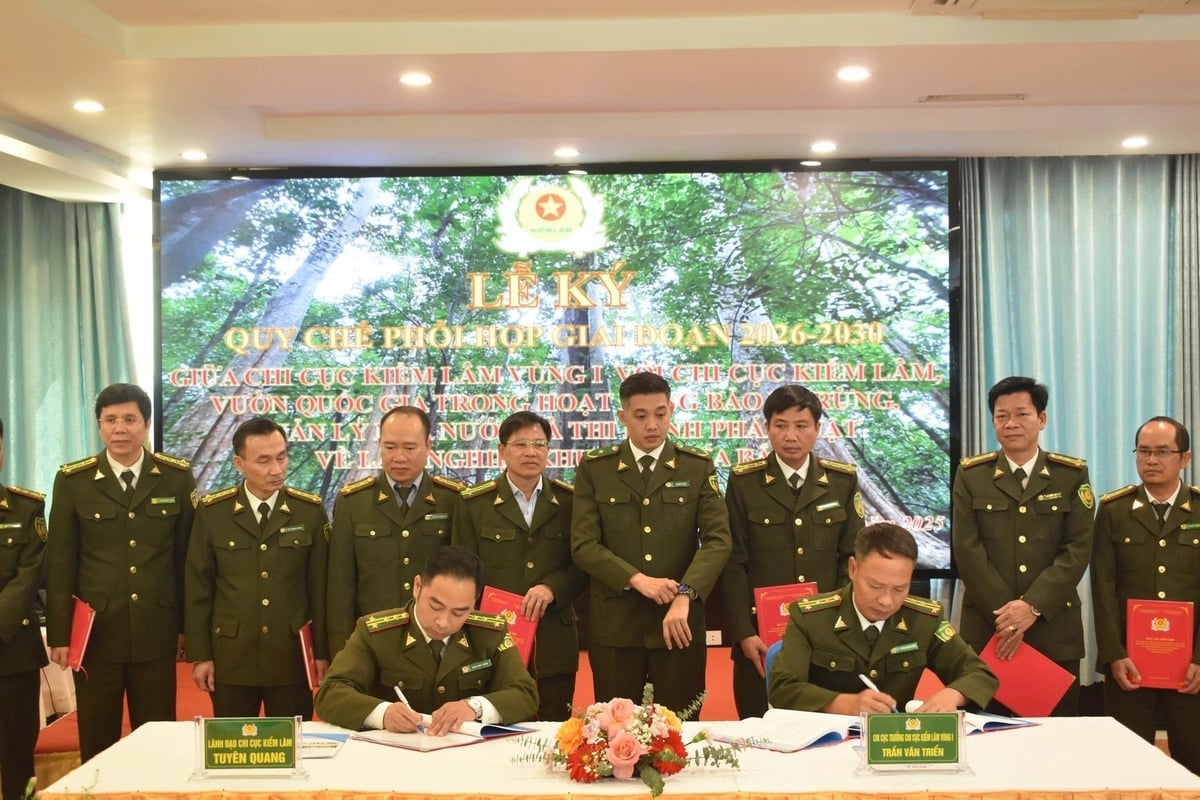
Signing ceremony for the cooperation agreement with the Regional Forestry Department I and local Forestry Departments. Photo: Dinh Muoi.
Could you share information about the coordination between the Sub-Department and local agencies and authorities, especially in supporting farmers in planting economic forests?
Mr. Tran Van Trien: Protecting and developing forests requires the joint efforts of the entire political system and society. Over the past 10 years, the Sub-Department has signed cooperation agreements with 12 provincial Forest Protection Sub-Departments and 8 National Parks, focusing on the implementation of forestry laws. The signing of these cooperation agreements aims to improve professional skills and enhance the efficiency of work. The Regional Forest Protection Sub-Department I, as a specialized state management agency, will assist national parks in the region in improving forest fire prevention and control, forest fire prevention and control measures, and forest fire warning systems. Furthermore, it will disseminate forestry laws to the people in particular and tourists in general, raising awareness of legal regulations to better protect forest resources.
As a result, violations are detected early and handled promptly; the consequences of illegal deforestation decreased by an average of 21.7% during the 2020-2025 period compared to the previous period. We also guide and support people in complying with regulations on plant varieties and forest product traceability, helping to provide legally sourced timber, bringing higher economic value to farmers and businesses. The Sub-Department coordinates the dissemination of information to raise awareness among people living near forests about legal regulations on forest protection, forest fire prevention and control, and prohibited acts under the Law on Forestry, etc., through various forms of communication, such as mobile outreach, leaflet distribution, and community meetings.
Mr. Tran Van Trien emphasized: "Forest fires during the 2025-2026 dry season are predicted to be very dangerous. The entire system is making every effort, but the cooperation of the community is essential to preserve the green lungs of Northern Vietnam, protect the environment, and ensure long-term livelihoods for farmers."
Thank you very much, sir!
Source: https://nongnghiepmoitruong.vn/chi-cuc-kiem-lam-vung-i-bao-dong-do-chay-rung-mua-kho-d789033.html

![[Image] Leaked images ahead of the 2025 Community Action Awards gala.](/_next/image?url=https%3A%2F%2Fvphoto.vietnam.vn%2Fthumb%2F1200x675%2Fvietnam%2Fresource%2FIMAGE%2F2025%2F12%2F16%2F1765882828720_ndo_br_thiet-ke-chua-co-ten-45-png.webp&w=3840&q=75)
![[Photo] Prime Minister Pham Minh Chinh receives Lao Minister of Education and Sports Thongsalith Mangnormek](/_next/image?url=https%3A%2F%2Fvphoto.vietnam.vn%2Fthumb%2F1200x675%2Fvietnam%2Fresource%2FIMAGE%2F2025%2F12%2F16%2F1765876834721_dsc-7519-jpg.webp&w=3840&q=75)


![[Photo] Prime Minister Pham Minh Chinh receives the Governor of Tochigi Province (Japan)](/_next/image?url=https%3A%2F%2Fvphoto.vietnam.vn%2Fthumb%2F1200x675%2Fvietnam%2Fresource%2FIMAGE%2F2025%2F12%2F16%2F1765892133176_dsc-8082-6425-jpg.webp&w=3840&q=75)














































![[Photo] Prime Minister Pham Minh Chinh attends the Vietnam Economic Forum 2025](https://vphoto.vietnam.vn/thumb/402x226/vietnam/resource/IMAGE/2025/12/16/1765893035503_ndo_br_dsc-8043-jpg.webp)

































Comment (0)