

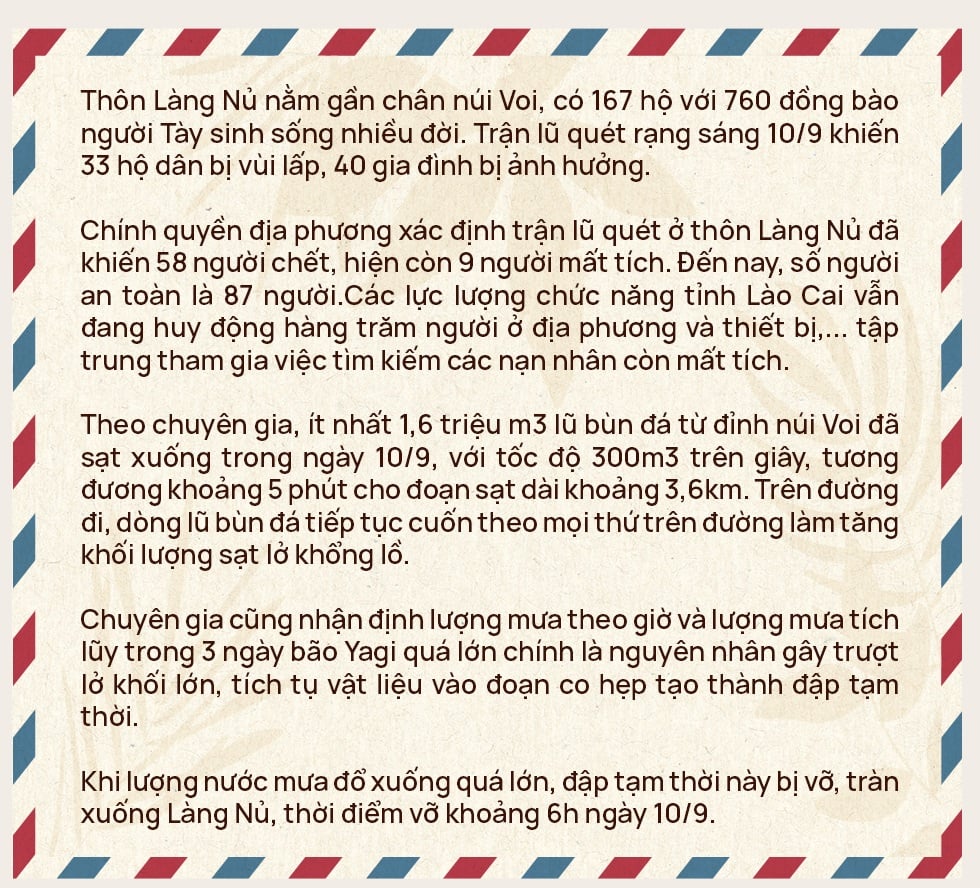
On September 10th, the village of Lang Nu, Phuc Khanh commune, Bao Yen district, Lao Cai province, was almost completely wiped out. At least 58 people have been confirmed dead, and nine are still missing, despite the search efforts of hundreds of officers and soldiers over the past two weeks.
As one of the units mobilized, the Hanoi Mobile Police Regiment (E22, Mobile Police Command, Ministry of Public Security ) sent 100 officers and soldiers to Lang Nu to organize rescue and search operations for victims.

At 9:00 AM on September 13th, Lieutenant Colonel Dang Hong Tinh, Deputy Commander of Regiment E22, along with his comrades, moved from the Regiment's headquarters in Soc Son district ( Hanoi ) to Phuc Khanh commune. After more than 7 hours of marching, the riot police soldiers arrived at Lang Nu village.
During his journey, Lieutenant Colonel Tinh only knew that the place he was about to go to perform his duty had been severely flooded, with many people in distress. He had almost no information from the scene because the village of Nủ was completely isolated in terms of communication at that time.
However, the closer he got to Nu Village, the more Tinh felt the seriousness and danger of the situation.
“After traveling along the Hanoi-Lao Cai expressway, the convoy turned onto National Highway 70 to reach Bao Yen district. Along the highway, many sections have experienced landslides, posing a constant risk of further incidents,” Lieutenant Colonel Tinh said.
Upon arriving at Nu Village, the sight before the Deputy Commander of Regiment E22 was "beyond imagination".
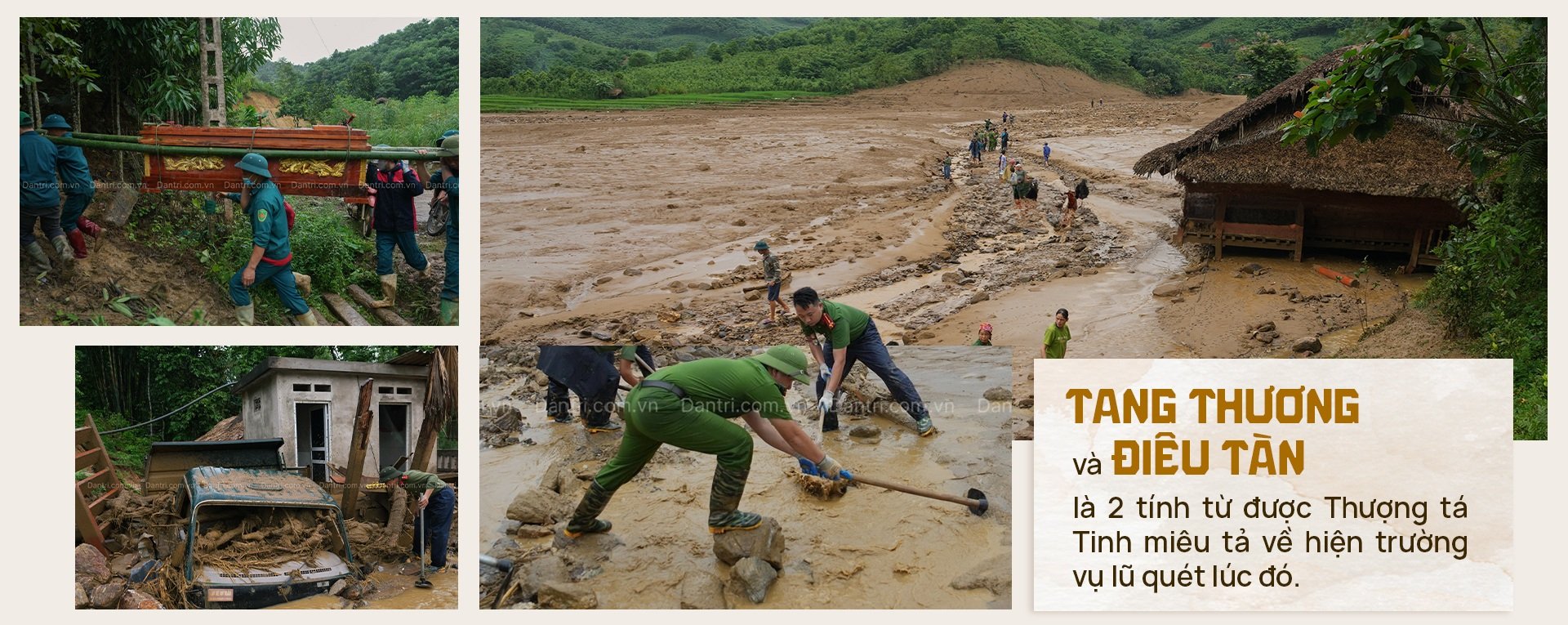
Grief and devastation are the two adjectives that Lieutenant Colonel Tinh used to describe the scene of the flash flood at that time.
"The entire village was reduced to just a few rooftops; the rest was mud, earth, rushing streams, and a pungent smell of death," the commander recounted, adding that the area the regiment was assigned to search was downstream, where many bodies were believed to be buried.
Observing those present at the scene, including many local residents and relatives of the victims, Lieutenant Colonel Tinh sensed their exhaustion and despair through their haggard, dazed, and "lost-hearted" faces.
“I felt so sorry for our compatriots. I couldn't believe how terrible and devastating the natural disaster was. At that time, all I could think about was how to get the assignment, quickly stabilize the living conditions of the soldiers, and get to work,” said Lieutenant Colonel Dang Hong Tinh.
Despite his high spirits, Tinh, as the commander of the unit, remained deeply concerned about the safety of his fellow soldiers, given the unstable conditions in Lang Nu village and the frequent occurrence of landslides and flash floods in many areas.

Describing the assigned area, Lieutenant Colonel Tinh stated that the search area covered approximately 750 square meters, along a 5-kilometer stretch of the floodwaters sweeping across a stream about 150 meters wide. With 100 soldiers under his command, the commander divided them into three teams of 30 soldiers each, while the remaining 10 were assigned logistical support and driving duties.
For the three search teams, the Lieutenant Colonel instructed each team to split into three groups, working in a sweeping motion horizontally along the stream, thoroughly searching each area before moving on. Each soldier was equipped with a face mask, life vest, gloves, etc.
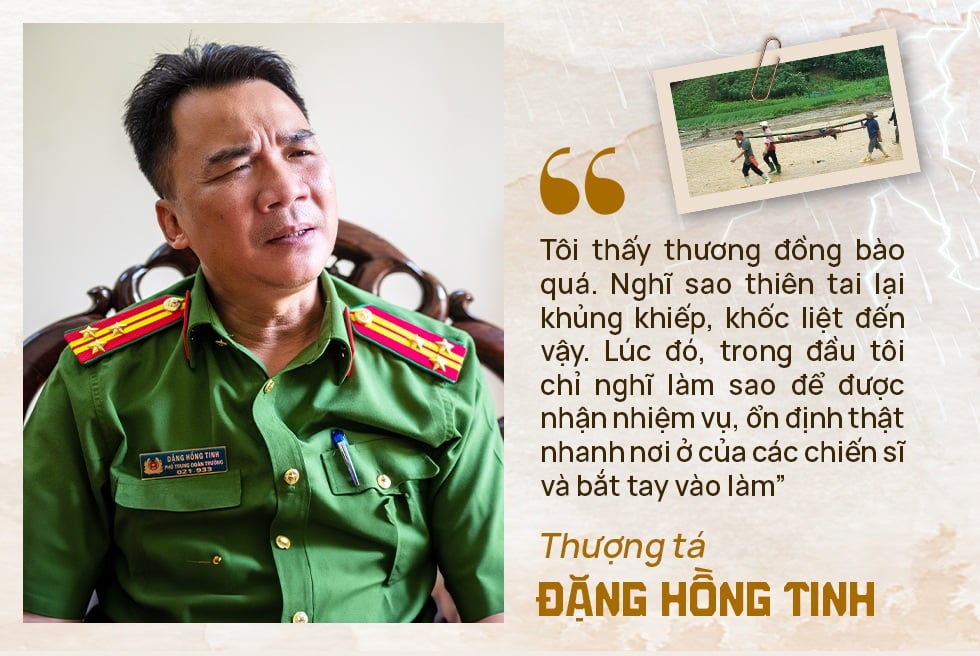
However, for Tinh personally and many of the riot police officers in the team, their experience in searching for and rescuing people during incidents and natural disasters was almost zero. Therefore, the team immediately learned from the experience of units that had organized search operations before.
“Each soldier, depending on their individual needs, would carry a crowbar, shovel, or a long stick (2-3 meters) to poke into the mud. When they pulled it out and smelled a foul odor, they suspected there was a body underneath. The body here wasn't necessarily that of a civilian; it could be an animal.”
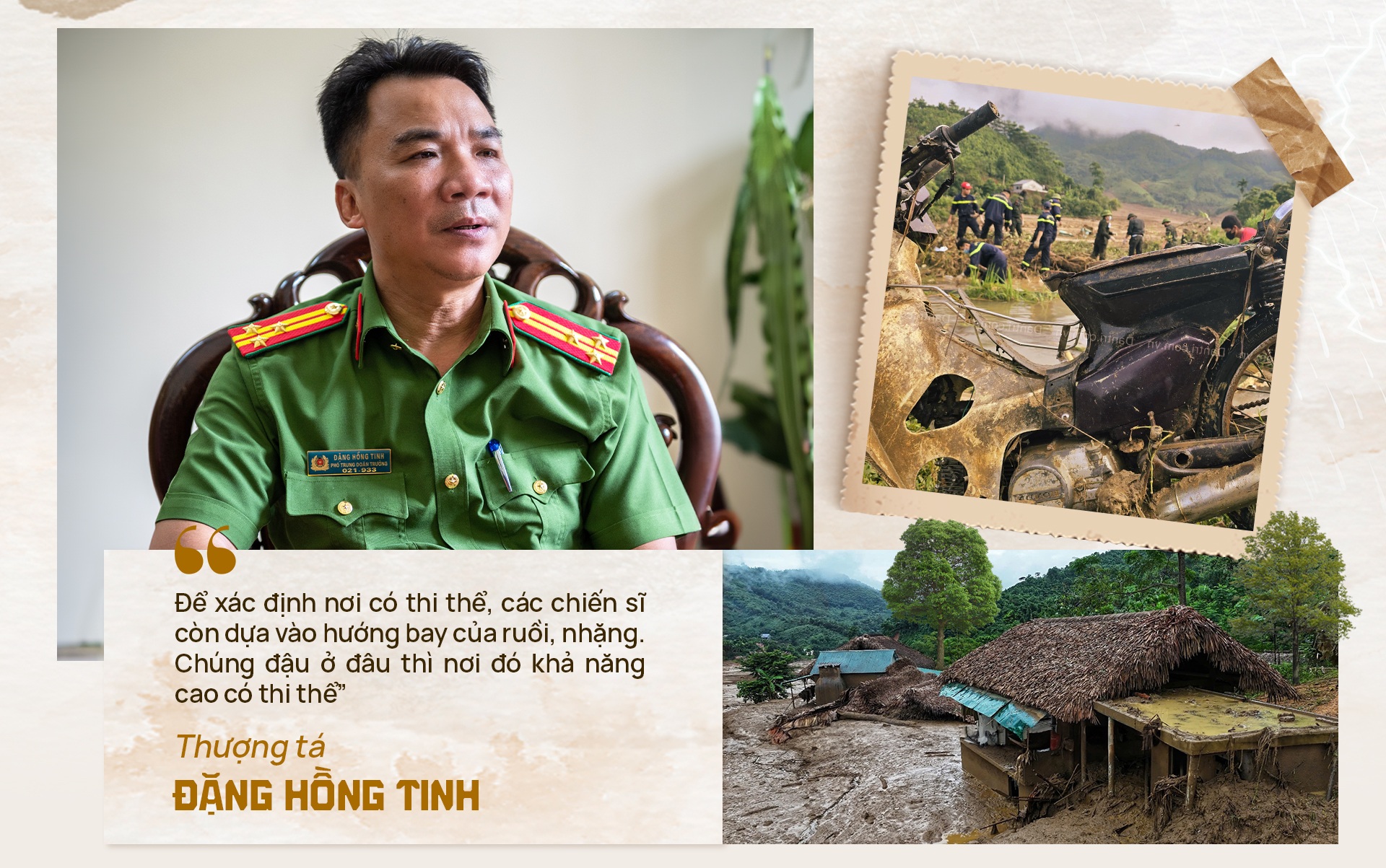
In addition, to pinpoint the location of a body, the soldiers also relied on the flight path of flies and gnats. Wherever they landed, there was a high probability that a body was there.
Another source of information comes from local residents. People living here know the area well, for example, where there used to be a pond, a body might be caught there, or which sections of the stream have swirling currents that could easily leave bodies behind," Lieutenant Colonel Tinh recounted the search method and emphasized the importance of local support.
The methods were in place, and personnel were actively deployed, but it wasn't until around 5 PM on September 15th, via radio, that Lieutenant Tinh received the first report about finding the bodies of people who died in the flash flood in Lang Nu village.
Despite his grief, the commander felt relieved that the efforts of all the soldiers had brought some final solace to the victims and their families.

Captain Pham Quang Chien is one of 90 riot police officers who directly waded through mud and soil to search for bodies buried in Lang Nu village.
While on duty in a place that had just claimed the lives of dozens of people, Captain Chien said he wasn't afraid at all, partly because he was a soldier assigned to the mission, and partly because the Captain knew he was going to rescue his fellow citizens in distress.
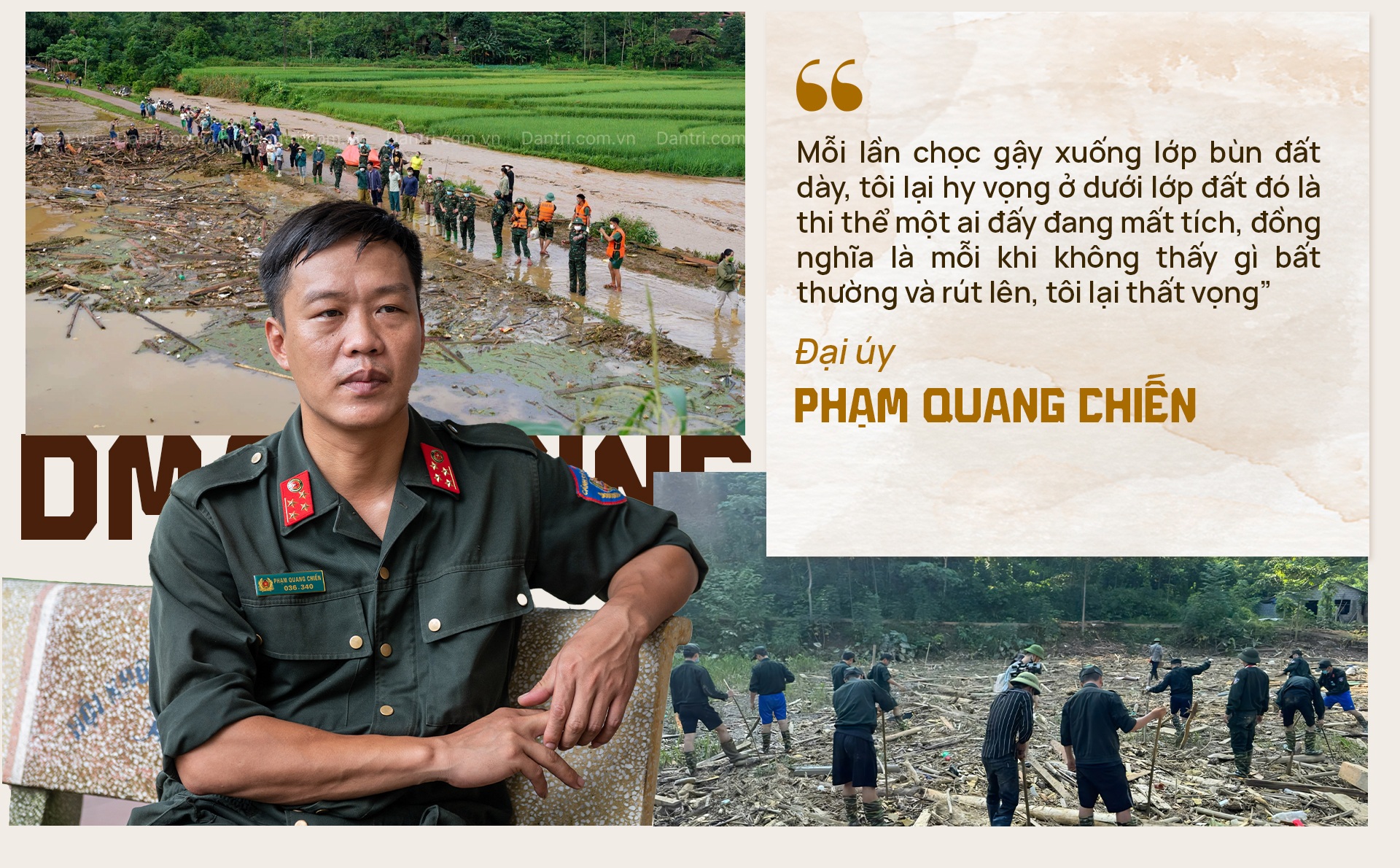
During those days, Captain Chien was equipped with boots, a combat vest… and a walking stick.
"Every time I poked the stick into the thick layer of mud, I hoped there was the body of someone missing beneath, and every time I saw nothing unusual and pulled it up, I was disappointed," Chiến recounted.
Recalling the incident, Captain Chien said that during the "search for bodies at the bottom of the mud," a young man born in 2000 repeatedly asked to accompany him.
“That young man was looking for his mother. Nine members of his family were buried in the flash flood in Nu Village. Eight bodies have been recovered, but only the body of his mother is still missing,” Chiến shared.
During their rare moments of conversation, Captain Chien could only offer words of encouragement to the young man and promise to do his best to find his mother.
On the afternoon of September 15th, Captain Chien's search team discovered the body of a man near the end of the area they were assigned to search. The body was lying face down, with its back exposed just above the muddy surface. After reporting to their commander, Captain Chien and another soldier were sent to approach the body to retrieve it.
Captain Chien and his teammates then put on life jackets, tied ropes around themselves, and were slowly lowered from a height of about 3 meters from the shore into the flash flood area. To retrieve the bodies, Captain Chien carried a sack to "wrap" them in, ensuring that "the bodies of our compatriots would not be damaged."
"Initially, I was a little scared because the corpse had been lying in the mud for several days and was in a state of decomposition. However, I quickly calmed down and tried to approach the body as gently as possible, avoiding damaging it," the officer shared.
Because he didn't want the body to be damaged, Chiến didn't use a hoe or shovel to dig through the mud, but used his bare hands.
This stage then encountered difficulties as Captain Chien's hand kept scraping away the mud, only for water and sand to bury it again. This forced the soldier to scrape continuously at a very fast speed, resulting in a deep cut caused by a piece of sheet metal hidden in the mud.
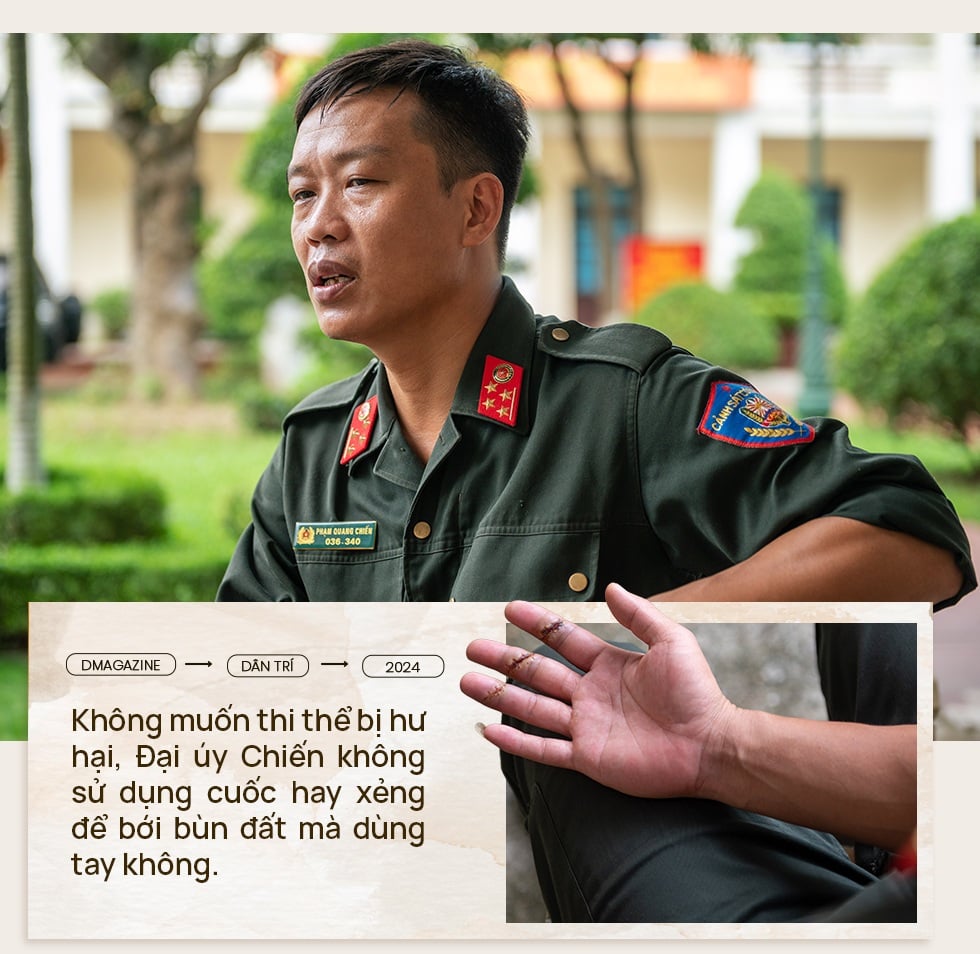
“The sheet metal cut through my gloves, tearing four fingers on my right hand. I didn't feel any pain at the time. I took off the torn gloves, put on new ones, then continued digging and put the victim's body into a bag, tying a rope so that people on the shore could pull it up,” Chiến recounted.
By the time the job was done, Captain Chien's right glove was soaked with blood. The riot police officer was immediately taken to the emergency room, where he received stitches and a tetanus shot. After receiving first aid, Captain Chien returned to the scene to continue his duties.
"The doctor told me the injury didn't affect the bone, but I'll have difficulty bending and grasping later," Chiến confided.
At approximately 7 PM on the same day, forces from Regiment E22 found another female body, about 3 km from the location of the first body.

According to Lieutenant Colonel Dang Hong Tinh, on the first day of approaching Lang Nu village, the soldiers of Regiment E22 stayed at a stilt house belonging to a local resident, about 7km from the scene. Later, the local authorities found and arranged for the soldiers to stay at a kindergarten, only about 1km from the area affected by the flash flood.
During their 8-day mission here, Tinh and his comrades received meals from kindhearted people and locals who cooked them in the town and brought them to Nu Village to ensure the soldiers' health.
“The people of Lang Nu village are mostly Tay, Dao, and Man ethnic groups. Their customs are very similar to those of the Kinh people, and they are very affectionate. Whatever they could do to help us, they would give it to us. If we needed a place to bathe, wash clothes, or sleep, the villagers would proactively invite us into their homes to do so.”
"At the first stilt house where we stayed on the first day, even a member of their family had lost someone in the flash flood. Yet, they still enthusiastically provided support," Lieutenant Colonel Tinh shared.
According to the Deputy Regiment Commander, during the course of their duties, the riot police officers inevitably suffered injuries, and many had stepped on nails.
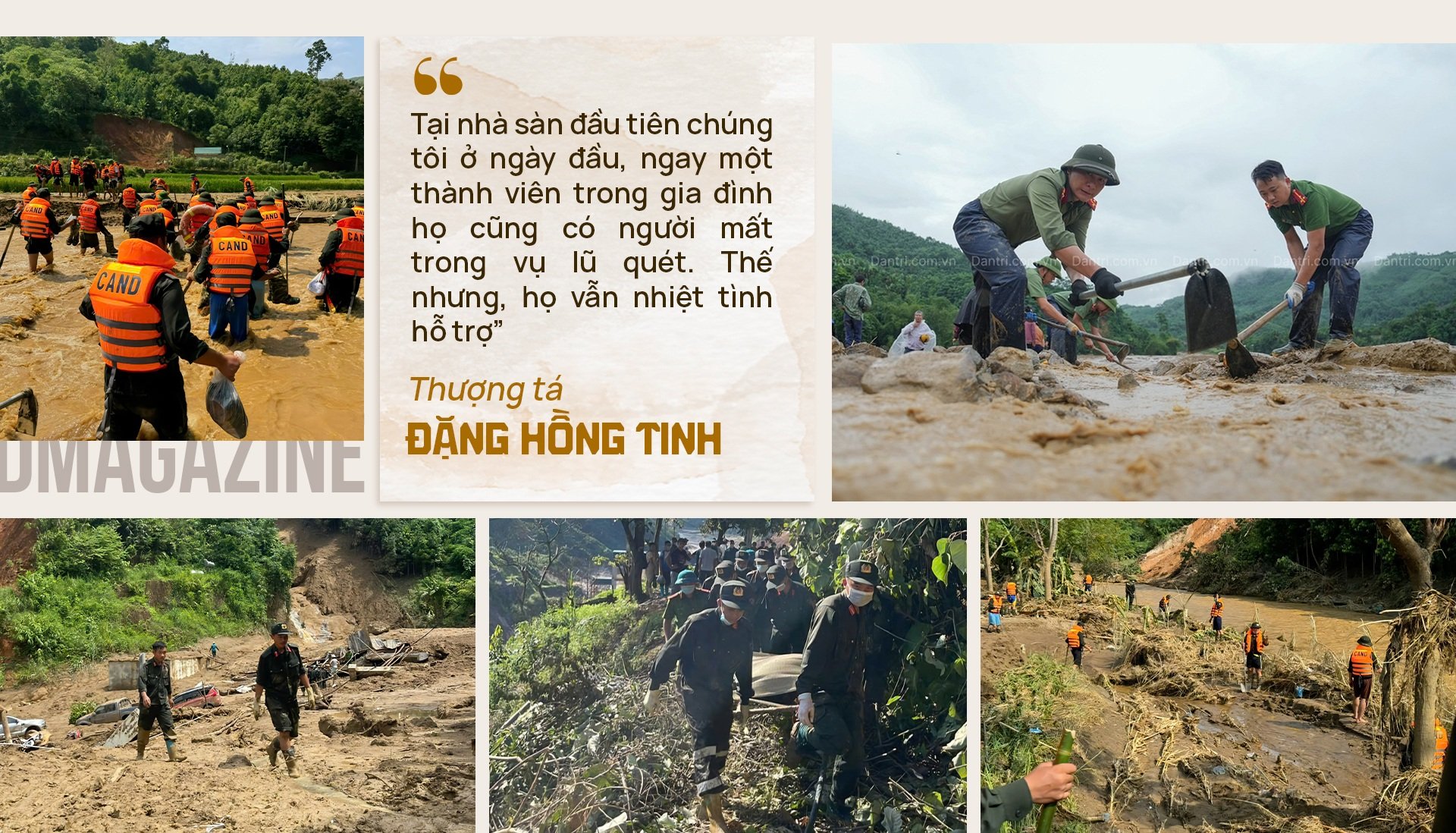
“Almost every day on duty, soldiers get injured. Besides that, the soldiers have to wear boots during marches, which leads to blisters on the soles of their feet. Although many soldiers expressed a desire to wear plastic sandals, I didn't allow it, because I was worried about everyone getting injured,” Lieutenant Colonel Tinh said.
After an 8-day search operation, the Hanoi Mobile Police Regiment recovered two bodies of victims from the flash flood in Lang Nu village. Returning from the operation, Lieutenant Colonel Tinh was still deeply saddened and troubled, knowing that beneath the mud and debris lay the bodies of his fellow villagers yet to be found.
According to Colonel Nguyen Van Hung, Commander of the Capital City Riot Police Regiment, during Typhoon Yagi and its aftermath, the Regiment dispatched 300 officers and soldiers to Tuyen Quang, Lao Cai, Ha Nam, Hung Yen, etc., to reinforce and coordinate with local forces in dealing with the consequences of the typhoon.
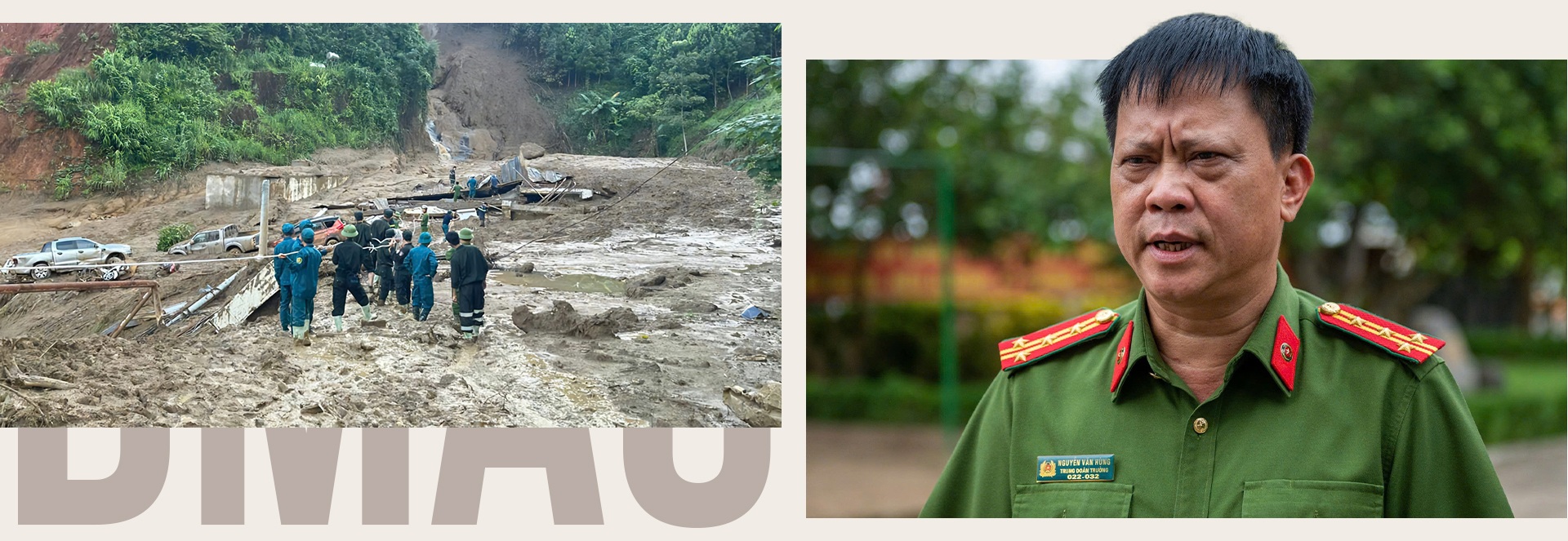
In Lao Cai, the regiment mobilized 200 soldiers, divided into two groups. One group advanced into Lang Nu village, the other went to Bac Ha district. In Bac Ha district, 100 riot police officers were further divided into two teams.
One team, consisting of 20 soldiers led by Major Dang Cong Khoi (Deputy Battalion Commander), was tasked with searching for and rescuing four missing victims at the landslide at the Southeast Asia Hydropower Plant's control building. The second team went to Nam Tong village, where 18 people were found missing under the rubble.
After 15 days, 200 riot police officers in Lao Cai successfully recovered a total of 20 bodies of victims and handed them over to local authorities and families for burial.
Besides search and rescue operations, soldiers from Regiment E22 also helped people clean up their homes and overcome the aftermath of the storm; and donated many gifts to the people of Nam Luc commune, Bac Ha district.
As a result, 2 collectives and 47 individuals of Regiment E22 were awarded certificates of merit and commendations by the People's Committee of Lao Cai province, the People's Committee of Hai Ba Trung district (Hanoi), the Lao Cai Provincial Police, etc.
Dantri.com.vn
Source: https://dantri.com.vn/xa-hoi/chuyen-mo-xac-day-bun-tai-lang-nu-cua-nguoi-linh-cscd-20241004194141432.htm






![[Photo] Prime Minister Pham Minh Chinh attends the inauguration ceremony of the Lang Nu village reconstruction project.](https://vphoto.vietnam.vn/thumb/402x226/vietnam/resource/IMAGE/2025/1/20/1e004d2c56404dba91ad022d6f4fc1cd)














































































Comment (0)