

Tuffy , a young red-tailed falcon whose nest was stolen by a bald eagle on May 20th, is now living with the family of its captor in the Bay Area forest.
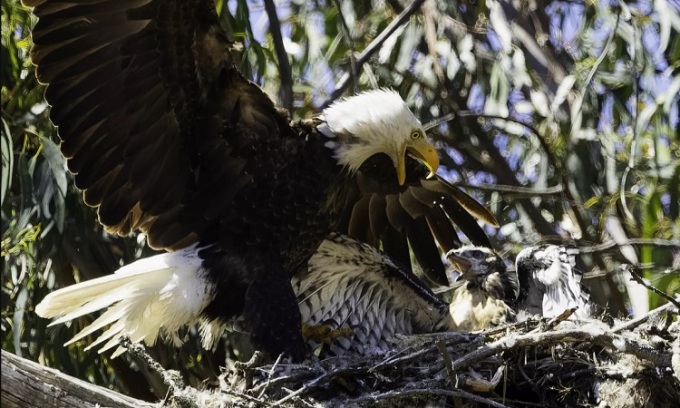
Young red-tailed falcons grow up in an eagle's nest. Photo: Doug Gillard.
The foster parents brought food back for Tuffy and their biological offspring, Lona. Tuffy is growing very quickly; in the past week, it has successfully flown several times, according to the Los Angeles Times . This came as a surprise to birdwatchers because, for them, bald eagles and red-tailed hawks are "eternal enemies." This behavior is extremely rare and has only been recorded four times in the wild.
Six weeks ago, Doug Gillard, a professor of surgery and physiology at Life Chiropractic College West in Hayward, photographed the eagle family. He discovered the nest last year and returned in January of this year to observe the eagles mating, nesting in the eucalyptus tree, incubating their eggs, foraging, and caring for their new chick, Lona.
The bald eagle was removed from the US Endangered Species list in 2017 but remains endangered in California. They have a wingspan of 2.4 meters and weigh 3.6–6.4 kg. The red-tailed hawk is smaller and more abundant. Its wingspan is only half that of the bald eagle, and it weighs about one kilogram. The binoculars image of Tuffy and Lola clearly shows the size difference between the two species.
Gillard encountered the female eagle dropping Tuffy into the nest on May 20th. He was surprised to find it alive the next day. A week later, a second falcon chick appeared in the nest, but it was much smaller and disappeared overnight. A nearby livestock farmer told Gillard that the male eagle had killed it.
No one knows for sure what's going on, but some experts say the female eagle may have captured the young red-tailed hawk while foraging for food for her offspring. After dropping the hawk into the nest and hearing its calls, the female eagle may have become confused. "I've read about some similar adoption cases. The young hawk was brought back to the nest as prey but survived," shared Cheryl Dykstra, a bird of prey researcher and editor at Raptor Research. "The parent eagle then started feeding the hawk as if it were their own offspring."
According to Dykstra, this behavior has also been observed in several other species of the family, including white-tailed sea eagles adopting kites. "It's unclear whether birds of prey can distinguish their own offspring, but they generally don't show aggression towards adopted chicks," Dykstra said.
Jordan Spyke, director of bird of prey rescue and operations at the Montana Bird Conservation Center, speculates that the eagle didn't know the young red-tailed hawk was still alive when it caught it because hawks typically lie flat when they spot predators, especially young ones.
An Khang (According to Los Angeles Times )
Source link


![[Photo] Prime Minister Pham Minh Chinh holds a phone call with the CEO of Russia's Rosatom Corporation.](/_next/image?url=https%3A%2F%2Fvphoto.vietnam.vn%2Fthumb%2F1200x675%2Fvietnam%2Fresource%2FIMAGE%2F2025%2F12%2F11%2F1765464552365_dsc-5295-jpg.webp&w=3840&q=75)
![[Photo] Closing Ceremony of the 10th Session of the 15th National Assembly](/_next/image?url=https%3A%2F%2Fvphoto.vietnam.vn%2Fthumb%2F1200x675%2Fvietnam%2Fresource%2FIMAGE%2F2025%2F12%2F11%2F1765448959967_image-1437-jpg.webp&w=3840&q=75)
















































![[OFFICIAL] MISA GROUP ANNOUNCES ITS PIONEERING BRAND POSITIONING IN BUILDING AGENTIC AI FOR BUSINESSES, HOUSEHOLDS, AND THE GOVERNMENT](https://vphoto.vietnam.vn/thumb/402x226/vietnam/resource/IMAGE/2025/12/11/1765444754256_agentic-ai_postfb-scaled.png)

















































Comment (0)