

Commune-level officials and civil servants are directly responsible for organizing and implementing the Party's guidelines and policies, and the State's laws and regulations, to the people. Their professional skills and expertise determine the effectiveness of their work at the local level. Therefore, Dai Tu district always prioritizes improving the professional skills and expertise of its commune-level officials to meet the demands of socio-economic development.
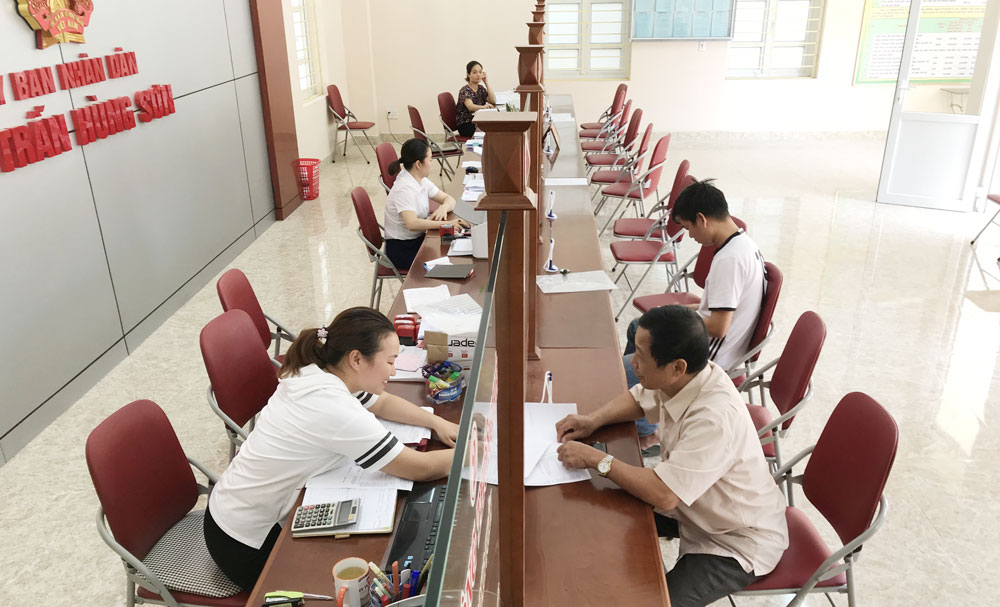 |
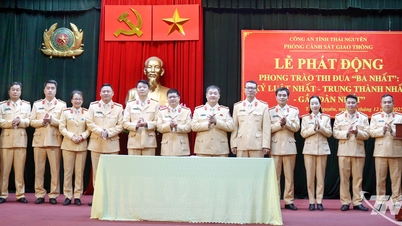
| The staff and civil servants of Hung Son town all meet the required standards and fulfill their duties well. |
Comrade Nguyen Manh Hoat, Permanent Deputy Secretary of the Dai Tu District Party Committee, said: The 4.0 era demands that the cadre team become increasingly sophisticated, not only excelling in professional skills and state management, but also possessing knowledge of information technology, foreign languages, and the ability to apply information technology to their work. Therefore, the District Party Committee has directed the Party committees of communes and towns to do a good job of managing, educating , and training the local cadre team.
First and foremost, it is necessary to raise awareness and responsibility throughout the entire political system, especially at all levels of Party committees, regarding improving the quality of grassroots cadres. This includes promoting the responsibility of cadres, Party members, subordinate Party branches, the Fatherland Front, and political and social organizations at the grassroots level in identifying, recommending, educating, and training personnel to meet the immediate and long-term needs of cadre work.
In addition, Party committees at agencies and units strictly implement working regulations and refine working regulations according to their functions and tasks. These regulations include provisions defining responsibilities and authority regarding personnel development, placement, and arrangement, ensuring they align with practical realities and the requirements of personnel management.
Based on the annual staffing quotas, the district strictly implements the recruitment, training, and professional development of cadres, civil servants, and public employees in accordance with regulations, ensuring that the positions to be filled are filled.
In addition, communes and towns regularly review the professional qualifications and political theory of their staff and civil servants to develop plans for training and professional development to meet the requirements of their duties. From there, they select and send officials, civil servants, and public employees for training and professional development in specialized skills, politics, foreign languages, computer skills, information technology applications, and skills according to job title standards, competency frameworks, and job positions… Simultaneously, they register training and professional development plans to standardize the workforce.
From 2021 to the present, the district has organized 142 training courses for over 9,500 participants, including officials and civil servants, to improve their skills. In addition to professional training and theoretical education, the district has collaborated with various departments to organize hands-on training sessions.
Furthermore, the district regularly and rigorously implements inspection, supervision, and strict management of its staff and civil servants. The responsibility of the head of each agency and unit in managing their staff and civil servants is emphasized within their authority.
Timely commendation and rewarding of officials and civil servants who have excellently completed their tasks; at the same time, strictly and resolutely handling cases of officials and civil servants who violate ethical standards, lifestyle, work discipline, or fail to complete assigned tasks.
Dai Tu District has 29 administrative units, including 27 communes and 2 towns, with over 500 commune-level officials and civil servants. In recent years, this workforce has been gradually standardized and its quality improved.
Currently, 100% of key officials at the commune level have professional qualifications from university level or higher; 100% of grassroots Party committee members have professional qualifications from intermediate level or higher and political theory qualifications from intermediate level or higher; 100% of grassroots Party committee members have received training in professional skills, Party building work, state management knowledge, and legal knowledge.
The Fatherland Front and mass organizations at the commune and town level have 144/144 heads and 88/138 deputy heads with intermediate-level political theory qualifications. The Fatherland Front and mass organizations at the commune and town level have 132/144 heads with university-level professional qualifications and 96/138 deputy heads with intermediate-level political theory qualifications. Among commune and town-level civil servants, 209/255 have university-level professional qualifications and 163/255 have intermediate-level political theory qualifications.
It can be seen that the commune-level officials in Dai Tu district have undergone many changes and are increasingly meeting the requirements of their tasks. According to annual assessments of official performance, 90% of officials and civil servants have completed their tasks well or better.
Source link

![[Photo] Prime Minister Pham Minh Chinh receives the Governor of Tochigi Province (Japan)](/_next/image?url=https%3A%2F%2Fvphoto.vietnam.vn%2Fthumb%2F1200x675%2Fvietnam%2Fresource%2FIMAGE%2F2025%2F12%2F16%2F1765892133176_dsc-8082-6425-jpg.webp&w=3840&q=75)
![[Photo] Prime Minister Pham Minh Chinh receives Lao Minister of Education and Sports Thongsalith Mangnormek](/_next/image?url=https%3A%2F%2Fvphoto.vietnam.vn%2Fthumb%2F1200x675%2Fvietnam%2Fresource%2FIMAGE%2F2025%2F12%2F16%2F1765876834721_dsc-7519-jpg.webp&w=3840&q=75)

![[Live] 2025 Community Action Awards Gala](/_next/image?url=https%3A%2F%2Fvphoto.vietnam.vn%2Fthumb%2F1200x675%2Fvietnam%2Fresource%2FIMAGE%2F2025%2F12%2F16%2F1765899631650_ndo_tr_z7334013144784-9f9fe10a6d63584c85aff40f2957c250-jpg.webp&w=3840&q=75)
![[Image] Leaked images ahead of the 2025 Community Action Awards gala.](/_next/image?url=https%3A%2F%2Fvphoto.vietnam.vn%2Fthumb%2F1200x675%2Fvietnam%2Fresource%2FIMAGE%2F2025%2F12%2F16%2F1765882828720_ndo_br_thiet-ke-chua-co-ten-45-png.webp&w=3840&q=75)






























![[Photo] Prime Minister Pham Minh Chinh attends the Vietnam Economic Forum 2025](https://vphoto.vietnam.vn/thumb/402x226/vietnam/resource/IMAGE/2025/12/16/1765893035503_ndo_br_dsc-8043-jpg.webp)



















Comment (0)