

| Imports of Chinese cars into Vietnam are increasing rapidly, and prices are expected to continue falling. Chinese cars are "flooding" Vietnam. |
Competition in the Chinese automotive market is becoming increasingly fierce.
Support from the Chinese government has helped domestic automotive companies develop and compete strongly in the market, especially in the areas of technology and software for electric vehicles.
This investment and subsidies help Chinese companies research, develop, and manufacture advanced automotive products, while reducing production costs and increasing competitiveness. This has led to a significant decline in US car sales in China, from their peak a few years ago.
Michael Dunne of Dunne Insights, who has studied the Chinese market and other Asian countries for nearly 30 years, said: “It is highly likely that major automakers such as Ford, GM, Hyundai, Kia, and Nissan could leave the Chinese market within the next five years, as they are no longer competitive enough.”
General Motors' (GM) sales in China, including those from its joint ventures in the country, fell from a high of 4 million vehicles in 2017 to 2.1 million in 2023. This figure is lower than the 2.59 million vehicles sold in the US for the first time since 2009.
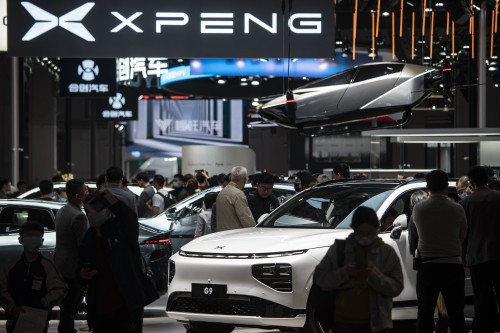 |
| The Chinese automotive market is very dynamic and highly competitive. (Photo: CNBC) |
The decline in General Motors' earnings from the Chinese market is a significant indicator of the company's performance in the country. Earnings fell 34% year-on-year to $446 million, and a 54% year-on-year drop in the fourth quarter alone, suggesting GM is facing serious challenges in the Chinese market.
Several factors have contributed to the decline of American automakers in China. These include competition from Chinese automakers, challenges related to costs and profitability, and competition from foreign rivals.
Chinese automakers not only have the advantage of low production costs but also government support, a deep understanding of the local market, and the flexibility to meet consumer demands.
With increasing competition from Chinese automakers, American and other manufacturers are having to find ways to adapt or limit their operations in this market.
China is stepping up innovation, investment, and international cooperation in automobile manufacturing.
Chinese automakers have learned a great deal from foreign automakers through collaborations and acquisitions of brands, such as those from the UK and Sweden, aimed at accessing technology and management expertise from foreign companies. China has acquired brands like MG, Lotus, and Volvo, helping them expand their reach and strengthen their brands in the global market.
In addition, Chinese automakers, such as BYD, have increased investment in research and development of advanced automotive technologies, including electric vehicles and autonomous cars.
At the same time, China is also actively cooperating with foreign companies, such as Berkshire Hathaway's investment in BYD. This demonstrates the interest in and confidence in the development potential of the Chinese automotive industry. This cooperation process brings financial benefits, providing capital and management expertise to Chinese automakers.
The Chinese automotive market has undergone significant changes over the past decade, witnessing a strong development of smart, connected technologies in the automotive industry. Bill Russo, a former Chrysler executive who runs Automobileity, a Shanghai-based consulting firm, points out that American automakers should not abandon the Chinese market despite declining sales.
For American automakers and their non-Chinese partners, finding a suitable and flexible development strategy in a highly competitive market is essential. This may include strengthening research and development, seeking local strategic partners, and optimizing marketing and sales strategies.
Source: https://congthuong.vn/doanh-so-ban-hang-giam-sau-cac-nha-san-xuat-o-to-my-lo-mat-thi-truong-ty-dan-319618.html































































































Comment (0)