

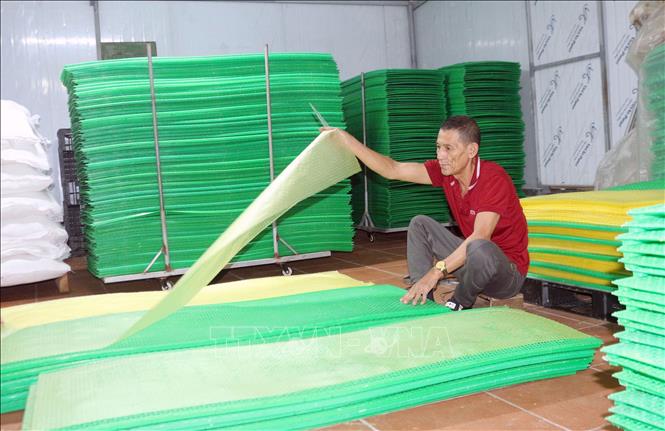
Born in a traditional rice paper making village with hundreds of years of history, Mr. Tran Ngoc Nghia has always been concerned with preserving and developing the profession left by his ancestors. In 2021, after many years of working abroad, he decided to return to his hometown to start a business, finding ways to overcome the limitations of manual production methods, developing the traditional rice paper making profession to a new level.
With the accumulated capital, Mr. Nghia borrowed more from friends and relatives to invest nearly 3 billion VND to build a factory, invest in modern machinery and equipment for production such as: automatic flour mixer, dough sheeter, dryer... Applying technology to production not only helps save time but also ensures the exact ratio of flour and water, the even thickness of the cake, helping the cake not to crumble or stick together. The industrial drying method helps him to always be proactive in the production stage, not interrupted by weather factors. The products made ensure food hygiene and safety, can be preserved longer and retain their characteristic flavor.
Mr. Tran Ngoc Nghia shared that applying technology to production not only helps improve product quality but also increases productivity 2-3 times, meeting the increasing number of orders. Each year, after deducting expenses, his rice paper production facility earns 400-500 million VND, creating regular jobs for 20 middle-aged workers in the locality with an income of 6-7 million VND/person/month. Currently, he hopes that associations and unions will create conditions to access loan programs to expand production scale, contributing to preserving and developing the traditional craft of his hometown.
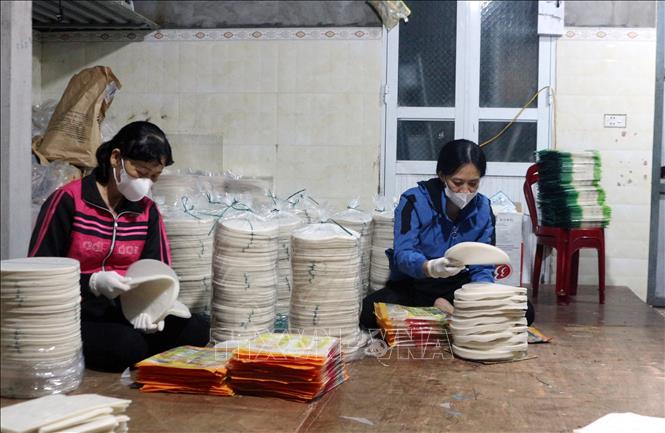
Constantly improving the production process, boldly investing in modern machinery, aiming to improve productivity and product quality, Mr. Nguyen Van Dinh, Tran Xa village, Nam Xang commune has also succeeded in exporting his hometown's traditional rice paper to France - a market that requires many very strict standards.
Mr. Nguyen Van Dinh said that in order to overcome the limitations of the previous manual method of making rice paper, he has researched and applied modern technology in a closed production model, ensuring food hygiene and safety: automatic dough mixer, dough rolling machine, automatic packaging; switching from drying in the room to continuous drying in the form of a chain. After being spread on the screen, the rice paper will dry after a period of movement. It is the initiative in the production process that has helped the facility access large orders.
In particular, in 2020, after many exchanges and sending samples to France, his facility's rice paper products met export standards. His family's export turnover is currently about 500 million VND/year. This is not a large number, but it is a source of pride and good news for him and the villagers. Currently, he is stepping up promotion and advertising to increase export sales as well as expand the consumption market for his hometown's traditional rice paper products.
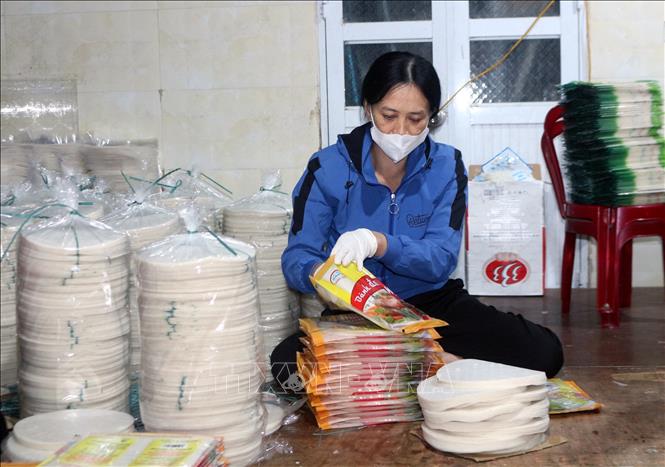
In Nam Xang commune, there are currently over 900 households producing and processing rice paper products with nearly 200 rice paper making machines and about 20 households investing in dryers, creating jobs for over 1,200 local workers. The local traditional rice paper products are famous throughout the regions and are present in all parts of the country, especially nearly 30% of the output is exported to countries: China, India, France and Eastern European countries.
Mr. Tran Van Tuong, Chairman of the Association of Production and Trading of Rice Paper in Cheu Village, said that in the past, the traditional rice paper production process was completely dependent on the weather, especially the drying stage, but in recent years, local rice paper producers and traders have boldly invested in machinery, factories and modern equipment, contributing to increasing productivity and product quality. The application of modern technology combined with the secret of the profession helps people get rich, increase income from the simple products of their homeland, and at the same time increase the value of products made from rice grains to reach out to the world .
Source: https://baotintuc.vn/kinh-te/don-bay-phat-trien-nghe-truyen-thong-banh-da-nem-lang-cheu-20251110133243821.htm































































![Dong Nai OCOP transition: [Article 3] Linking tourism with OCOP product consumption](https://vphoto.vietnam.vn/thumb/402x226/vietnam/resource/IMAGE/2025/11/10/1762739199309_1324-2740-7_n-162543_981.jpeg)






Comment (0)