

When you gaze up at the night sky, the light from the twinkling stars is actually a message from the past. These celestial bodies emitted light millions, even billions of years ago, and have only recently reached Earth. So how can telescopes "see" such distant galaxies?
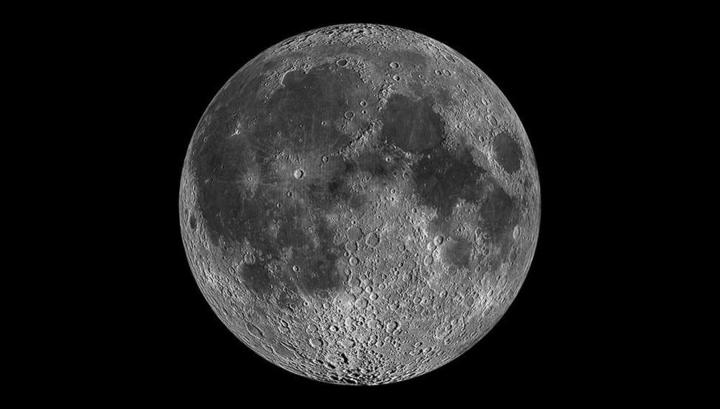
Although the Moon is very close to us, it still takes 1.3 seconds for the light emitted from it to reach the observer's eye. (Source: NASA)
Light – a message from the distant universe
Celestial bodies in the universe constantly emit electromagnetic radiation, including light visible to the human eye. This light travels at a speed of approximately 300,000 km/s. When we say a galaxy is 13 billion light-years from Earth, it means that light from that galaxy has taken 13 billion years to reach us. Therefore, telescopes don't see the present, but rather the past of the universe.
The human eye has a very limited ability to gather light. Meanwhile, telescopes act as giant light collectors. The light-gathering capacity of a telescope is directly proportional to the square of its principal mirror diameter. For example, a 2-meter diameter telescope can gather four times more light than a 1-meter telescope.
The telescope located atop Mauna Kea (Hawaii) has a 10-meter mirror capable of gathering 600,000 times more light than the human eye. Thanks to this, it can observe galaxies more than 13 billion light-years away.
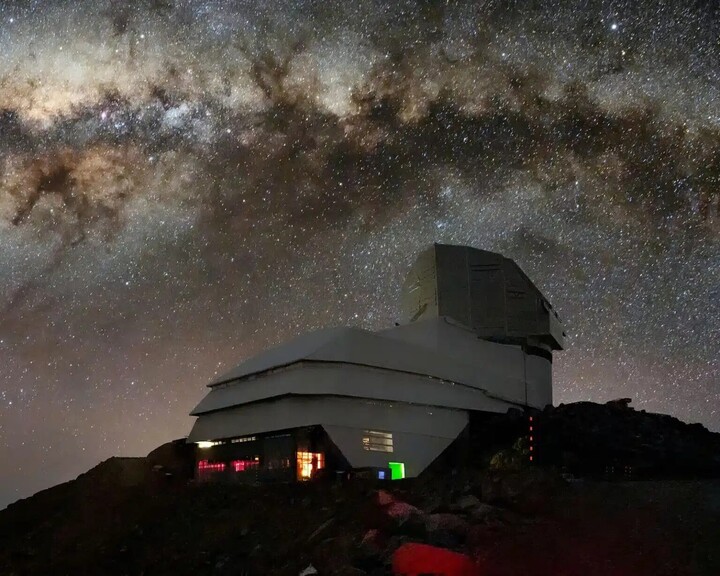
The Vera C. Rubin Observatory is one of the world's most advanced ground-based telescopes. (Source: Rubin Observatory)
The Vera C. Rubin Observatory is one of the world's most advanced ground-based telescopes, built atop Cerro Pachón in Chile. The Vera C. Rubin Observatory will receive its "first light" on June 23, 2025, marking the moment the telescope begins operation and records its first images from space.
In over seven hours of observation, Rubin captured 678 images, revealing details of the Trifid Nebula, the Lagoon Nebula, and thousands of distant galaxies. Simultaneously, the telescope also discovered more than 2,000 new asteroids, demonstrating its ability to track objects within the Solar System.
Rubin has embarked on a 10-year survey phase – the Legacy Survey of Space and Time (LSST) – aimed at creating a “cosmic film” of the evolution of galaxies, stars, and planets.
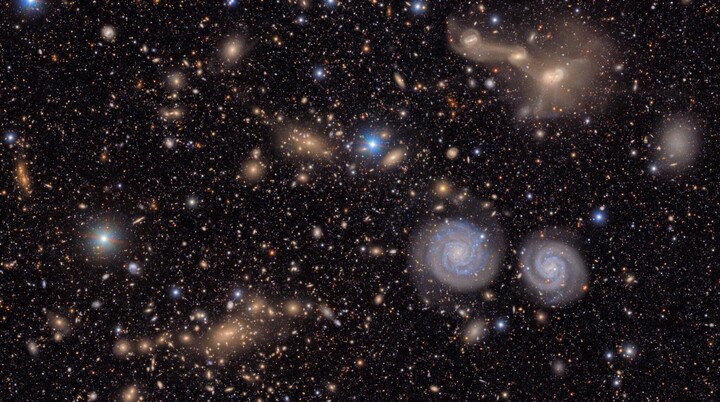
The Coma galaxy cluster, located over 300 million light-years from Earth, is proof that technology is helping humanity discover unprecedented possibilities. (Source: Rubin Observatory)
When technology helps humanity see things never seen before .
The James Webb Space Telescope (JWST), launched in 2021, is the most advanced instrument currently available. Webb's primary mirror has a diameter of 6.5m and a light-gathering area of over 25m².
Due to the expansion of the universe, light from distant galaxies is stretched into infrared wavelengths – a phenomenon called “redshift”. The Webb telescope was designed to detect this light, allowing us to “look back in time” to the early universe.
In August 2025, Webb captured the Hubble Deep Field – a tiny region of the sky, covering only 1/12.7 millionth of the sky's surface area, but containing more than 2,500 distant galaxies. Some of these galaxies formed just 300–400 million years after the Big Bang.
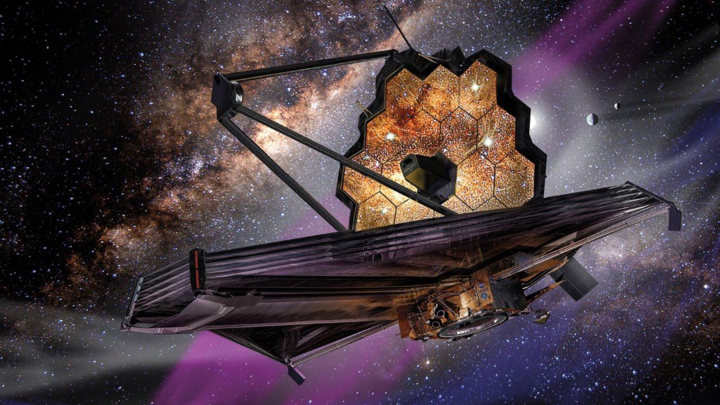
The James Webb Telescope. (Source: NASA)
The resolution of a telescope depends on its aperture. According to the Rayleigh standard, angular resolution is inversely proportional to the diameter of the mirror. The Hubble telescope, with an aperture of 2.4m, has a resolution of 0.05 arcseconds, sufficient to distinguish individual stars in the Andromeda galaxy, 2.5 million light-years away.
The European Extremely Large Telescope (ELT), currently under construction in Chile, has a 39.3m primary mirror. When completed, the ELT will have a resolution of up to 0.001 arcseconds, allowing for direct observation of the surfaces of exoplanets.
Telescopes don't just pierce through space; they capture and decode ancient photons that have traveled billions of light-years. Thanks to modern technology, humanity is gradually expanding the boundaries of cosmic observation, uncovering mysteries about the origin and evolution of galaxies, stars, and planets.
Source: https://vtcnews.vn/giai-ma-bi-an-cach-kinh-thien-van-nhin-thay-qua-khu-vu-tru-ar972298.html


![[Photo] Prime Minister Pham Minh Chinh attends the Conference summarizing and implementing tasks of the judicial sector.](/_next/image?url=https%3A%2F%2Fvphoto.vietnam.vn%2Fthumb%2F1200x675%2Fvietnam%2Fresource%2FIMAGE%2F2025%2F12%2F13%2F1765616082148_dsc-5565-jpg.webp&w=3840&q=75)






























































































Comment (0)