

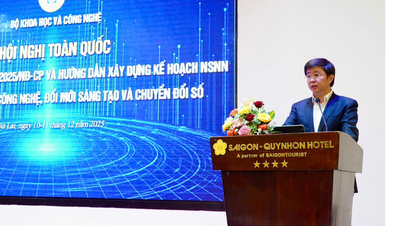
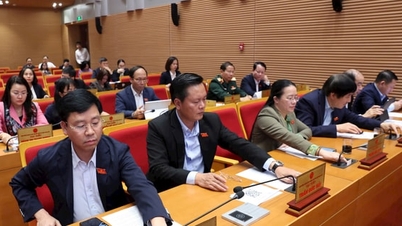
On the morning of December 12th, the Department of Finance and Sectoral Economics ( Ministry of Finance ) coordinated with the State Audit Office to organize a conference on the implementation of the settlement and auditing of the State Budget of ministries and central agencies according to the State Budget Law of 2025.
In his opening remarks, Mr. Chu Duc Lam, Director of the Department of Finance and Sectoral Economics, affirmed that the State Budget Law of 2025 was passed by the National Assembly and will take effect from the 2026 fiscal year. The amendments to the State Budget Law will firmly consolidate and create momentum for the management, allocation, and use of the budget. Many of the revised contents are significant for the budget settlement and auditing work of ministries and central agencies.
The conference will help ministries and central agencies to promptly update themselves on the new regulations in the 2025 State Budget Law, thereby enabling them to implement the annual State Budget settlement work in a timely and effective manner.
According to Mr. Chu Duc Lam, the conference focused on three main areas: disseminating updates on new points in the operational procedures of the law, review, appraisal, and compilation; discussing common difficulties and obstacles encountered in budget allocation and utilization; sharing best practices to improve budget settlement; and discussing the organization of audits of the management and use of the State Budget and reporting on the use of the State Budget in the new context.

Mr. Chu Duc Lam, Director of the Department of Finance and Industry Economics, delivered the opening remarks. Photo: DM
Presenting a paper on the review and consolidation of State Budget settlements of Ministries and central agencies according to the State Budget Law of 2025, Ms. Vu Thi Hai Yen - Deputy Director of the Department of Finance and Sectoral Economics, stated that regarding the review of State Budget settlements, the regulations on the responsibility of the directly superior budget-estimating unit to review the settlements of subordinate budget-using units have been amended and supplemented to strengthen decentralization, clarify the responsibilities of budget-estimating units, overcome overlapping in the review of settlements, and ensure a shorter time for consolidating settlements.
Regarding the audit of budget settlements by financial agencies at all levels: The regulation on reviewing/auditing budget settlements by financial agencies at all levels is abolished and replaced with the inspection and consolidation of State Budget settlements of Level I budget-estimating units; checking the completeness and accuracy between the settlement figures and the confirmation of the State Treasury for Level I budget-estimating units, which are also budget-using units. Simultaneously, regulations are established on the content of State Budget settlement audits of Level I budget-estimating units to strengthen the role and responsibility of the heads of Level I budget-estimating units, thereby shortening the time for consolidating State Budget settlements…
Regarding decentralization and delegation of authority, regulations are supplemented concerning the duties and powers of Ministers, heads of ministerial-level agencies, government agencies, and other central agencies, as well as heads of budget-allocating units, regarding accountability related to the preparation, allocation, management, and settlement of the State budget when requested.
Regarding the reduction and simplification of procedures, during the State budget settlement process, procedures, inspection processes, and the content and procedures for reviewing settlements by financial agencies and first-level budget units have been simplified and reduced. The procedure for appraising settlements by higher-level financial agencies for directly subordinate budgets at the local level has been eliminated.
According to Mr. Le Dinh Thang, Auditor and Chief Auditor of Sector 2 (State Audit Office), this is the first time a tripartite conference has been held (distribution, supervision, and use of state financial management). In previous audits, there were often differing opinions that needed to be resolved. The State Budget Law has undergone many changes, the budget schedule has changed, requiring the settlement process to adapt accordingly; some operational procedures have changed; and the audit schedule has also changed. This requires close coordination between ministries, central agencies, and other relevant bodies because this is a core issue, involving the national financial information system…

Source: https://vtcnews.vn/nhieu-diem-moi-trong-cong-tac-quyet-toan-va-kiem-toan-ngan-sach-nha-nuoc-ar992728.html

![[Photo] Prime Minister Pham Minh Chinh attends the Conference summarizing and implementing tasks of the judicial sector.](/_next/image?url=https%3A%2F%2Fvphoto.vietnam.vn%2Fthumb%2F1200x675%2Fvietnam%2Fresource%2FIMAGE%2F2025%2F12%2F13%2F1765616082148_dsc-5565-jpg.webp&w=3840&q=75)





















































































Comment (0)