

Astronomers have just confirmed that the longest total solar eclipse of the century will occur on July 22, 2028. This rare event will cast a shadow over midday for several minutes, creating a magical and emotional moment for millions around the world .
The path of the shadow – known as the total path – will sweep across the Indian Ocean, Australia, and New Zealand, where observers can experience more than 5 minutes of total solar eclipse, a period considered a "luxury" in astronomy.
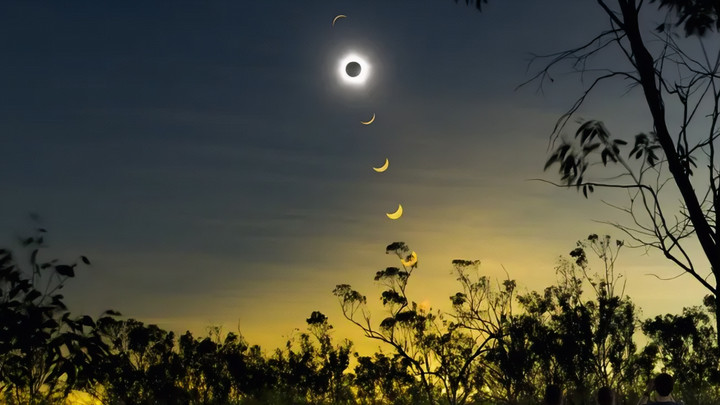
The moment of a total solar eclipse was captured in stages – from the initial light to the deep shadows and the brilliant corona. (Source: Getty Images)
This phenomenon belongs to the Saros 146 cycle, which repeats every 18 years, 11 days, and 8 hours, but very few people have the opportunity to witness it.
According to NASA, this will be the first time this phenomenon has been observable in Sydney since 1857 and also the last time until 2858. With the Sydney Opera House and Sydney Harbour Bridge as a backdrop, the event promises to be a historic moment for the city's more than 5 million residents.
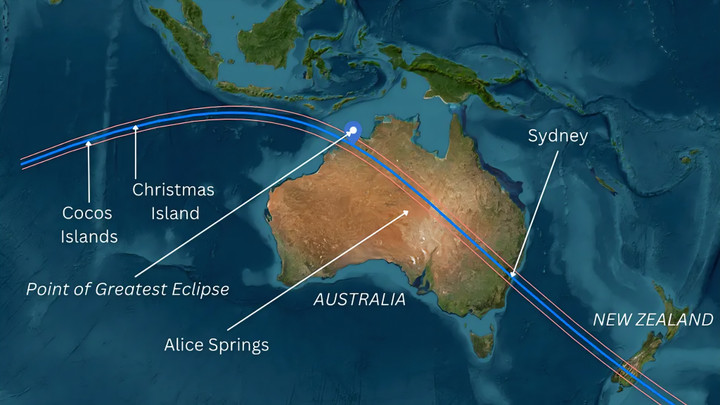
The path of the 2028 total solar eclipse stretches from the Indian Ocean across Australia to New Zealand. (Source: Maphub.net, Ersi, Maxar)

The Kimberley region of Western Australia is one of the ideal locations to observe the 2028 total solar eclipse, with its spectacular scenery and clear winter skies. (Source: Francesco Riccardo Iacomino)
However, eclipse hunters are likely to choose the Kimberley and Outback regions of Western Australia, where the dry winter skies promise a full experience of more than 5 minutes of total solar eclipse. Meanwhile, New Zealand's South Island will witness the final phase of the eclipse as the sun sets.
The path of the solar eclipse stretched nearly 12,000 km, starting in the Indian Ocean, passing over Cocos Islands, Christmas Island, Western Australia, the Northern Territory, Queensland, New South Wales, and then across the Tasman Sea to New Zealand. In total, approximately 6.3 million people were within the eclipse's path.
Additionally, a partial eclipse will also be visible in many major cities such as Jakarta, Darwin, Wellington, Brisbane, Melbourne, Singapore, and Kuala Lumpur, with coverage ranging from 50% to over 90% depending on the area.
To fully enjoy this moment, viewers should choose a spot within the totality line, prepare light-filtering glasses, check the weather, and arrive early to immerse themselves in the magical atmosphere. During a solar eclipse, the light will turn indigo, the temperature will drop rapidly, animals will become disoriented, and a thin white halo will appear around the moon – known as the corona.

Source: https://vtcnews.vn/ngay-mat-troi-bien-mat-nhat-thuc-dai-nhat-the-ky-se-dien-ra-vao-22-7-2028-ar992512.html






















![[Image] Close-up of the newly discovered "sacred road" at My Son Sanctuary](/_next/image?url=https%3A%2F%2Fvphoto.vietnam.vn%2Fthumb%2F1200x675%2Fvietnam%2Fresource%2FIMAGE%2F2025%2F12%2F13%2F1765587881240_ndo_br_ms5-jpg.webp&w=3840&q=75)


























































Comment (0)