

 |
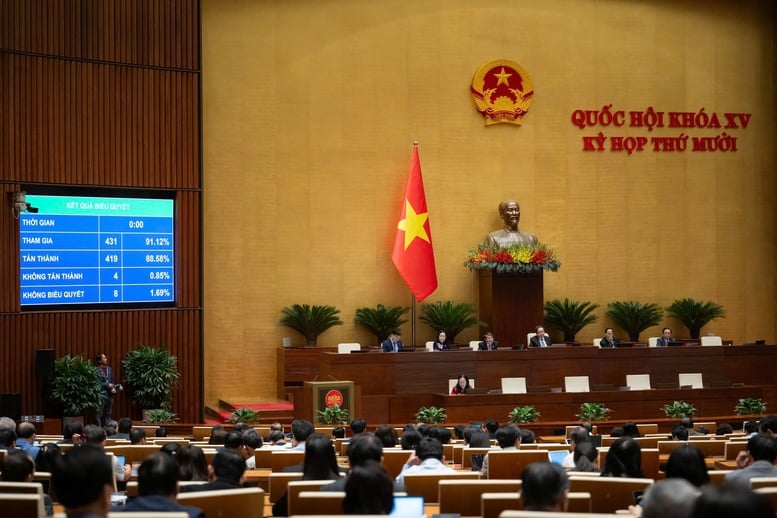
| The National Assembly passed a Resolution on a number of special and outstanding mechanisms and policies to achieve breakthroughs in education and training development. |
Resolution with 5 outstanding policy groups
The draft resolution consists of 9 articles, focusing on 5 key policy groups aimed at fundamental and comprehensive reform of education and training. Before the vote, the National Assembly heard Minister of Education and Training Nguyen Kim Son present a report on the acceptance and explanation of delegates' opinions.
According to National Assembly Vice Chairwoman Nguyen Thi Thanh, the draft received 79 comments from group discussions, 56 speeches in the plenary session, and numerous opinions from sessions of the Culture and Social Affairs Committee and the National Assembly Standing Committee.
Minister Nguyen Kim Son stated that one of the major issues is the policy for developing human resources in the education sector. The government has revised the draft to clearly decentralize the authority for recruitment and personnel management: the Director of the Department of Education and Training decides on recruitment, assignment, and transfer for cases within their jurisdiction or involving two or more communes; the Chairman of the People's Committee at the commune level decides on matters within their scope of management.
The draft also adds a mechanism for autonomy in job positions for vocational education and universities, allowing the recruitment of foreign experts and scientists, and supplementing preferential allowances for professions according to a roadmap.
Free textbooks before 2030
In the policy group on educational program development, the resolution stipulates the unification of a single national set of textbooks, to be implemented by the Minister of Education and Training starting from the 2026-2027 school year. By 2030, the State will complete the provision of free textbooks, prioritizing learners in disadvantaged areas. In addition, the State guarantees a roadmap for free tuition and the provision of national defense and security education curricula in vocational and higher education. The Government also expands cooperation with research institutes and businesses to develop training programs linked to the labor market and innovation.
The draft resolution stipulates that the State prioritizes the development of a national education database, investing in infrastructure and a shared digital platform to ensure connectivity across the entire sector. By 2030, higher education institutions will have essentially completed a synchronized digital infrastructure. Higher education and vocational education institutions will have autonomy in organizing international conferences and seminars, only requiring reporting when the content is sensitive or when ministerial-level leaders are in attendance.
The resolution also stipulates the authority to establish branch campuses of public higher education institutions abroad, in accordance with the laws of the host country.
Supporting learners, developing high-quality human resources, and identifying talent early.
To ensure opportunities for learning and developing high-quality human resources, students will have access to preferential credit from the Social Policy Bank, while consideration will be given to expanding funding sources. The resolution adds a national key program for full-time doctoral training under a commissioned mechanism, linked to scientific and technological tasks, and with scholarships and living support.
In addition, there are mechanisms for identifying and nurturing young talents in specialized fields such as art and sports, and allowing for long-term training contracts with artisans, artists, and coaches.
The resolution empowers provincial People's Councils to supplement medium-term investment projects and land use plans for education through a simplified procedure. Provincial People's Committees are given priority in allocating land, utilizing surplus public buildings, and allowing the conversion of certain types of land for educational purposes without being subject to land use planning. The State continues to guarantee a minimum of 20% of the total budget expenditure on education, prioritizing particularly disadvantaged areas.
During the transitional period following the termination of the School Council's activities, the direct management body will carry out tasks within the School Council's authority, ensuring organizational and personnel stability, and allowing the appointment of a number of deputy positions exceeding the ceiling for a maximum of 5 years according to a gradual reduction plan.
Source: Government Newspaper
Source: https://baodongnai.com.vn/xa-hoi/202512/hoan-thanh-cung-cap-sach-giao-khoa-mien-phi-den-nam-2030-e9a1445/















![[Photo Gallery] Admiring the 123m-tall 'lotus bud' at Long Thanh Airport](https://vphoto.vietnam.vn/thumb/402x226/vietnam/resource/IMAGE/2025/12/10/1765365850401_anh_8_20251210163954_20251210180813.jpeg)




![[Video] The craft of making Dong Ho folk paintings has been inscribed by UNESCO on the List of Crafts in Need of Urgent Safeguarding.](https://vphoto.vietnam.vn/thumb/402x226/vietnam/resource/IMAGE/2025/12/10/1765350246533_tranh-dong-ho-734-jpg.webp)


















































Comment (0)