

The night before the final in Jakarta, coach Jorvan Vieira made the Iraqi players sit down at the Bung Karno stadium after training. "Look around," he said. "Here, tomorrow, is our match. I don't think Iraq will ever reach this stage again."
The Brazilian coach's message was clear: the players had to seize the opportunity and win at all costs. When it was their turn to respond, the whole team agreed.
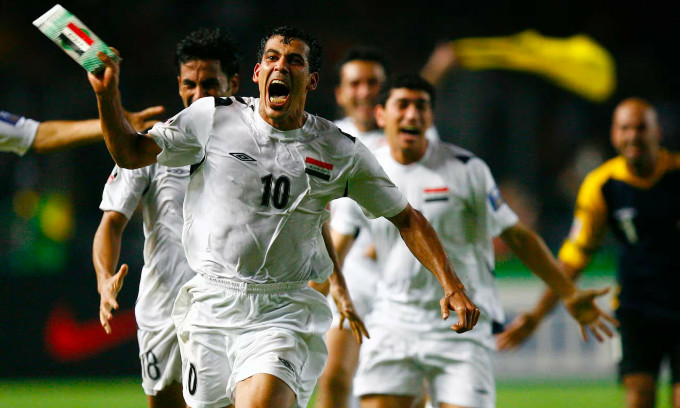
Captain and striker Younis Mahmoud (number 10) celebrates the only goal of the Asian Cup final between Iraq and Saudi Arabia at the Bung Karno Stadium in Jakarta, Indonesia, on the evening of July 29, 2007. Photo: Reuters
About 22 days earlier, the atmosphere around the team was very different as they prepared for their opening match against Thailand in Bangkok. Never before had the team been so demoralized, mainly due to problems between coach Vieira and the key players. This situation was a microcosm of the civil war back home at that time.
The first thing Vieira did when he met with the Vice President of the Iraqi Football Association (IFA), Najeh Humoud, was to present a list of players he wanted to get rid of from Thailand immediately. A few days earlier, they had lost 0-2 to Uzbekistan in a friendly match. After the game, a group of players told his compatriot assistant, Rahim Hameed, that they were willing to pay contract termination fees to have Vieira fired immediately.
The coach-player relationship was so bad that the IFA had prepared to call up the U23 team to Bangkok for the Asian Cup instead of the senior national team. However, the Asian Football Confederation (AFC) had already set a deadline for finalizing the player list, so the IFA didn't have time to make changes. They also wanted to replace Vieira, but couldn't find a suitable replacement as the tournament was approaching.
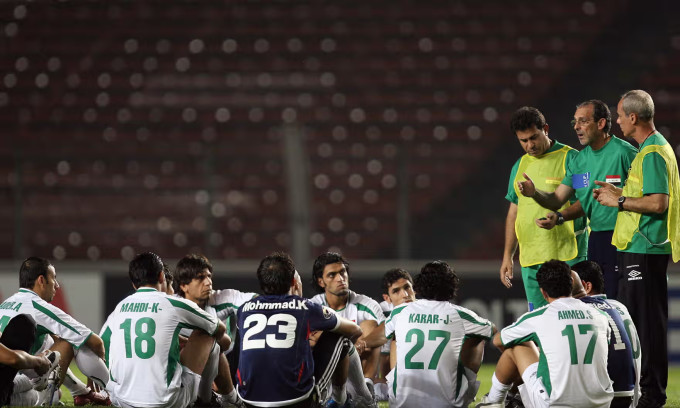
Coach Jorvan Vieira (second from right) gives advice to the Iraqi players on the Bung Karno stadium pitch, evening of July 28, 2007. Photo: AFP
Against Thailand, Iraq got off to a bad start, conceding a penalty from midfielder Sutee Suksomkit after just six minutes. But the visitors equalized in the first half thanks to a header from striker Younis Mahmoud.
Mahmoud later recounted seeing his compatriots waving Iraqi flags to celebrate the equalizer in the stands, regardless of their political affiliation. He felt a sense of national unity and anger towards any force that might have tried to divide the country at that time.
After drawing with Thailand, Iraq faced Australia, who boasted a star-studded squad from the English Premier League, including goalkeeper Mark Schwarzer, midfielders Harry Kewell and Tim Cahill, and striker Mark Viduka. Australia was playing in its first tournament in Asia after joining the AFC, but was considered a strong contender for the title.
If Iraq had lost that match, Vieira would almost certainly have been sacked. But a miracle happened at the Rajamangala Stadium, when Mahmoud and his teammates won 3-1. The 0-0 draw against Oman in the final match was just enough to secure Iraq top spot in Group A, allowing them to stay in Bangkok for the quarter-final against Vietnam. Iraq won that match 2-0, with a brace from Mahmoud, to advance to the semi-finals against South Korea.
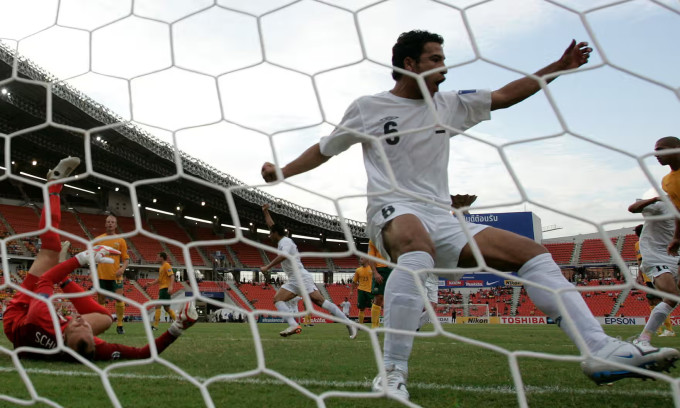
Forward Saleh Sadir (number 6) celebrates Nashat Akram's opening goal in the Iraq vs. Australia match at Rajamangala Stadium, Bangkok, Thailand, Group A of the Asian Cup on July 13, 2007. Photo: Reuters
Exactly 27 days before the semi-final, Iraq faced South Korea in a friendly match and lost 0-3 in the rain in Daejeon. It's fair to say Vieira's team suffered a complete defeat, even though South Korea were missing star midfielder Park Ji-sung and defender Lee Young-pyo. That loss led to several emergency meetings for Iraq. In one such meeting, midfielder Nashat Akram urged his teammates to stand up and show their determination, or go home.
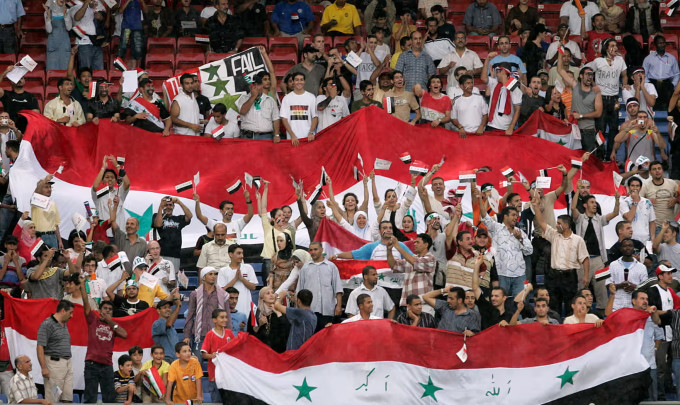
Iraqi spectators at the semi-final match against South Korea at the Bukit Jalil Stadium in Kuala Lumpur, Malaysia, on July 25, 2007. Photo: Reuters
Iraqi fans' joy was short-lived as tragedy struck back home. Two consecutive suicide bombings in Baghdad killed 50 people, following a victory for Vieira and his team.
The Iraqi players were devastated upon hearing the news. Then, a woman appeared on national television, saying that her 12-year-old son, Haidar, had died in the terrorist attack. She vowed not to hold a funeral for him until the team returned from the Asian Cup. Seeing her cry, the Iraqi players assured them they would win the final match for Haidar, and for all Iraqis.
The final took place in Jakarta, with Iraq facing three-time champions Saudi Arabia. The two teams had met six months earlier in the Gulf Cup, with Saudi Arabia winning 1-0 and Iraq being eliminated.
At that time, coach Akram Salman was still in charge of Iraq, not Vieira. Before the match, Salman held a team meeting and hinted that he had reached an agreement with Saudi Arabia that the two teams would draw, a result just enough for them to advance together. Three Iraqi players were banned from playing for two years after the match for accusing IFA President Hussein Saeed of match-fixing. Salman was fired for the official reason of "miscommunication with the players".
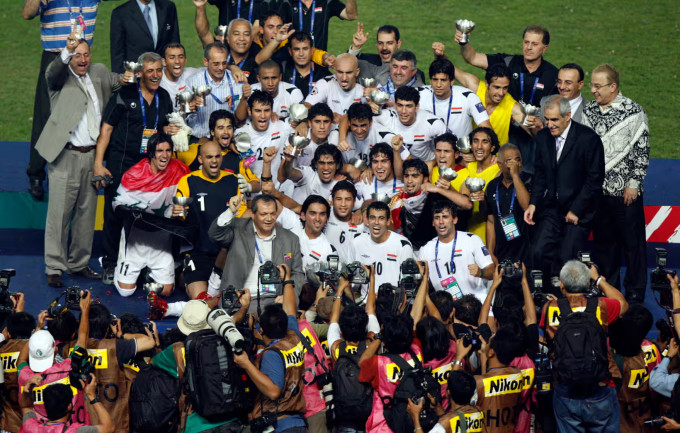
Iraqi players celebrate winning the 2007 Asian Cup at the Bung Karno Stadium. Photo: Reuters
Vieira was appointed as a replacement after working with Al-Tai in the Saudi League. He was sacked by the club after only five months due to altercations with some players. Therefore, his reunion with Saudi Arabia in the Asian Cup final also reflects a personal connection between the Brazilian coach and the Saudis.
Over 60,000 spectators flocked to the Bung Karno Stadium for the final match, which took place on the evening of July 29, 2007. Iraq played so well that the players felt scoring was only a matter of time. Chants of "Iraq, Iraq, Iraq" echoed from all corners of the stadium. As midfielder Hawar Mulla Mohammed prepared to take a corner kick in the 72nd minute, commentator Raad Nahi's voice could be clearly heard on Al-Iraqiya Sports , saying: "May God bring joy to my heart and my people."
Hawar crossed the ball, and Mahmoud rose to head it in, scoring the only goal of the match. When asked about the goal, Mahmoud said: "All the Iraqis scored, not just me."
Therefore, on the day Iraq won the Asian Cup for the first time, they united as one. The 11 players accomplished what the Iraqi government at the time was powerless to do: unite the entire nation and bring joy to everyone, instead of tears and suffering.
Xuan Binh (according to Guardian )
Source link
















































































Comment (0)