

Digital transformation has become a prominent driving force.
According to the tenth annual e- Conomy SEA 2025 report, recently published by Google, Temasek, and Bain & Company, the Vietnamese economy continues to maintain significant resilience, primarily thanks to its dynamic private sector.
Specifically, exports continued to grow steadily thanks to FDI inflows into the manufacturing sector, while domestic retail sales also recorded double-digit growth. Coupled with the State Bank of Vietnam's flexible monetary policy to maintain macroeconomic stability, the business environment became more favorable for private enterprises.
The tourism industry continues to be one of the key pillars of the economy. From 2024 to 2025, the number of international visitors is expected to increase steadily thanks to favorable visa policies and promotional activities in Asian and European markets. The domestic tourism segment maintains strong purchasing power, contributing significantly to the overall revenue growth of the industry.
Furthermore, the implementation of electronic identification for citizens and businesses simplifies the use of online public services. The banking sector has completed the identity verification of all digital payment accounts, thereby reducing fraud and standardizing customer information.
New laws on data and digital technology have established a clear legal framework for the exploitation of artificial intelligence, data, and digital assets, while also providing impetus for technology companies to develop new products.
As of 2024, the country recorded approximately 30 million active e-wallet accounts, leading to a significant increase in cashless payments. The VietQR payment wave is spreading, along with the goal of increasing the proportion of cashless transactions in e-commerce to 80% by 2030. The full connection of Vietnam's QR system with Thailand and Cambodia also opens up new development opportunities for cross-border tourism and trade.
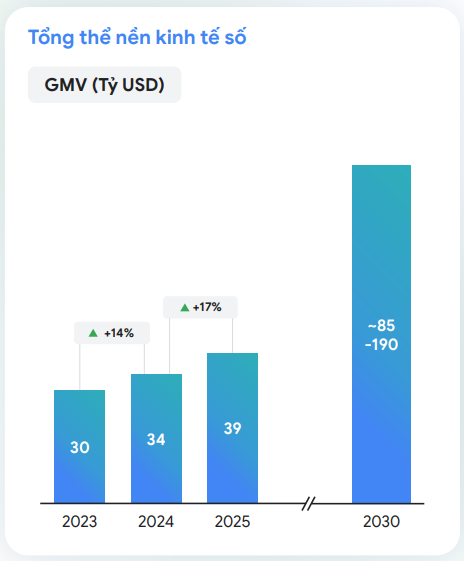
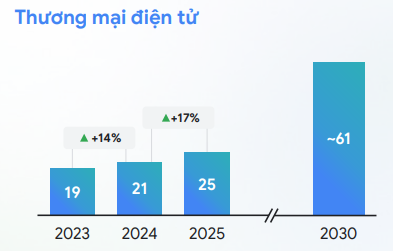
According to the report, the transaction value of Vietnam's digital economy will reach US$39 billion in 2025, up from US$34 billion in 2024 and US$30 billion in 2023. E-commerce will play a leading role, increasing to US$25 billion in 2025. The transportation and food delivery sectors will maintain their growth momentum, reaching US$5 billion, while online tourism and online content will reach US$4 billion and US$6 billion respectively. It is projected that by 2030, the total value of Vietnam's digital economy could reach between US$85 and US$190 billion.
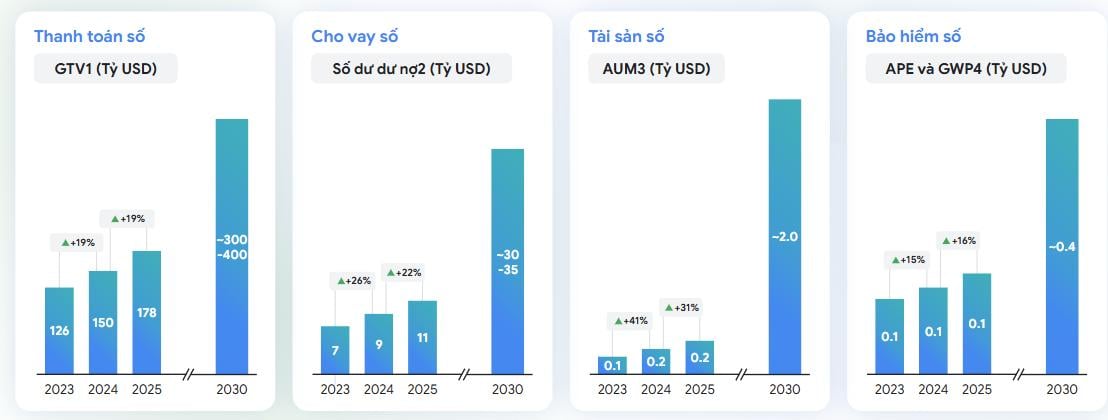
Digital payments continue to grow strongly, with the total value of transactions reaching $178 billion in 2025. Digital lending is projected to reach $11 billion, up from $9 billion in 2024. The digital asset and digital insurance sectors, despite their smaller scale, are also experiencing rapid expansion.
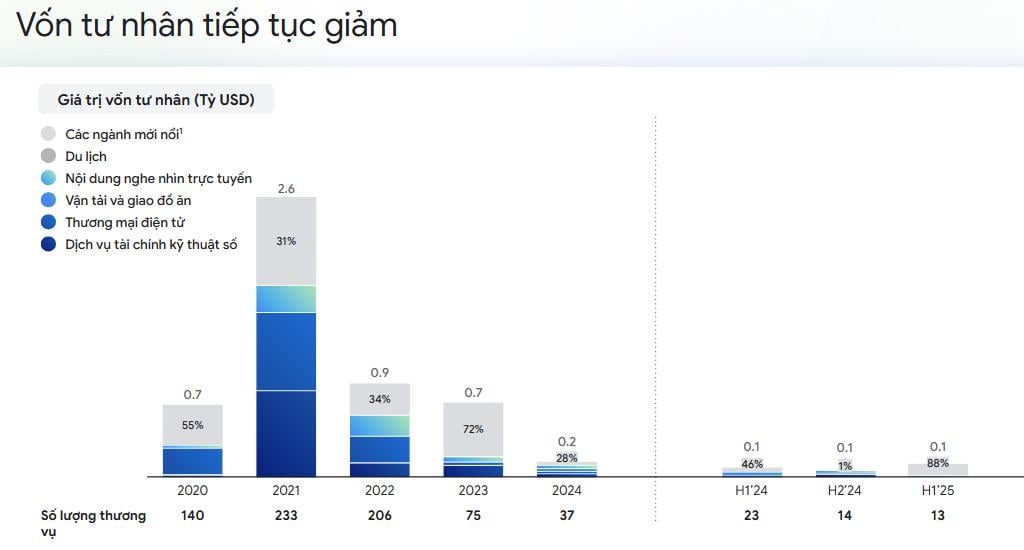
One notable point is the significant decline in private capital inflows into the technology sector. Total investment in 2024 is only $0.2 billion, a sharp decrease from the peak of $2.6 billion in 2021. Nevertheless, investors remain interested in emerging sectors such as sustainable technology, software and services, and Web3.
Vietnamese people lead the region in terms of interaction with AI.
A survey of over 7,200 consumers in 10 ASEAN countries shows that Vietnam is the most dynamic market in the use of artificial intelligence (AI). Vietnamese users interact with AI tools daily at a significantly higher frequency than the regional average. They frequently chat with or ask questions of chatbots and believe that AI can help them make faster decisions, reducing the effort required to process information in their daily lives.
Not only are people using AI, but a large number are also actively learning about it, indicating a high level of readiness to embrace it. Furthermore, a significant portion of users are considering sharing personal data to receive more personalized experiences, although concerns about privacy and data security still persist.
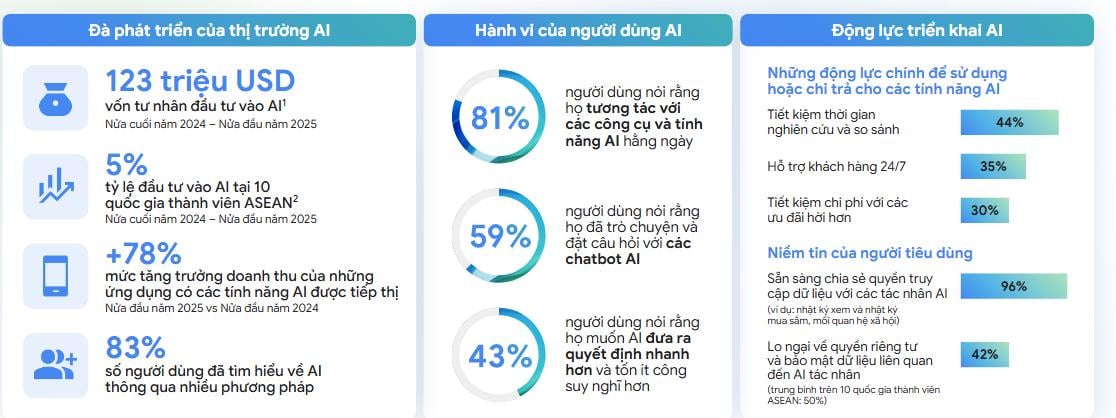
In terms of investment, Vietnam attracted approximately US$123 million in private capital into the AI sector between the second half of 2024 and the first half of 2025, equivalent to 5% of the total AI investment of the 10 ASEAN countries. This figure reflects the expanding Vietnamese AI market and its becoming an important destination for technology companies in the region.
In the video sales market, Vietnam is showing impressive growth, with both the number of sellers and transactions increasing simultaneously. By 2025, the country is expected to have approximately 650,000 active sellers on various platforms, a 60% increase compared to the previous year. The number of transactions is also projected to increase correspondingly, reaching 1.3 billion.
Online video sales are experiencing significant growth, with the top 10 sellers in each category contributing up to one-fifth of total transactions. The average order value ranges from $5.50 to $7. Among the product categories, fashion and accessories account for the largest share, followed by cosmetics and personal care, electronics, and fast-moving consumer goods.
Furthermore, the maturation of the global gaming market has led Vietnamese studios to shift from a download-driven model to building sustainable revenue strategies. Businesses are focusing on increasing in-app purchase rates, improving player retention, and expanding into products outside the gaming sector, leveraging their strengths in mobile application development.
Overall, the report shows that Vietnam is entering a new growth phase thanks to a combination of private sector capabilities, the public's readiness to adopt technology, and strategic direction in digital transformation. The rise of AI, cashless payments, and video commerce is projected to continue providing strong impetus to the digital economy in the coming years.
Source: https://baotintuc.vn/kinh-te/kinh-te-so-viet-nam-but-pha-manh-trong-nam-2025-20251125131315577.htm


































![[Photo] Reception to welcome General Secretary and President To Lam and his wife on their State visit to the Philippines](https://vphoto.vietnam.vn/thumb/1200x675/vietnam/resource/IMAGE/2026/06/01/1780295488620_vna-potal-chieu-dai-chao-mung-tong-bi-thu-chu-tich-nuoc-to-lam-va-phu-nhan-tham-cap-nha-nuoc-toi-philippines-8798060-7855-jpg.webp)













































































Comment (0)