

Entertainment games (Games) appeared, becoming a digital content industry
In the early 1990s, game consoles and cartridge-based video games (NES/Famicom) began appearing as portable devices or consoles in arcades. However, they truly boomed in the early 2000s with the widespread availability of the Internet and ADSL.
In 2003, Vietnam saw the emergence of its first online games, notably Vo Lam Truyen Ky (2003) and Audition (2006) – ushering in the "era of Vietnamese online games". Subsequently, from 2004 to 2010 was the golden age of PC online games, with major publishers like VTC, VNG,FPT Online, Net2E… developing strongly. From 2013 to the present: Mobile games have become the main market; prominent Vietnamese developers such as VNG, Amanotes, Hiker Games, Topebox, Wolffun, VTC… have emerged.

Games are not just entertainment; they can be an industry if developed in the right direction.
The Vietnamese gaming industry is booming, with projected revenue reaching US$1.66 billion in 2025, a CAGR of 9.77%, and ranking among the top 5 in Southeast Asia. A population of over 100 million, an internet penetration rate of 78.8% (approximately 79.8 million users), and over 106 million smartphone subscribers provide a solid foundation for mobile gaming. This is further supported by a young, tech-savvy population with high entertainment demands; a high-quality programming and graphics workforce at competitive costs; and the government 's growing interest in and recognition of gaming as part of the digital content industry.
Despite strong growth, the Vietnamese gaming industry still faces fierce competition: widespread copyright infringement reduces revenue and discourages innovation.
Quality and market fragmentation: Imported foreign games dominate, domestic profits are low; players easily abandon games if they are not appealing from the start.
Cross-border competition: High-quality international games are flooding the market, coupled with strict regulations such as content censorship and Decree 147/2024. Social prejudices prevent games from being properly recognized as a valuable cultural industry.
Businesses have undergone transformations, innovating and applying new technologies in the video game industry.
Faced with intense competition and the rise of mobile, businesses must shift from PC games to mobile games and eSports, while restructuring into a closed ecosystem encompassing publishing, payment, media, and infrastructure. Participating in G-Star 2025 demonstrates a strategic direction towards expanding collaborations and enhancing international standing.
Businesses need to innovate in product development by focusing on high-quality content with a distinct Vietnamese identity, incorporating deep localization, and investing in new mobile products. The eSports league system needs to be upgraded, creating a professional playing field and increasing brand recognition.
Businesses are stepping up the application of AI, 3D graphics, and mobile development, while also strengthening copyright protection technologies, training new technology personnel, and promoting comprehensive digital transformation.
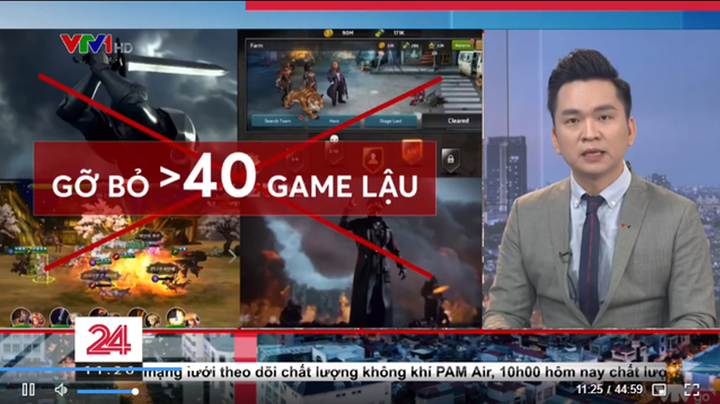
The issue of pirated games has been reported on by VTV (Vietnam Television).
Challenges faced in the issue of digital content copyright infringement.
Copyright infringement remains the biggest obstacle for the Vietnamese gaming industry. Game cloning, hacking/cheating, and the distribution of pirated software are widespread, resulting in losses of up to 30% of potential revenue. Not only foreign games but also successful Vietnamese games are frequently copied, especially from the Chinese market. This reduces profits, hinders exports, and discourages startups from investing.

Mr. Nguyen Hung Cuong - Deputy Director of VTC Intecom Company - VTC Corporation.
According to Mr. Nguyen Hung Cuong, Deputy Director of VTC Intecom, the company constantly faces issues such as pirated servers, content copying, source code hijacking, and similar game versions created to evade copyright. New technologies like AI and the placement of servers abroad are causing violations to spread rapidly and become difficult to control. Meanwhile, the current legal framework lags behind the pace of technological development, adding further compliance pressure on legitimate businesses.
" The piracy has caused VTC to lose significant revenue as players switch to free, unofficial servers, while the operating, anti-hacking, and marketing costs of the official server are very high. Competition also becomes unfair as cross-border games are not subject to taxes and copyright fees like VTC. This reduces business efficiency, hinders investment, and affects the creative motivation of the team, " Mr. Cuong said.
Therefore, game businesses are always actively cooperating with regulatory agencies and partners to protect the rights of publishers, specifically platforms such as Apple, Google, along with the Department of Broadcasting, Television and Electronic Information, and the Copyright Office (Ministry of Culture, Sports and Tourism)...
The company aims to coordinate closely with regulatory agencies to handle violations more quickly, while also proposing additional regulations for AI products and the responsibilities of digital platforms. It will focus on developing exclusive content with a distinct Vietnamese identity, strengthening eSports organization, perfecting the ecosystem, and promoting training and international cooperation to build long-term capacity for the industry.
Source: https://vtcnews.vn/lich-su-phat-game-tu-buoc-di-dau-tien-den-nganh-cong-nghiep-ar992003.html


















![[Video] AI application for early detection of common diseases on cassava plants](https://vphoto.vietnam.vn/thumb/402x226/vietnam/resource/IMAGE/2025/12/10/1765328634749_avatar-of-video-1038119-png.webp)














![[Photo] Urgently help people soon have a place to live and stabilize their lives](/_next/image?url=https%3A%2F%2Fvphoto.vietnam.vn%2Fthumb%2F1200x675%2Fvietnam%2Fresource%2FIMAGE%2F2025%2F12%2F09%2F1765248230297_c-jpg.webp&w=3840&q=75)






































































Comment (0)