

The newly announced safety test results of Global NCAP have created a wave of concern when the Hyundai Grand i10 version exported from India to the South African car market completely failed the crash tests. With an absolute score of 0 in adult protection, the i10 became one of the rare cases receiving the lowest rating from this prestigious organization.
Specifically, after undergoing tests from the #SaferCarsForAfrica program, the Grand i10 achieved 0.00/34 points in the adult protection category. Although equipped with two front airbags and a seat belt reminder system for the driver's seat, these equipment proved to be insufficient to ensure safety in real-life collision situations.
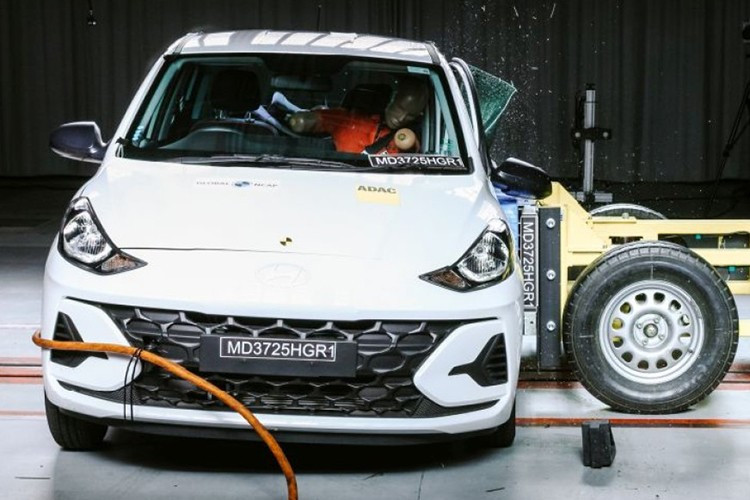
The main weakness lies in the vehicle’s frame structure and vacuum chamber, which are not strong enough to withstand the impact. In the frontal crash test, the vehicle structure is severely deformed, creating an extremely high risk of chest injury for both the driver and front passenger. The situation becomes even more worrying when considering the results of the side crash test, where the chest of the occupants continues to face a high level of danger due to the complete absence of protective devices such as side and curtain airbags.
Another notable point is that the Grand i10 is not equipped with the ESC electronic balance system, which has become a mandatory standard in many developed countries. This deficiency further widens the gap in safety standards between different markets.
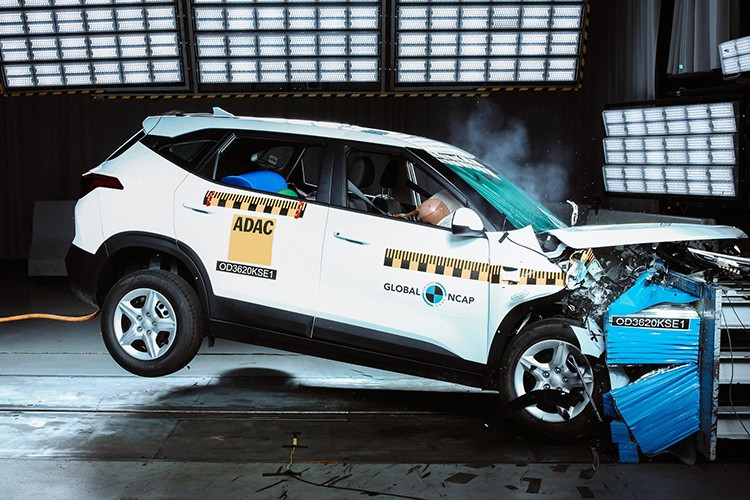
However, not all aspects are completely negative. In the child protection category, the Grand i10 achieved three stars with 28.12/49 points. This bright spot comes from good compatibility with child safety seats and the reliability of the seat anchor system.
The results have once again sparked debate about the phenomenon of "double standards" in the global auto industry. Global NCAP pointed out that many manufacturers still maintain discriminatory policies, in which models sold in developing markets often have significantly reduced safety equipment compared to similar versions in developed countries.
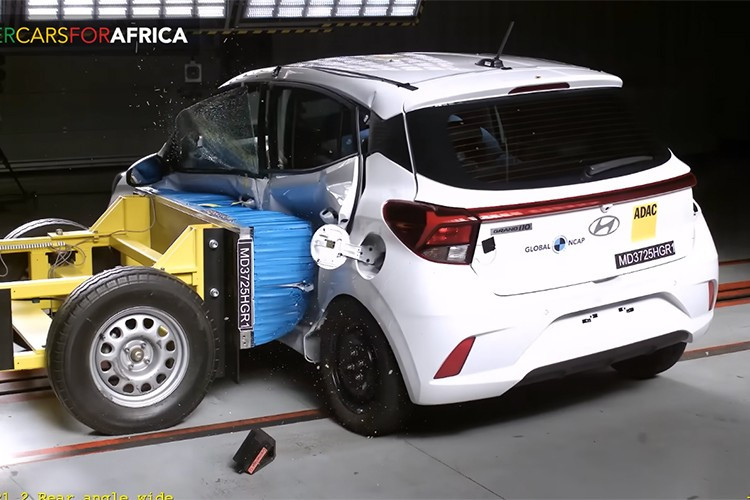
The response from the South African Automobile Association further underscored the urgency of the issue, calling for stricter regulations that would require all vehicles sold to be equipped with a minimum of ESC and side impact protection. It should be noted that the Grand i10 version currently on the Vietnamese market is a locally produced model, not the imported model from India as in the above test.
Source: https://khoahocdoisong.vn/hyundai-grand-i10-nhan-danh-gia-0-sao-an-toan-post2149074685.html



![[Photo] Explore the US Navy's USS Robert Smalls warship](/_next/image?url=https%3A%2F%2Fvphoto.vietnam.vn%2Fthumb%2F1200x675%2Fvietnam%2Fresource%2FIMAGE%2F2025%2F12%2F10%2F1765341533272_11212121-8303-jpg.webp&w=3840&q=75)


















![[Video] The craft of making Dong Ho folk paintings has been inscribed by UNESCO on the List of Crafts in Need of Urgent Safeguarding.](https://vphoto.vietnam.vn/thumb/402x226/vietnam/resource/IMAGE/2025/12/10/1765350246533_tranh-dong-ho-734-jpg.webp)



















































Comment (0)