

The North American power grid, comprising five smaller grids, is considered the largest machine humanity has ever created.
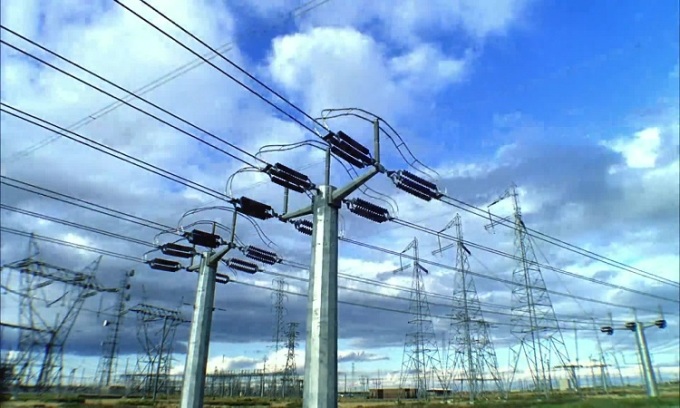
Power transmission lines in the US. Photo: Popular Science
The United States alone possesses 965,606 km of transmission lines and 8.8 million km of distribution lines. In every respect, this is a technological achievement, according to Popular Science . This machine has evolved from a small power station in New York City to a megaproject spanning the entire continent.
At 3 p.m. on September 4, 1882, an engineer working at a power station in central Manhattan switched on the circuit breaker. Within seconds, six 100-kilowatt, 27-ton coal-fired generators began operating. Supplying direct current (DC) to residents within a 400-meter radius, Thomas Edison's Pearl Street station was the world's first power station, providing electricity to 400 lights for its initial 85 customers. This marked the beginning of the American power grid.
Although the Pearl Street substation ushered in a new era and Edison's DC technology proved its value, it couldn't transmit power over long distances because engineers at the time couldn't increase the voltage after power generation. Due to this limitation, substations needed to be built extensively, like mailboxes, throughout cities and towns.
However, with the support of businessman George Westinghouse, another inventor and former Edison employee named Nikola Tesla developed an induction electric motor using alternating current (AC), which was easier to manufacture and had less energy loss because its voltage could be increased/decreased using a transformer.
The competition between the two sides lasted until the late 1880s, with AC slowly gaining the upper hand. In the 1890s, several AC power plants in Colorado, Oregon, and California began transmitting electricity over long distances to residents. As the War of the Currents drew to a close, more power plants sprang up across the United States, providing electricity for new inventions such as the wheelbarrow.
The man who led the American power grid into the future was businessman Samuel Insull. When Insull arrived in Chicago in 1892, the city relied on electricity from 20 different companies. After becoming president of the Chicago Edison Company, Insull quickly increased the load factor, used more efficient steam turbines, and acquired other companies to convert rival power plants into substations. Within 15 years, Insull acquired more than a dozen power generation facilities and renamed the company Commonwealth Edison.
Many businesses quickly emulated Insull's success, raising concerns about a potential monopoly. The U.S. government established numerous local and federal coordinating agencies. As America increasingly electrified the country, President Franklin Roosevelt implemented a series of policies encouraging competition and expanding access to rural areas.
Finally, before World War II, the modern American power grid began to take shape. To avoid power outages, the federal government required cross-connections between power companies. This meant that if there was a power outage in Boston, Massachusetts, electricity produced in Ohio could compensate for the shortfall. By the 1960s, the Eastern and Western grids supplied most of the electricity in the United States. Although these two large grids were synchronized, connections between them were limited.
Throughout the 10th century, advancements in DC voltage boosting and lowering emerged. In 1990, the first large-scale high-voltage direct current (HVDC) system began supplying electricity to New England. HVDC systems are more expensive due to the need for converters at both the power plant and the substation, but electricity can be transmitted further and more efficiently than high-voltage AC (HVAC) systems. Today, HVDC is preferred for transmitting electricity over distances of nearly 650 km.
An Khang (According to Popular Mechanics )
Source link





![[Photo] National Assembly Chairman Tran Thanh Man successfully concludes his participation in IPU-152](https://vphoto.vietnam.vn/thumb/1200x675/vietnam/resource/IMAGE/2026/04/18/1776502638199_vna-potal-chu-tich-quoc-hoi-ket-thuc-tot-dep-chuong-trinh-tham-du-ipu-152-8709975-jpg.webp)























































































Comment (0)